ISV Girona, IDIAP Jordi Gol, Girona, Catalunya, Spain.
IDIBGI, Girona, Catalunya, Spain.
BMJ Open Diabetes Res Care. 2020 Mar;8(1). doi: 10.1136/bmjdrc-2019-000977.
We sought to compare the association of categorized ankle-brachial index (ABI) with mortality and complications of diabetes in persons with no symptoms of peripheral arterial disease (PAD) and in primary cardiovascular disease prevention.
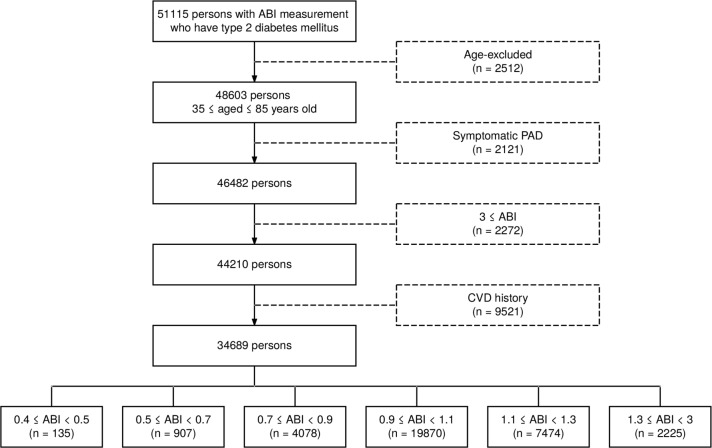
This is a retrospective cohort study of persons with type 2 diabetes aged 35-85 years, from 2006 to 2011. Data were obtained from the Sistema d'Informació per al Desenvolupament de la Investigació en Atenció Primària (SIDIAP). Participants had an ABI measurement that was classified into six categories. For each category of ABI, we assessed the incidence of mortality; macrovascular complications of diabetes: acute myocardial infarction (AMI), ischemic stroke, and a composite of these two; and microvascular complications of this metabolic condition: nephropathy, retinopathy, and neuropathy. We also estimated the HRs for these outcomes by ABI category using Cox proportional hazards models.
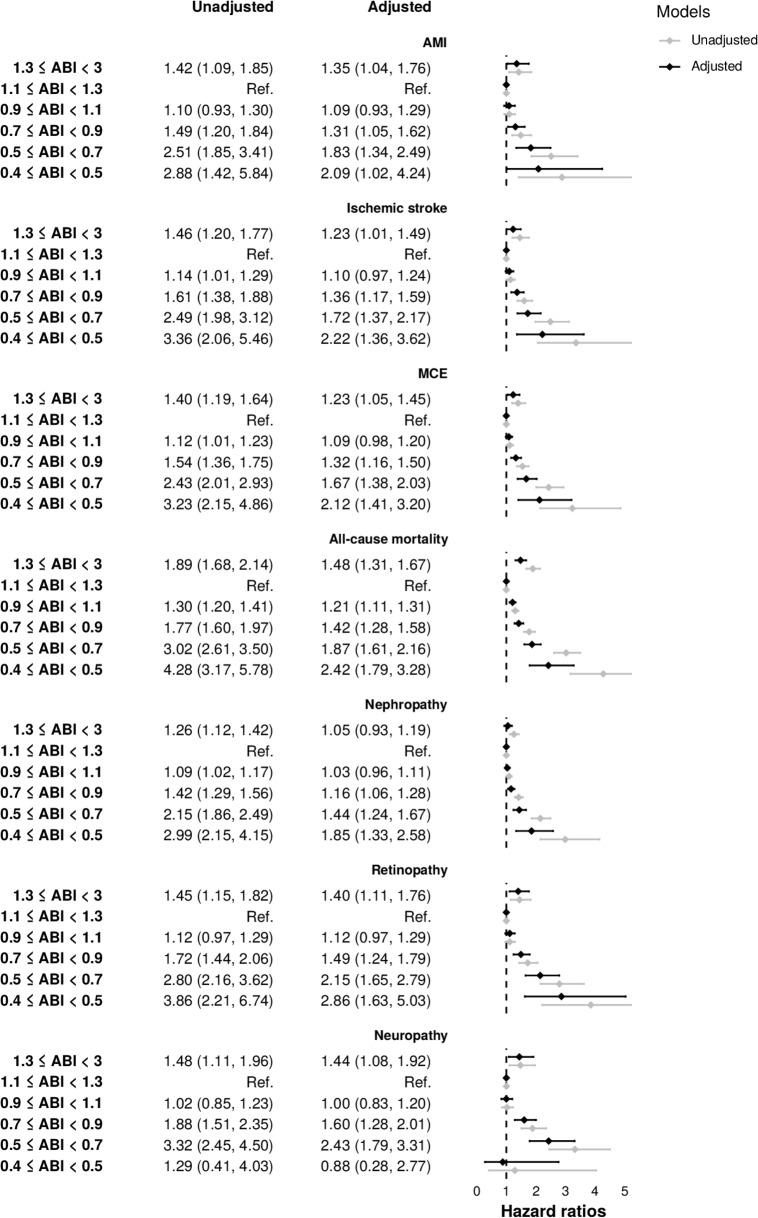
Data from 34 689 persons with type 2 diabetes were included. The mean age was 66.2; 51.5% were men; and the median follow-up was 6.0 years. The outcome with the highest incidence was nephropathy, with 24.4 cases per 1000 person-years in the reference category of 1.1≤ABI≤1.3. The incidences in this category for mortality and AMI were 15.4 and 4.1, respectively. In the Cox models, low ABI was associated with increased risk and was significant from ABI lower than 0.9; below this level, the risk kept increasing steeply. High ABI (over 1.3) was also associated with significant increased risk for most outcomes.
The studied categories of ABI were associated with different risks of type 2 diabetes complications in persons asymptomatic for PAD, who were in primary cardiovascular prevention. These findings could be useful to optimize preventive interventions according to the ABI category in this population.
我们旨在比较踝臂指数(ABI)分类与无症状外周动脉疾病(PAD)人群和一级心血管疾病预防人群中糖尿病的死亡率和并发症之间的关联。
这是一项回顾性队列研究,纳入了 2006 年至 2011 年间年龄在 35-85 岁之间的 2 型糖尿病患者。数据来自于 SIDIAP(用于初级保健研究开发的信息系统)。参与者进行了 ABI 测量,并将其分为六类。对于 ABI 的每一类,我们评估了死亡率、糖尿病的大血管并发症:急性心肌梗死(AMI)、缺血性中风,以及这两者的综合;以及这种代谢状况的微血管并发症:肾病、视网膜病变和神经病变。我们还使用 Cox 比例风险模型按 ABI 类别评估了这些结果的 HR。
共纳入 34689 例 2 型糖尿病患者。平均年龄为 66.2 岁;51.5%为男性;中位随访时间为 6.0 年。发病率最高的是肾病,参考类别 1.1≤ABI≤1.3 的发病率为每 1000 人年 24.4 例。该类别中 AMI 的死亡率和发病率分别为 15.4 和 4.1。在 Cox 模型中,ABI 较低与风险增加相关,且在 ABI 低于 0.9 时具有显著意义;在这一水平以下,风险急剧增加。ABI 升高(超过 1.3)也与大多数结果的显著增加风险相关。
在无症状 PAD 的一级心血管预防人群中,ABI 的研究类别与 2 型糖尿病并发症的不同风险相关。这些发现可能有助于根据该人群的 ABI 类别优化预防干预措施。