Niwa Diabetic Care Clinic.
Department of Rheumatology, Endocrinology and Nephrology, Faculty of Medicine and Graduate School of Medicine, Hokkaido University.
J Atheroscler Thromb. 2019 Jul 1;26(7):616-623. doi: 10.5551/jat.45674. Epub 2018 Nov 28.
This study elucidates the association of macroangiopathy development in type 2 diabetes patients with various arteriosclerosis risk factors (ARFs) and results of cardio-ankle vascular index (CAVI) and ankle-brachial pressure index (ABI).
The correlation between current and past macroangiopathy development, with ARFs or CAVI/ABI data, was retrospectively analyzed using multivariate logistic regression in 816 patients with type 2 diabetes at a single center. C-statistics combining some independent variables selected using the stepwise method were evaluated.
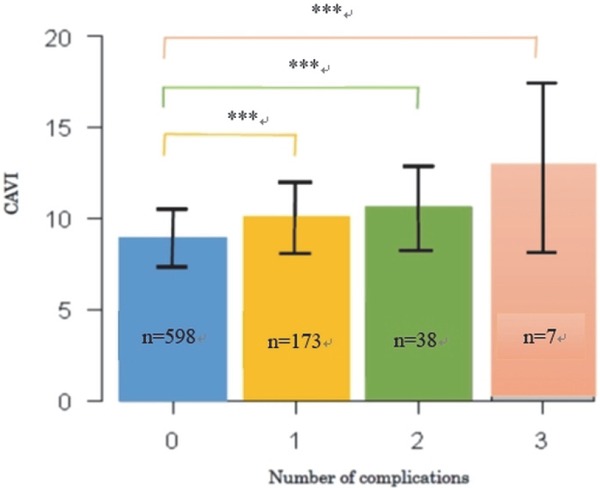
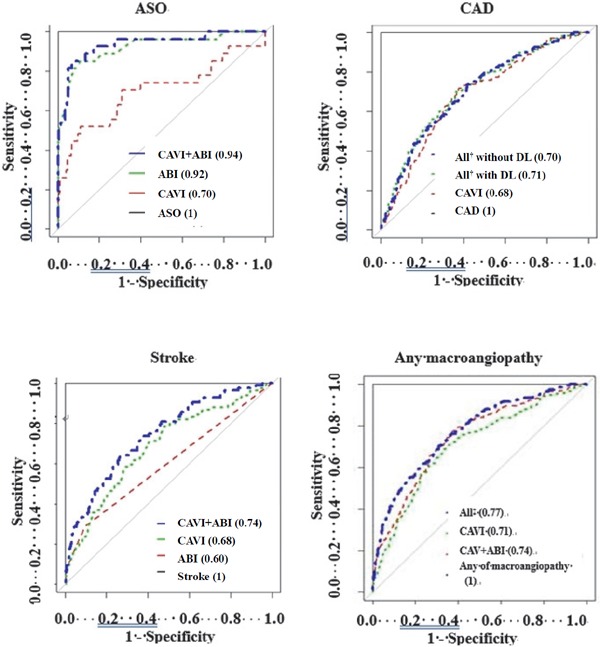
CAVI was significantly correlated with macroangiopathies, including coronary artery disease (CAD), arteriosclerosis obliterans (ASO), and stroke with odds ratios (OR) of 1.20, 1.22, and 1.19, respectively. ABI significantly correlated with ASO and stroke with respective OR of 13.6 and 2.47, but not with CAD. Areas under the receiver operating characteristic curves (ROCs) revealed the accuracy of detecting ASO and stroke was increased by the combination of CAVI+ABI (0.94 and 0.74, respectively). However, areas under the ROC for the presence of CAD can be increased by the combination of CAVI and ARFs especially including dyslipidemia.
CAVI/ABI and some ARFs are useful tools in daily clinical care units to identify the current and past existence of macroangiopathy in patients with type 2 diabetes, but the prediction weights using these factors were different among CAD, ASO, and stroke.
本研究阐明了 2 型糖尿病患者大血管病变的发生与各种动脉硬化危险因素(ARFs)及心血管踝臂指数(CAVI)和踝臂血压指数(ABI)结果的关系。
回顾性分析了 816 例单中心 2 型糖尿病患者的当前和过去大血管病变发展与 ARFs 或 CAVI/ABI 数据的相关性,采用逐步法选择的一些独立变量的多变量逻辑回归。评估了结合一些独立变量的 C 统计量。
CAVI 与冠心病(CAD)、动脉硬化闭塞症(ASO)和中风等大血管疾病显著相关,其优势比(OR)分别为 1.20、1.22 和 1.19。ABI 与 ASO 和中风显著相关,其 OR 分别为 13.6 和 2.47,但与 CAD 无关。受试者工作特征曲线(ROC)下的面积表明,CAVI+ABI 的结合提高了 ASO 和中风的检测准确性(分别为 0.94 和 0.74)。然而,CAVI 和 ARFs 的结合,尤其是包括血脂异常在内的 ARFs 的结合,可以提高 CAD 存在的 ROC 面积。
CAVI/ABI 和一些 ARFs 是 2 型糖尿病患者日常临床护理中识别大血管疾病当前和过去存在的有用工具,但这些因素的预测权重在 CAD、ASO 和中风之间有所不同。