Bourgeois Laure, Zhang Yong, Zhang Zezhong, Chen Yiqiang, Medhekar Nikhil V
Monash Centre for Electron Microscopy, Monash University, Victoria, 3800, Australia.
Department of Materials Science and Engineering, Monash University, Victoria, 3800, Australia.
Nat Commun. 2020 Mar 6;11(1):1248. doi: 10.1038/s41467-020-15087-1.
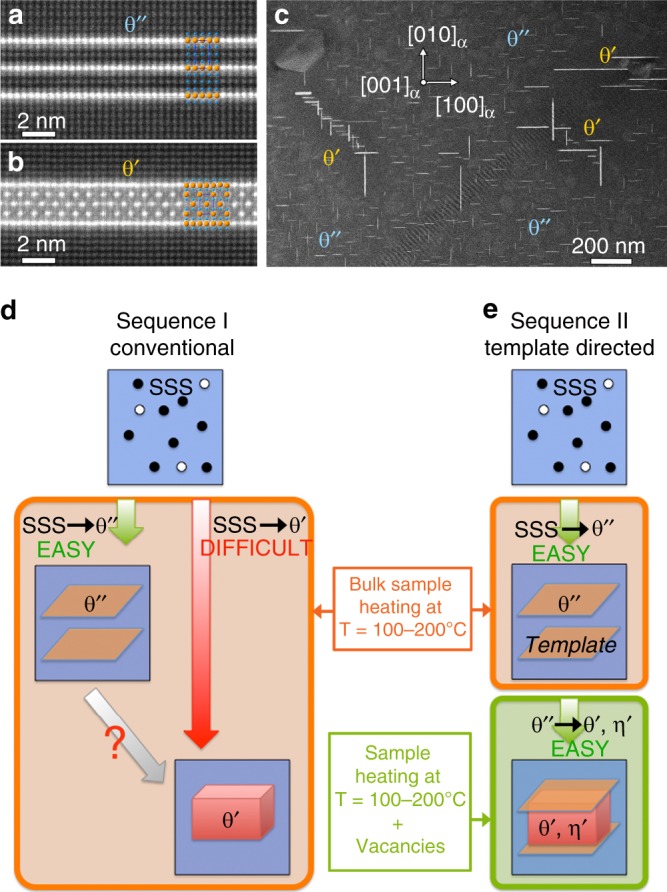
Many phase transformations associated with solid-state precipitation look structurally simple, yet, inexplicably, take place with great difficulty. A classic case of difficult phase transformations is the nucleation of strengthening precipitates in high-strength lightweight aluminium alloys. Here, using a combination of atomic-scale imaging, simulations and classical nucleation theory calculations, we investigate the nucleation of the strengthening phase θ' onto a template structure in the aluminium-copper alloy system. We show that this transformation can be promoted in samples exhibiting at least one nanoscale dimension, with extremely high nucleation rates for the strengthening phase as well as for an unexpected phase. This template-directed solid-state nucleation pathway is enabled by the large influx of surface vacancies that results from heating a nanoscale solid. Template-directed nucleation is replicated in a bulk alloy as well as under electron irradiation, implying that this difficult transformation can be facilitated under the general condition of sustained excess vacancy concentrations.
许多与固态沉淀相关的相变在结构上看似简单,但令人费解的是,其发生过程却极为困难。高强度轻质铝合金中强化析出物的形核就是一个相变困难的典型例子。在此,我们结合原子尺度成像、模拟和经典形核理论计算,研究了铝铜合金体系中强化相θ'在模板结构上的形核过程。我们发现,在至少具有一个纳米尺度维度的样品中,这种相变能够被促进,强化相以及一个意外相的形核速率极高。加热纳米尺度固体导致大量表面空位涌入,从而开启了这种模板导向的固态形核途径。在块状合金以及电子辐照条件下,均可复制模板导向形核过程,这意味着在持续存在过量空位浓度的一般条件下,这种困难的相变能够得以促进。