Staatliches Museum für Naturkunde Stuttgart, Rosenstein 1, 70191, Stuttgart, Germany.
Vicerrectoría de Investigación y Postgrado, Universidad de Magallanes, Avenida Bulnes, 01855, Punta Arenas, Chile.
Sci Rep. 2020 Mar 6;10(1):4206. doi: 10.1038/s41598-020-61070-7.
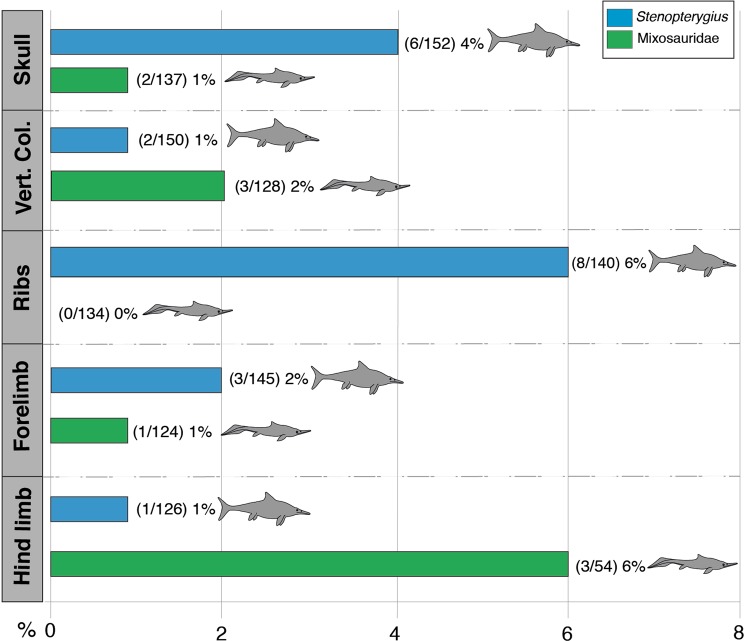
Changing predator-prey interactions during the Mesozoic Marine Revolution (MMR) profoundly altered the trajectory of marine tetrapod evolution. Here, we assess potential signatures of this landmark transition through the fossil record of skeletal pathologies in ichthyosaurs - iconic marine reptiles that developed increasingly 'fish-like' body plans over time. We surveyed a stratigraphically constrained sample of 200 Middle Triassic ichthyosaur specimens and compared the type, distribution and prevalence of pathologies with an approximately equivalent assemblage of Early Jurassic age. Overall, skeletal pathologies were equally prevalent in these groups, and most often manifested in species >4 m long. However, pathological bones were found to be concentrated in the hind limbs and tail of Triassic ichthyosaurs, whereas the jaws, forelimbs, and ribcage were preferentially affected in Jurassic taxa. We posit that the occurrence of ankylosed zygapophyses in the caudal peak of Triassic ichthyosaurs could represent a functional by-product of their primitive 'eel-like' swimming. Conversely, increased instances of broken ribs in Jurassic ichthyosaurs may infer ramming or tail strike behaviours that characterise morphologically 'fish-like' marine tetrapods, such as modern toothed whales. Different categories of skeletal pathologies thus evidently reflect structural modifications in the ichthyosaur body plan, and indirectly coincide with ecological turnover during the MMR.
在中生代海洋革命(MMR)期间,捕食者-猎物相互作用的变化深刻地改变了海洋四足动物进化的轨迹。在这里,我们通过对鱼龙骨骼病理学的化石记录来评估这一具有里程碑意义的转变的潜在特征——鱼龙是标志性的海洋爬行动物,随着时间的推移,它们的身体结构逐渐变得“鱼类化”。我们调查了一个受地层限制的 200 个中三叠世鱼龙标本的样本,并将病变的类型、分布和流行程度与一个大约相当于早侏罗世的集合体进行了比较。总的来说,这两个群体的骨骼病理学都同样普遍,而且最常见于体长超过 4 米的物种。然而,病理骨骼被发现集中在三叠纪鱼龙的后肢和尾部,而在侏罗纪类群中,下颚、前肢和肋骨箱则优先受到影响。我们假设,三叠纪鱼龙尾部峰值处的关节突骨融合的出现可能是它们原始的“鳗鱼样”游泳的功能副产品。相反,在侏罗纪鱼龙中肋骨断裂的情况增加可能推断出它们具有冲撞或尾部撞击行为,这些行为是形态上“鱼类化”的海洋四足动物的特征,例如现代齿鲸。因此,不同类别的骨骼病理学显然反映了鱼龙身体结构的变化,并间接地与 MMR 期间的生态转型相吻合。