Thomas Roth Sleep Disorders & Research Center, Division of Sleep Medicine, Henry Ford Health System, Detroit, MI 48202 USA.
Thomas Roth Sleep Disorders & Research Center, Division of Sleep Medicine, Henry Ford Health System, Detroit, MI 48202 USA.
Sleep Health. 2020 Apr;6(2):185-191. doi: 10.1016/j.sleh.2019.11.011. Epub 2020 Mar 4.
Insomnia and depression are highly prevalent perinatal complications. Ruminating on stress is etiologically implicated in both disorders, and ruminating while trying to fall asleep has been linked to insomnia and depression during pregnancy. Incompatible with rumination is everyday mindfulness, i.e., living with intentional and nonjudgmental awareness of internal and external experiences in the present moment. Responding to stress mindfully may protect against stress-related perinatal complications such as insomnia and depression. The present study described the association between everyday mindfulness and nocturnal rumination, and examined whether these trait characteristics were independently related to perinatal insomnia and depression.
Cross-sectional and secondary analysis of existing data from 65 pregnant women recruited from a multisite hospital in Metro Detroit, MI, USA. Subjects completed online surveys including the Insomnia Severity Index, Edinburgh Postnatal Depression Scale, Presleep Arousal Scale, and the revised Cognitive and Affective Mindfulness Scale.
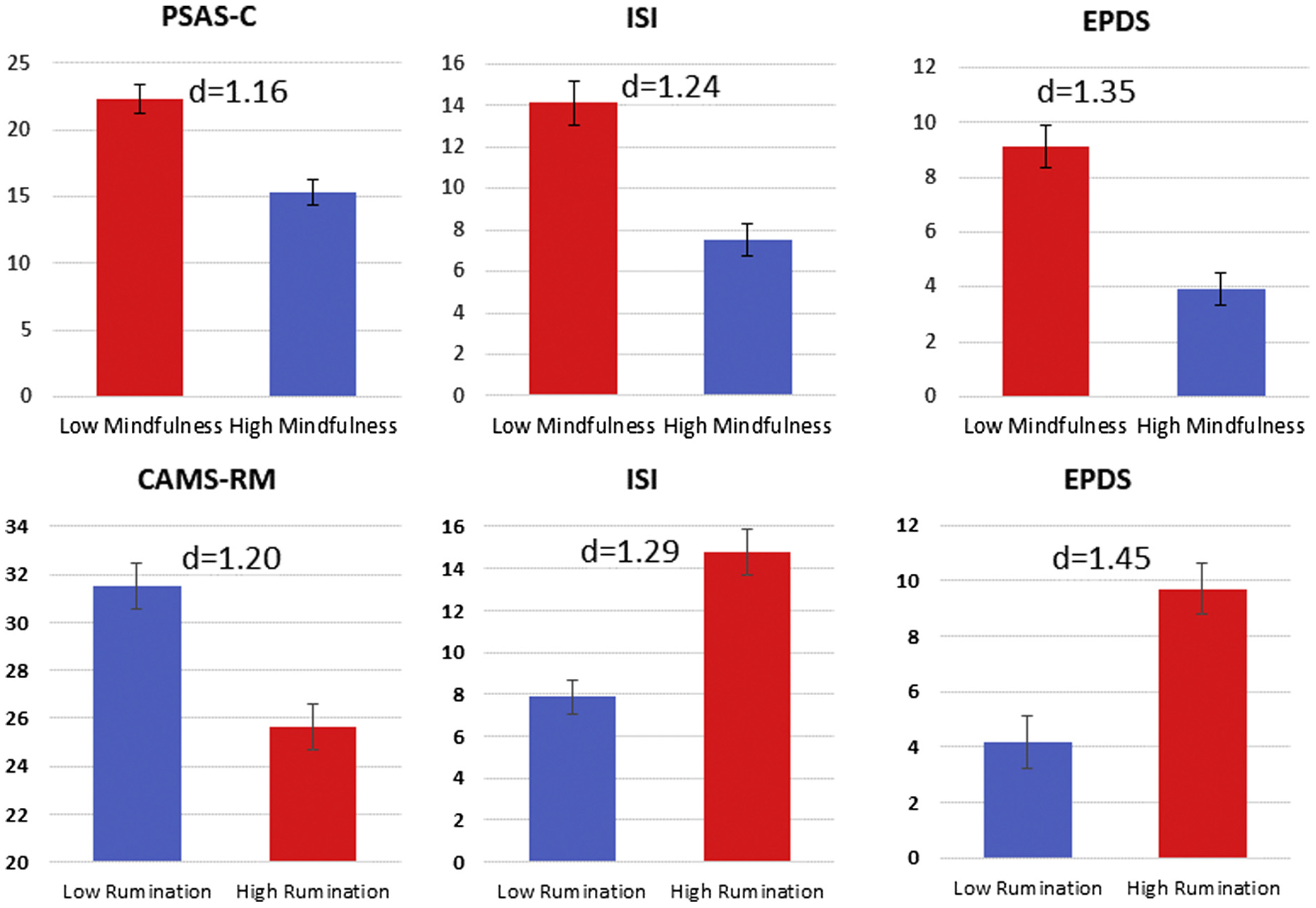
Over half (53.8%) of women screened positive for clinical insomnia and 12.3% screened positive for major depression. Women high in mindfulness, relative to those low in mindfulness, reported less nocturnal rumination (Cohen's d=1.16), insomnia symptoms (Cohen's d=1.24), and depressive symptoms (Cohen's d=1.35). Multivariate linear regression revealed that both mindfulness (β=-.24, p=.03) and rumination (β=.38, p<.01) were independently associated with insomnia. Similarly, a multivariate model showed that mindfulness (β=-.41, p<.001) and rumination (β=.35, p<.01) were independently associated with depression.
Ruminating in bed at night is strongly associated with insomnia and depression during pregnancy, whereas mindfulness may potentially protect against these stress-related perinatal complications.
失眠和抑郁是围产期高发的并发症。沉思应激在这两种疾病中都有病因学上的牵连,而在试图入睡时沉思与怀孕期间的失眠和抑郁有关。与沉思相反的是日常正念,即在当下以有意和非评判的方式感知内部和外部体验。有意识地应对压力可能有助于预防与压力相关的围产期并发症,如失眠和抑郁。本研究描述了日常正念与夜间沉思之间的关系,并探讨了这些特质是否与围产期失眠和抑郁独立相关。
横断面和对美国密歇根州底特律都会区多家医院招募的 65 名孕妇现有数据的二次分析。受试者完成了在线调查,包括失眠严重程度指数、爱丁堡产后抑郁量表、睡前觉醒量表和修订后的认知和情感正念量表。
超过一半(53.8%)的女性筛查出有临床失眠,12.3%的女性筛查出有重度抑郁。与正念水平低的女性相比,正念水平高的女性报告夜间沉思(Cohen's d=1.16)、失眠症状(Cohen's d=1.24)和抑郁症状(Cohen's d=1.35)较少。多元线性回归显示,正念(β=-.24,p=.03)和沉思(β=.38,p<.01)都与失眠独立相关。同样,一个多元模型显示,正念(β=-.41,p<.001)和沉思(β=.35,p<.01)与抑郁独立相关。
夜间在床上沉思与怀孕期间的失眠和抑郁密切相关,而正念可能有助于预防这些与压力相关的围产期并发症。