Cancer Biotherapy Center, Yunnan Cancer Hospital, The Third Affiliated Hospital of Kunming Medical University, Kunming, China.
Cancer Institute, Yunnan Cancer Hospital, The Third Affiliated Hospital of Kunming Medical University, Kunming, China.
Thorac Cancer. 2020 May;11(5):1180-1190. doi: 10.1111/1759-7714.13371. Epub 2020 Mar 9.
The aim of this study was to determine the function of long non-coding RNA small nucleolar RNA host gene 6 (SNHG6) in non-small cell lung cancer (NSCLC) and its underlying mechanisms.
The association of SNHG6 or miR-101-3p with clinicopathological characteristics and prognosis in patents with NSCLC was assessed by TCGA dataset. Cell proliferation and invasion were evaluated by MTT and Transwell assays and SNHG6-specific binding with miR-101-3p was verified by bioinformatic analysis, luciferase gene report and RNA immunoprecipitation assays. qRT-PCR and Western blot was used to assess the effects of SNHG6 on the expression of miR-101-3p and chromodomain Y like (CDYL) in NSCLC cells. A xenograft tumor model in vivo was established to observe the effects of SNHG6 knockdown on tumor growth.
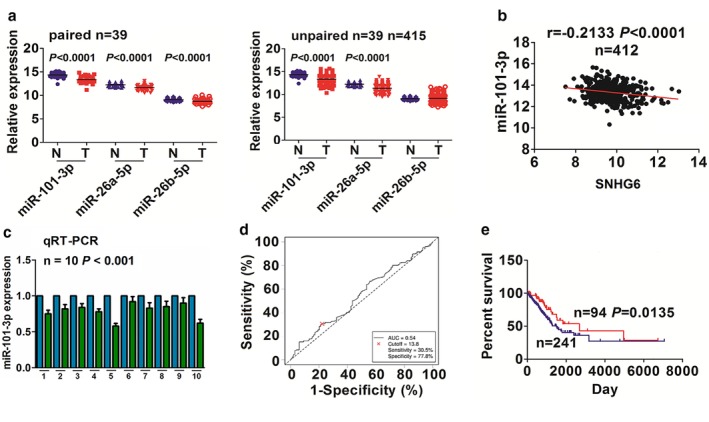
We found that increased expression of SNHG6 was associated with pathological stage and lymph node infiltration, and acted as an independent prognostic factor of tumor recurrence in patients with NSCLC. Silencing SNHG6 expression repressed cell growth and invasion in vitro and in vivo, but overexpression of SNHG6 reversed these effects. Furthermore, SNHG6 was identified to act as a sponge of miR-101-3p, which could reduce cell proliferation and attenuate SNHG6-induced CDYL expression. Low expression of miR-101-3p or high expression of CDYL was related to poor survival in patients with NSCLC.
Our findings demonstrated that lncRNA SNHG6 contributed to the proliferation and invasion of NSCLC by downregulating miR-101-3p.
本研究旨在确定长链非编码 RNA 小核仁 RNA 宿主基因 6(SNHG6)在非小细胞肺癌(NSCLC)中的作用及其潜在机制。
通过 TCGA 数据集评估 SNHG6 或 miR-101-3p 与 NSCLC 患者临床病理特征和预后的相关性。通过 MTT 和 Transwell 分析评估细胞增殖和侵袭,通过生物信息学分析、荧光素酶基因报告和 RNA 免疫沉淀分析验证 SNHG6 与 miR-101-3p 的特异性结合。qRT-PCR 和 Western blot 用于评估 SNHG6 对 NSCLC 细胞中 miR-101-3p 和 chromodomain Y like(CDYL)表达的影响。建立体内异种移植肿瘤模型观察 SNHG6 敲低对肿瘤生长的影响。
我们发现 SNHG6 的表达增加与病理分期和淋巴结浸润有关,并且是 NSCLC 患者肿瘤复发的独立预后因素。沉默 SNHG6 表达可抑制体外和体内细胞生长和侵袭,但过表达 SNHG6 可逆转这些效应。此外,SNHG6 被鉴定为 miR-101-3p 的海绵,可降低细胞增殖并减弱 SNHG6 诱导的 CDYL 表达。miR-101-3p 表达低或 CDYL 表达高与 NSCLC 患者的不良生存相关。
我们的研究结果表明,lncRNA SNHG6 通过下调 miR-101-3p 促进 NSCLC 的增殖和侵袭。