Thuengtung Sukanya, Ogawa Yukiharu
Graduate School of Horticulture Chiba University Matsudo Japan.
Food Sci Nutr. 2020 Jan 9;8(2):965-972. doi: 10.1002/fsn3.1377. eCollection 2020 Feb.
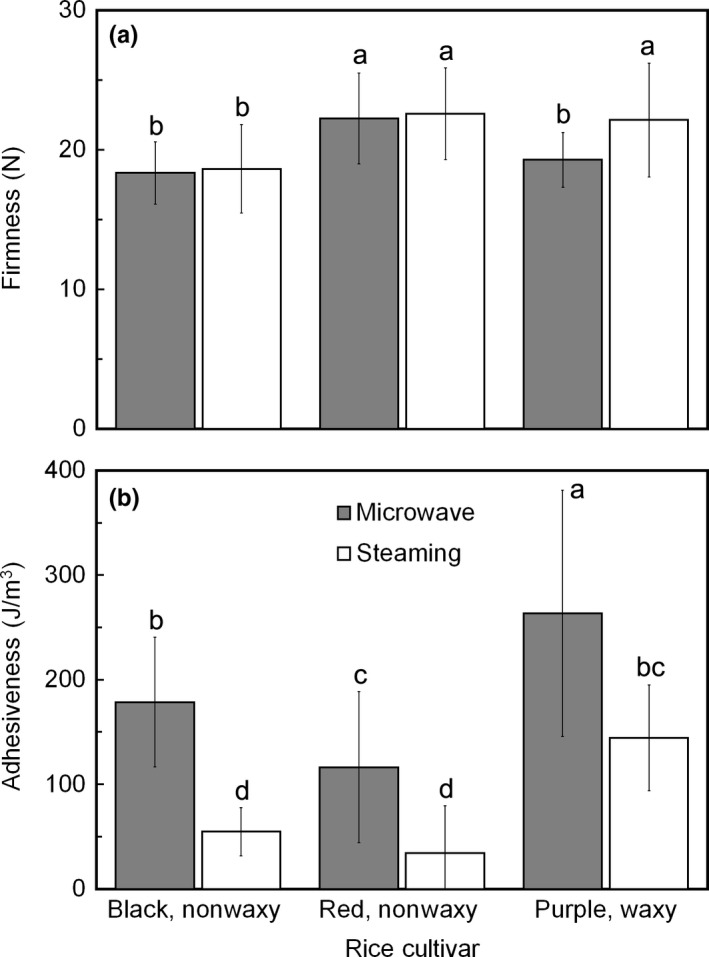
The impact of two different cooking processes (microwave and steaming) on cooked rice quality (i.e., texture), and changes in the bioactive compounds (total phenolic content [TPC] and total anthocyanin content [TAC]) and antioxidant activities (DPPH and FRAP assays) of black and red (nonwaxy) and purple (waxy) pigmented rice were investigated. No significant difference in the firmness between microwave-cooked rice and steam-cooked rice was found, except for cooked purple rice. However, microwave cooking promoted an increase in the cooked rice adhesiveness, which approximately higher 2- ~ 3-fold than that of steam cooking with varying among rice cultivars. Microwave cooking also exhibited significantly higher TPC (1.2- ~ 2.0-fold), TAC (2.0- ~ 3.2-fold), DPPH (1.3- ~ 2.5-fold), and FRAP (1.5- ~ 2.4-fold) than steam cooking for black and purple rice cultivars. There was a strong positive correlation among these bioactive compounds and the antioxidant activities ( < .01). Our study indicated that the TPC, TAC, DPPH, and FRAP of all rice examined were remarkably decreased after cooking, and the extent of the decrease depended on the rice cultivar and cooking method.
研究了两种不同烹饪方式(微波和蒸煮)对黑米、红米(非糯性)和紫米(糯性)米饭品质(即质地)的影响,以及生物活性化合物(总酚含量[TPC]和总花青素含量[TAC])和抗氧化活性(DPPH和FRAP测定)的变化。除了蒸煮紫米外,微波煮米饭和蒸煮米饭之间的硬度没有显著差异。然而,微波烹饪使煮米饭的粘性增加,比蒸煮烹饪高出约2至3倍,不同水稻品种之间存在差异。对于黑米和紫米品种,微波烹饪的TPC(1.2至2.0倍)、TAC(2.0至3.2倍)、DPPH(1.3至2.5倍)和FRAP(1.5至2.4倍)也显著高于蒸煮烹饪。这些生物活性化合物与抗氧化活性之间存在很强的正相关性(<0.01)。我们的研究表明,所有检测的水稻品种在烹饪后TPC、TAC、DPPH和FRAP均显著降低,降低程度取决于水稻品种和烹饪方法。