Center of Integrative Medicine, Beijing Ditan Hospital, Capital Medical University, Beijing 100015, China.
Department of Infections Disease, Putuo Hospital, Shanghai University of Traditional Chinese Medicine, Shanghai 200062, China.
Biomed Res Int. 2020 Feb 17;2020:1473718. doi: 10.1155/2020/1473718. eCollection 2020.
Portal vein tumor thrombosis (PVTT) is one of the major predictive factors for patients with hepatocellular carcinoma (HCC). The objective of this study was to establish a prognostic nomogram for identifying individual survival outcomes in patients with HCC and PVTT on conservative treatment based on specific factors.
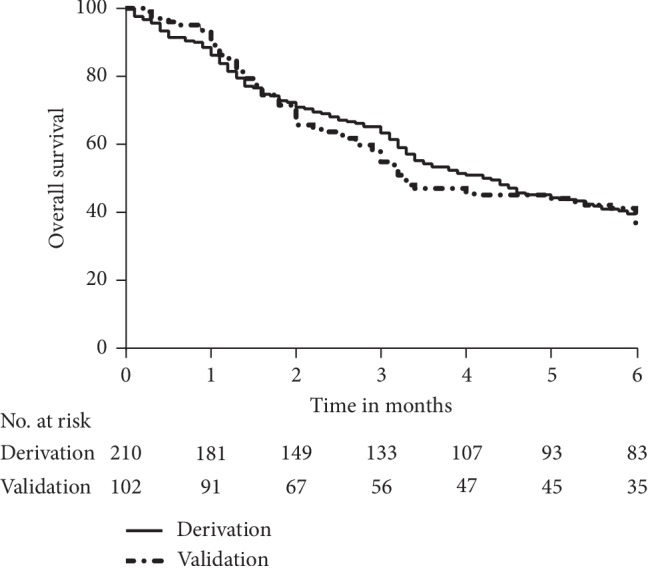
Two hundred and ten patients with HCC and PVTT on conservative treatment in Beijing Ditan Hospital between June 2008 and May 2017 were studied retrospectively as a derivation cohort. We built a nomogram based on independent risk factors for survival prediction. The concordance index (c-index) and a calibration curve were used to evaluate the predictive accuracy. During the study, 102 patients were included at the Putuo Hospital and Third People's Hospital of Changzhou as a validation cohort.
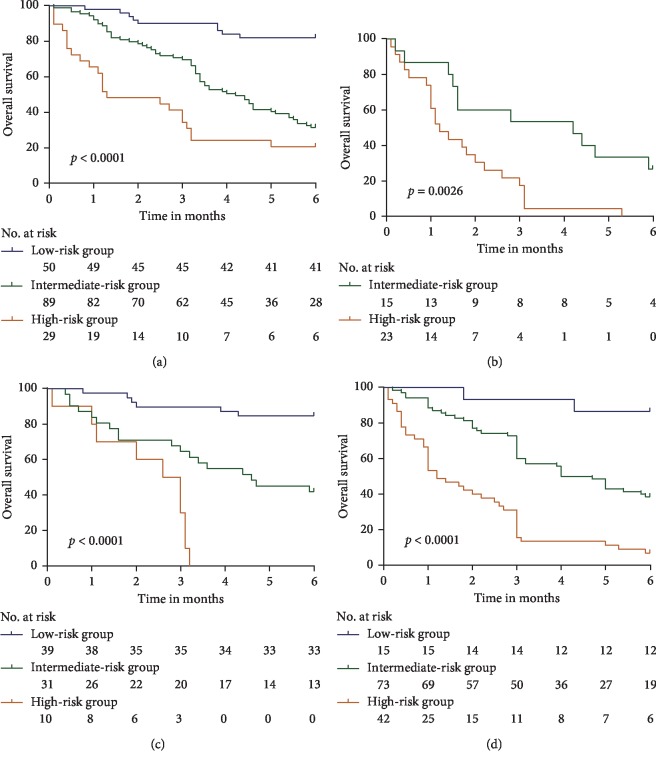
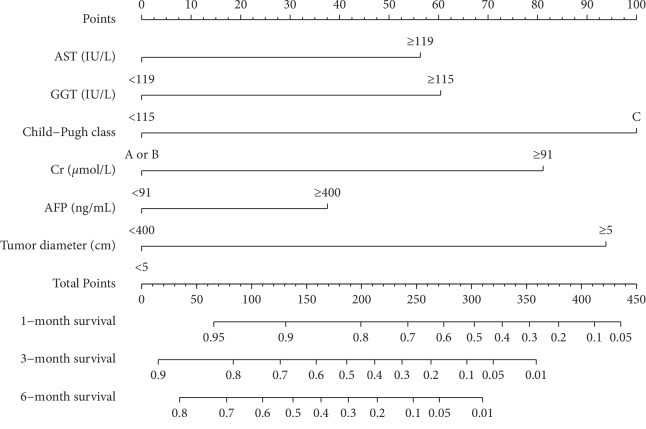
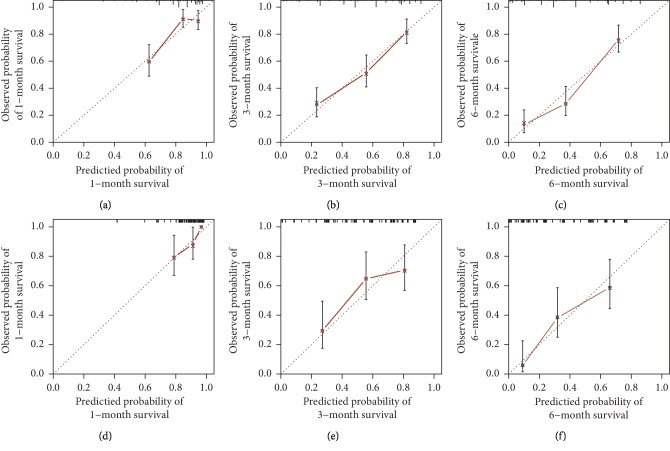
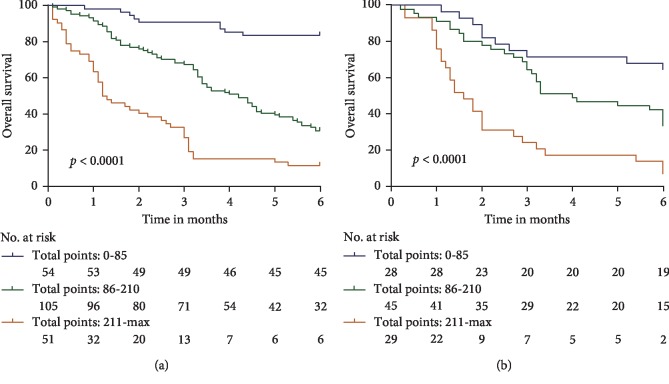
In the derivation cohort, the independent factors for overall survival were identified by multivariate analysis, namely, aspartate aminotransferase ≥119 IU/L, gamma-glutamyl transferase ≥115 IU/L, Child-Pugh class C liver function, creatinine ≥91 moI/L, -fetoprotein ≥400 ng/ml, and largest tumor diameter ≥5 cm. The nomogram had a c-index of 0.737 (95% confidence interval, 0.692-0.782) and the calibration curves fitted well. The median survival time was 4.2 months in the derivation cohort, with an MST of 5 months for BCLC C stage and 1.8 months for BCLC D stage patients. Kaplan-Meier analysis showed significant statistical differences in the 6-month overall survival rates of the primary and validation cohorts after the total scores were divided into three quartiles (low risk: 0-85; intermediate risk: 86-210; high risk: ≥211; < 0.0001 in both cohorts).
The nomogram can be a more accurate and individualized prediction for 6-month overall survival of patients with HCC and PVTT on conservative treatment, and it is possible to consider further active interventions for patients in the low-risk group (0-85 scores) to achieve the aim of prolonging survival.
门静脉癌栓(PVTT)是影响肝细胞癌(HCC)患者预后的主要预测因素之一。本研究旨在建立一种基于特定因素的预后列线图,以识别接受保守治疗的 HCC 合并 PVTT 患者的个体生存结局。
回顾性分析 2008 年 6 月至 2017 年 5 月期间在北京地坛医院接受保守治疗的 210 例 HCC 合并 PVTT 患者,作为推导队列。我们基于生存预测的独立危险因素构建了一个列线图。采用一致性指数(c-index)和校准曲线评估预测准确性。研究期间,将 102 例患者纳入普陀医院和常州第三人民医院作为验证队列。
在推导队列中,多因素分析确定了总生存的独立因素,包括丙氨酸氨基转移酶(AST)≥119IU/L、γ-谷氨酰转肽酶(γ-GT)≥115IU/L、Child-Pugh 肝功能 C 级、肌酐(Cr)≥91μmol/L、甲胎蛋白(AFP)≥400ng/ml 和最大肿瘤直径≥5cm。该列线图的 c-index 为 0.737(95%置信区间:0.692-0.782),校准曲线拟合良好。推导队列的中位生存时间为 4.2 个月,BCLC C 期和 BCLC D 期患者的 MST 分别为 5 个月和 1.8 个月。Kaplan-Meier 分析显示,在总评分分为三个四分位数后,推导和验证队列的 6 个月总生存率存在显著统计学差异(低危:0-85;中危:86-210;高危:≥211;在两个队列中均<0.0001)。
该列线图可更准确地预测接受保守治疗的 HCC 合并 PVTT 患者的 6 个月总生存率,对于评分处于低危(0-85 分)的患者,可能需要考虑进一步的积极干预,以延长生存时间。