Department of Endocrinology, The First Affiliated Hospital, Sun Yat-Sen University, 58th of Zhongshan Er Road, Guangzhou, China 510080.
Department of Laboratory Medicine, The First Affiliated Hospital, Sun Yat-Sen University, 58th of Zhongshan Er Road, Guangzhou, China 510080.
J Diabetes Res. 2020 Feb 18;2020:4097469. doi: 10.1155/2020/4097469. eCollection 2020.
Short-term intensive insulin therapy induces long-term glycemic remission in half of patients with newly diagnosed type 2 diabetes. The concomitant hypoglycemia needs further analysis.
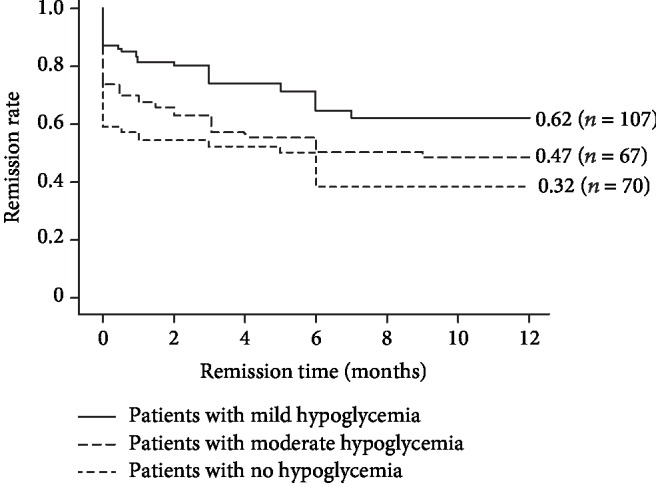
We collected data from three randomized trials conducted with the same inclusion and exclusion criteria at our institution from 2002 to 2015. Continuous subcutaneous insulin infusion (CSII) was provided to achieve the glycemic goals within a week and then maintained for 14 days. Hypoglycemia episodes during short-term treatment and the one-year drug-free glycemic remission were observed.
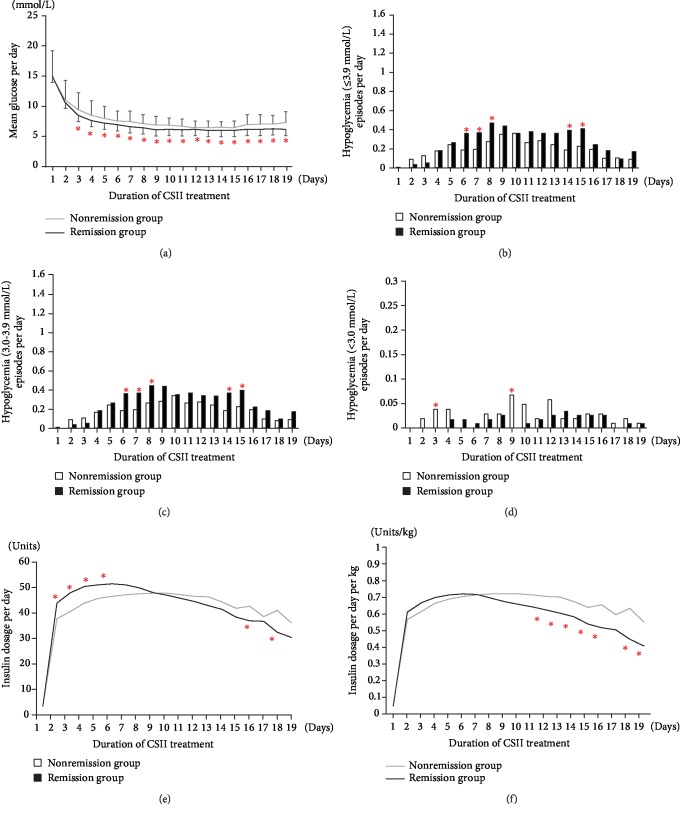
A total of 244 patients were included. The per day episode of mild hypoglycemia (3.0-3.9 mmol/L) was higher in the remission group than in the nonremission group (0.26 ± 0.20 vs. 0.18 ± 0.21, = 0.005). However, a moderate hypoglycemia episode (<3.0 mmol/L) per day was insignificantly lower in the remission group (0.02 ± 0.04 vs. 0.03 ± 0.04, = 0.005). However, a moderate hypoglycemia episode (<3.0 mmol/L) per day was insignificantly lower in the remission group (0.02 ± 0.04 vs. 0.03 ± 0.04, = 0.005). However, a moderate hypoglycemia episode (<3.0 mmol/L) per day was insignificantly lower in the remission group (0.02 ± 0.04 vs. 0.03 ± 0.04, = 0.005). However, a moderate hypoglycemia episode (<3.0 mmol/L) per day was insignificantly lower in the remission group (0.02 ± 0.04 vs. 0.03 ± 0.04.
Mild hypoglycemic episodes during the continuing insulin dose reduction period indicate a long-term drug-free euglycemic remission in patients with newly diagnosed type 2 diabetes. However, the insulin dosage should be reduced even more quickly in the future treatment to decrease the potential harms.
短期强化胰岛素治疗可使一半新诊断的 2 型糖尿病患者长期血糖缓解。同时需要进一步分析伴随的低血糖。
我们收集了 2002 年至 2015 年在我院进行的三项随机试验的数据,这些试验具有相同的纳入和排除标准。连续皮下胰岛素输注(CSII)用于在一周内达到血糖目标,然后维持 14 天。观察短期治疗期间的低血糖发作和一年无药物血糖缓解情况。
共纳入 244 例患者。缓解组的每日轻度低血糖(3.0-3.9mmol/L)发作次数高于未缓解组(0.26±0.20 vs. 0.18±0.21, = 0.005)。然而,缓解组的每日中度低血糖发作(<3.0mmol/L)次数无显著差异(0.02±0.04 vs. 0.03±0.04, = 0.005)。然而,缓解组的每日中度低血糖发作(<3.0mmol/L)次数无显著差异(0.02±0.04 vs. 0.03±0.04, = 0.005)。然而,缓解组的每日中度低血糖发作(<3.0mmol/L)次数无显著差异(0.02±0.04 vs. 0.03±0.04, = 0.005)。然而,缓解组的每日中度低血糖发作(<3.0mmol/L)次数无显著差异(0.02±0.04 vs. 0.03±0.04, = 0.005)。然而,缓解组的每日中度低血糖发作(<3.0mmol/L)次数无显著差异(0.02±0.04 vs. 0.03±0.04, = 0.005)。
在继续减少胰岛素剂量期间,轻度低血糖发作表明新诊断的 2 型糖尿病患者有长期无药物的血糖缓解。然而,在未来的治疗中,应该更快地减少胰岛素剂量,以减少潜在的危害。