Odum School of Ecology, University of Georgia, Athens, Georgia, United States of America.
Center for the Ecology of Infectious Diseases, University of Georgia, Athens, Georgia, United States of America.
PLoS Comput Biol. 2020 Mar 9;16(3):e1007679. doi: 10.1371/journal.pcbi.1007679. eCollection 2020 Mar.
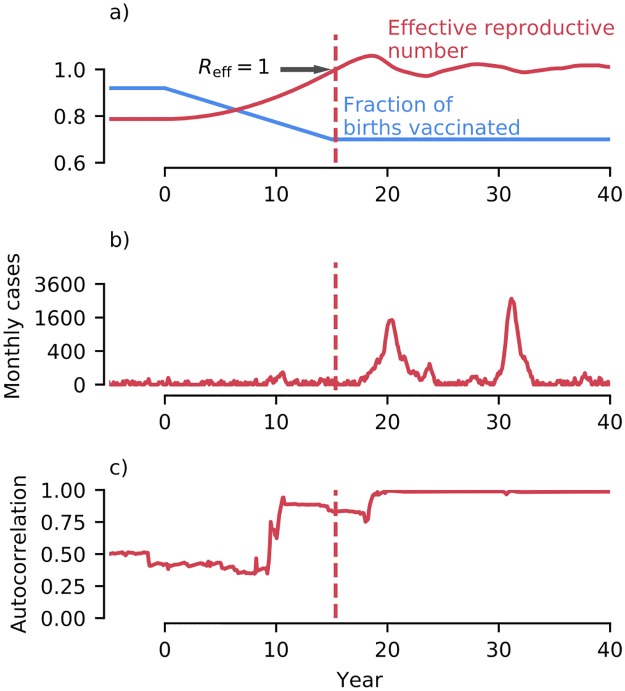
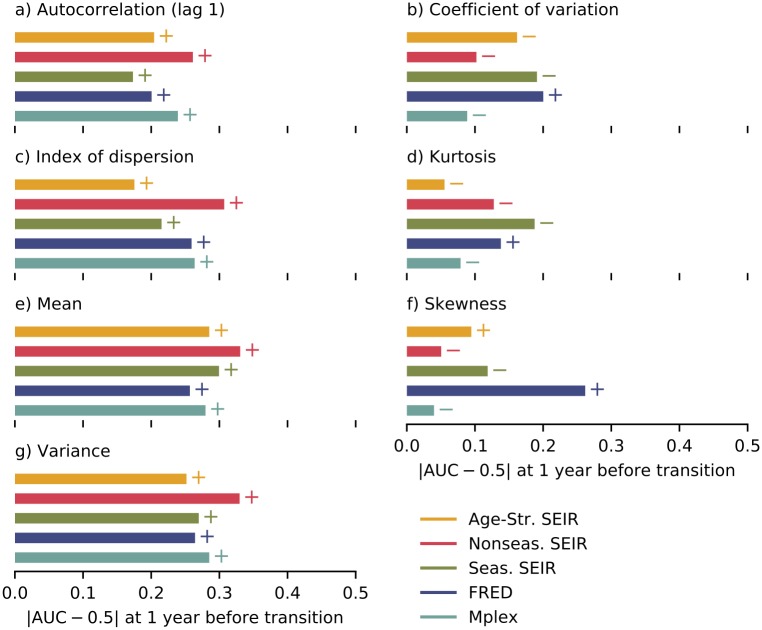
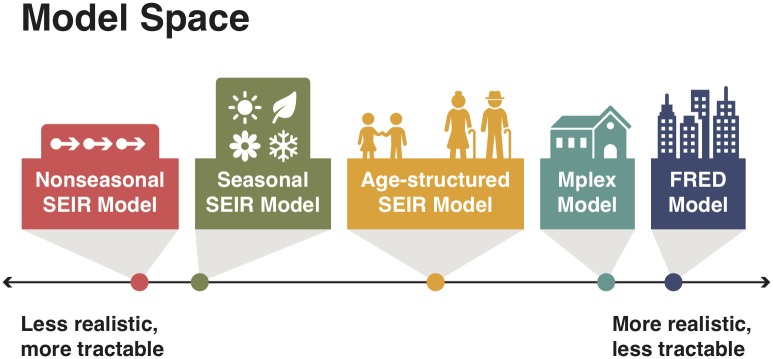
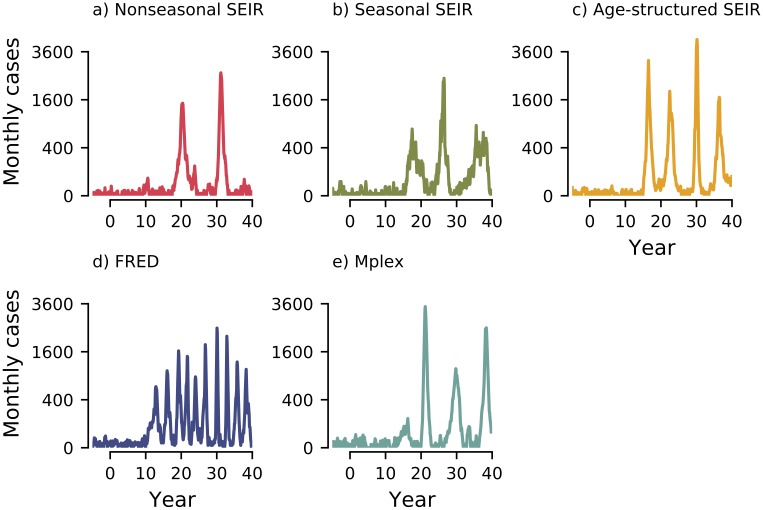
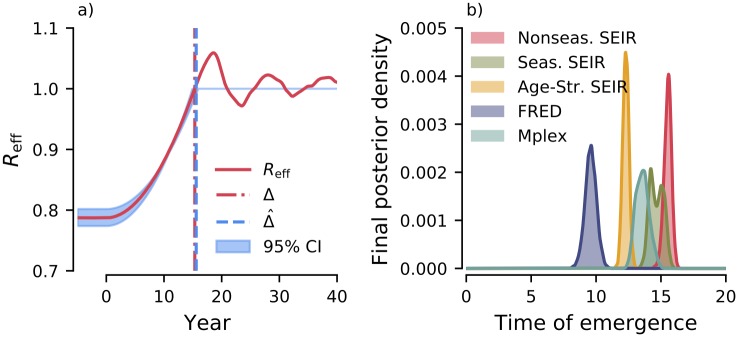
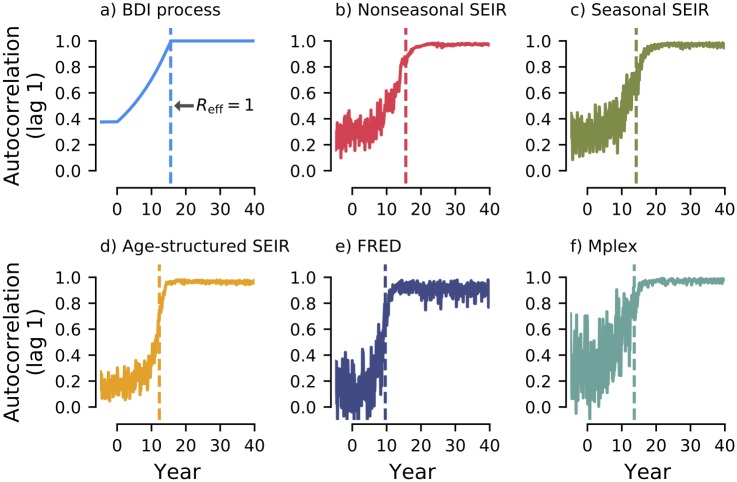
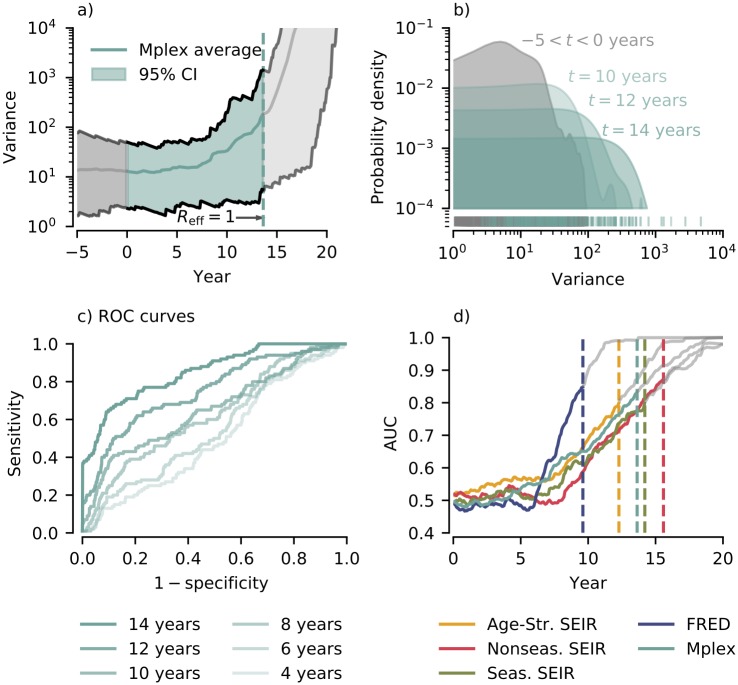
Despite medical advances, the emergence and re-emergence of infectious diseases continue to pose a public health threat. Low-dimensional epidemiological models predict that epidemic transitions are preceded by the phenomenon of critical slowing down (CSD). This has raised the possibility of anticipating disease (re-)emergence using CSD-based early-warning signals (EWS), which are statistical moments estimated from time series data. For EWS to be useful at detecting future (re-)emergence, CSD needs to be a generic (model-independent) feature of epidemiological dynamics irrespective of system complexity. Currently, it is unclear whether the predictions of CSD-derived from simple, low-dimensional systems-pertain to real systems, which are high-dimensional. To assess the generality of CSD, we carried out a simulation study of a hierarchy of models, with increasing structural complexity and dimensionality, for a measles-like infectious disease. Our five models included: i) a nonseasonal homogeneous Susceptible-Exposed-Infectious-Recovered (SEIR) model, ii) a homogeneous SEIR model with seasonality in transmission, iii) an age-structured SEIR model, iv) a multiplex network-based model (Mplex) and v) an agent-based simulator (FRED). All models were parameterised to have a herd-immunity immunization threshold of around 90% coverage, and underwent a linear decrease in vaccine uptake, from 92% to 70% over 15 years. We found evidence of CSD prior to disease re-emergence in all models. We also evaluated the performance of seven EWS: the autocorrelation, coefficient of variation, index of dispersion, kurtosis, mean, skewness, variance. Performance was scored using the Area Under the ROC Curve (AUC) statistic. The best performing EWS were the mean and variance, with AUC > 0.75 one year before the estimated transition time. These two, along with the autocorrelation and index of dispersion, are promising candidate EWS for detecting disease emergence.
尽管医学取得了进步,但传染病的出现和再现仍然对公共卫生构成威胁。低维流行病学模型预测,传染病的转变之前会出现临界减速(CSD)现象。这就提出了一种可能性,即使用基于 CSD 的预警信号(EWS)来预测疾病(再)出现,这些 EWS 是从时间序列数据中估计的统计矩。为了使 EWS 能够有效地检测未来的(再)出现,CSD 需要成为流行病学动态的通用(与模型无关)特征,而不论系统的复杂性如何。目前,尚不清楚从简单的低维系统中得出的 CSD 预测是否适用于高维的真实系统。为了评估 CSD 的通用性,我们对一系列模型进行了模拟研究,这些模型的结构复杂性和维度都在不断增加,用于模拟麻疹样传染病。我们的五个模型包括:i)非季节性同质易感性-暴露-感染-恢复(SEIR)模型,ii)具有传播季节性的同质 SEIR 模型,iii)年龄结构 SEIR 模型,iv)基于复网的模型(Mplex)和 v)基于代理的模拟器(FRED)。所有模型都被参数化,使其具有约 90%覆盖率的群体免疫免疫阈值,并在 15 年内疫苗接种率从 92%线性下降到 70%。我们在所有模型中都发现了疾病再出现之前存在 CSD 的证据。我们还评估了七种 EWS 的性能:自相关、变异系数、离差指数、峰度、均值、偏度、方差。性能使用 ROC 曲线下的面积(AUC)统计量进行评分。表现最好的 EWS 是均值和方差,其 AUC 在估计的转变时间前一年大于 0.75。这两个以及自相关和离差指数是检测疾病出现的有希望的候选 EWS。