Department of Endocrinology, the First Affiliated Hospital of Chongqing Medical University, Chongqing, Chongqing, China.
The Chongqing Key Laboratory of Translational Medicine in Major Metabolic Diseases, the First Affiliated Hospital of Chongqing Medical University, Chongqing, China.
BMJ Open Diabetes Res Care. 2020 Mar;8(1). doi: 10.1136/bmjdrc-2019-001078.
Cell-free DNA (cfDNA) is associated with diabetes and cardiovascular diseases. Our study was to evaluate whether serum cfDNA could predict the progression of diabetic kidney disease (DKD).
In this prospective study, a total of 160 patients with DKD were enrolled, and the kidney function was followed up by measurement of estimated glomerular filtration rate (eGFR) and urinary albumin-creatinine ratio (UACR) for three consecutive years. At baseline, concentrations of serum cfDNA were measured. DKD progression was defined as two-continuous decrease in eGFR and changes of UACR from less than 300 mg/g at baseline to higher than 300 mg/g at last follow-up. Regression models were used to analyze associations of serum cfDNA with the DKD progression.
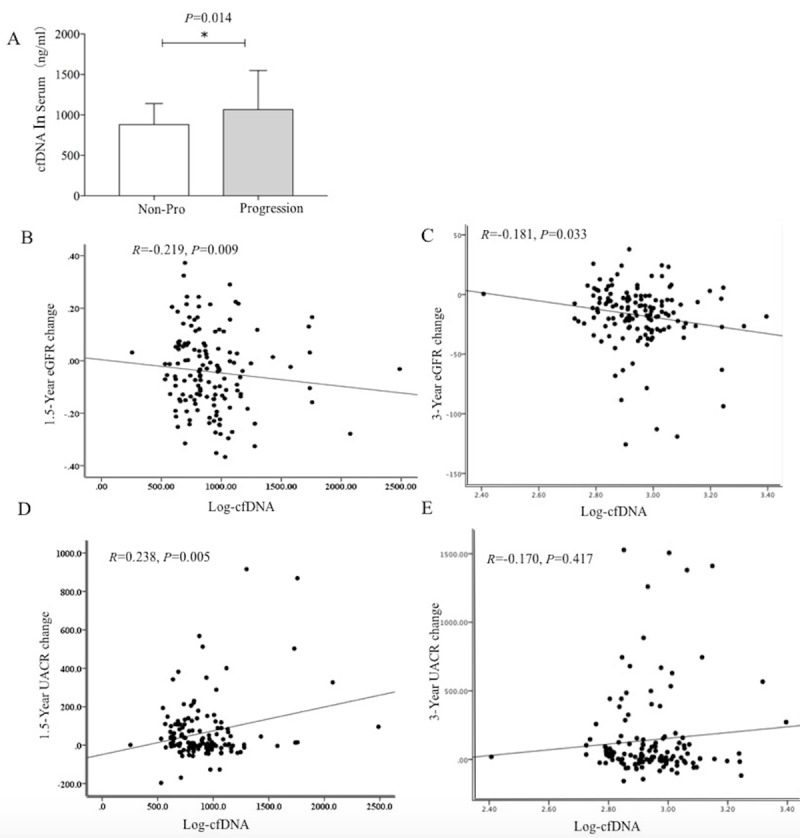
In total, 131 patients finished all the follow-up visits. At the end of the study, 64 patients showed decreased eGFR and 29 patients had changes of UACR from less than 300 mg/g at baseline to higher than 300 mg/g at follow-up. At baseline, the progression group had higher serum cfDNA levels than the non-progression group (960.49 (816.53, 1073.65) ng/mL vs 824.51 (701.34, 987.06) ng/mL, p=0.014). Serum cfDNA levels were significantly negatively associated with the 1.5-year eGFR change (r=-0.219 p=0.009) and 3-year eGFR change (r=-0.181, p=0.043). Multivariate logistic analyses showed that after adjustment of age, gender, body mass index, fast plasma glucose, smoking, triglycerides, total cholesterol, duration of diabetes, systolic blood pressure, diabetic retinopathy, eGFR, high sensitivity C-reactive protein, angiotensin receptor blocker/ACE inhibitor usage, with the increase of one SD of serum cfDNA levels, the risk of DKD progression increased by 2.4 times (OR, 2.46; 95% CI 1.84 to 4.89).
Serum cfDNA is closely associated with DKD, and it might be a predictor of DKD progression in patients with type 2 diabetes.
游离 DNA(cfDNA)与糖尿病和心血管疾病相关。本研究旨在评估血清 cfDNA 是否可预测糖尿病肾病(DKD)的进展。
在这项前瞻性研究中,共纳入 160 例 DKD 患者,连续 3 年通过估计肾小球滤过率(eGFR)和尿白蛋白-肌酐比(UACR)来随访肾功能。在基线时测量血清 cfDNA 浓度。DKD 进展定义为 eGFR 连续下降 2 次,且 UACR 从基线时的<300 mg/g 变为随访时的>300 mg/g。采用回归模型分析血清 cfDNA 与 DKD 进展的相关性。
共 131 例患者完成了所有随访。研究结束时,64 例患者 eGFR 下降,29 例患者 UACR 从基线时的<300 mg/g 变为随访时的>300 mg/g。基线时,进展组的血清 cfDNA 水平高于非进展组(960.49(816.53,1073.65)ng/mL 比 824.51(701.34,987.06)ng/mL,p=0.014)。血清 cfDNA 水平与 1.5 年 eGFR 变化(r=-0.219,p=0.009)和 3 年 eGFR 变化(r=-0.181,p=0.043)呈显著负相关。多变量逻辑分析表明,在校正年龄、性别、体重指数、空腹血糖、吸烟、甘油三酯、总胆固醇、糖尿病病程、收缩压、糖尿病视网膜病变、eGFR、高敏 C 反应蛋白、血管紧张素受体阻滞剂/血管紧张素转换酶抑制剂使用后,血清 cfDNA 水平每增加一个标准差,DKD 进展的风险增加 2.4 倍(OR,2.46;95%CI 1.84 至 4.89)。
血清 cfDNA 与 DKD 密切相关,可能是 2 型糖尿病患者 DKD 进展的预测因子。