Division of Molecular Medicine, Boston Children's Hospital, and Department of Pediatrics, Harvard Medical School, Boston, MA, USA.
ICCB-Longwood Screening Facility, Harvard Medical School, Boston, MA, USA.
Nat Chem Biol. 2020 May;16(5):529-537. doi: 10.1038/s41589-020-0496-y. Epub 2020 Mar 9.
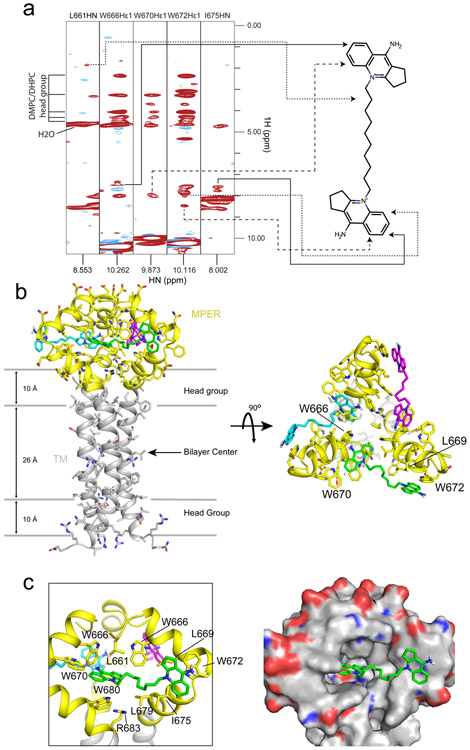
Combination antiretroviral therapy has transformed HIV-1 infection, once a fatal illness, into a manageable chronic condition. Drug resistance, severe side effects and treatment noncompliance bring challenges to combination antiretroviral therapy implementation in clinical settings and indicate the need for additional molecular targets. Here, we have identified several small-molecule fusion inhibitors, guided by a neutralizing antibody, against an extensively studied vaccine target-the membrane proximal external region (MPER) of the HIV-1 envelope spike. These compounds specifically inhibit the HIV-1 envelope-mediated membrane fusion by blocking CD4-induced conformational changes. An NMR structure of one compound complexed with a trimeric MPER construct reveals that the compound partially inserts into a hydrophobic pocket formed exclusively by the MPER residues, thereby stabilizing its prefusion conformation. These results suggest that the MPER is a potential therapeutic target for developing fusion inhibitors and that strategies employing an antibody-guided search for novel therapeutics may be applied to other human diseases.
联合抗逆转录病毒疗法改变了 HIV-1 感染,曾经是一种致命的疾病,变成了一种可控制的慢性疾病。耐药性、严重的副作用和治疗不依从性给临床实施联合抗逆转录病毒疗法带来了挑战,这表明需要额外的分子靶点。在这里,我们根据针对 HIV-1 包膜刺突的广泛研究的疫苗靶点——膜近端外部区(MPER),设计了几种小分子融合抑制剂,由中和抗体指导。这些化合物通过阻断 CD4 诱导的构象变化特异性抑制 HIV-1 包膜介导的膜融合。一种化合物与三聚体 MPER 构建体复合物的 NMR 结构表明,该化合物部分插入由 MPER 残基形成的疏水性口袋中,从而稳定其融合前构象。这些结果表明,MPER 是开发融合抑制剂的潜在治疗靶点,并且采用抗体指导寻找新型治疗药物的策略可能适用于其他人类疾病。