Dixit S P, Singh Sanjeev, Ganguly Indrajit, Bhatia Avnish Kumar, Sharma Anurodh, Kumar N Anand, Dang Ajay Kumar, Jayakumar S
Animal Genetics Division, ICAR-National Bureau of Animal Genetic Resources, Karnal, India.
Animal Genetics & Breeding Division, ICAR-National Dairy Research Institute, Karnal, India.
Front Genet. 2020 Feb 21;11:92. doi: 10.3389/fgene.2020.00092. eCollection 2020.
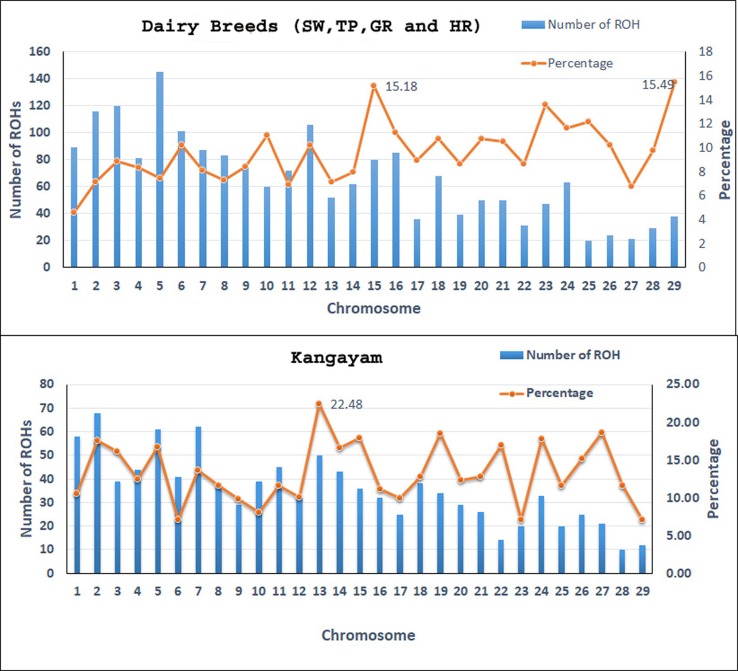
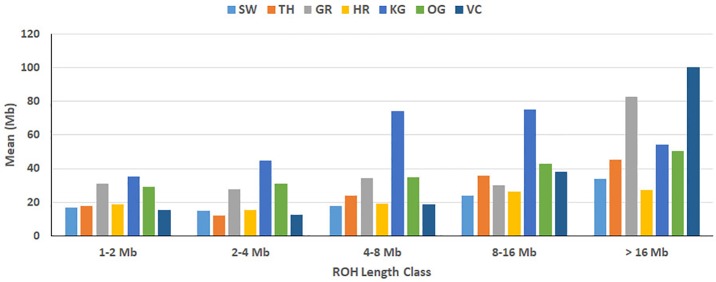
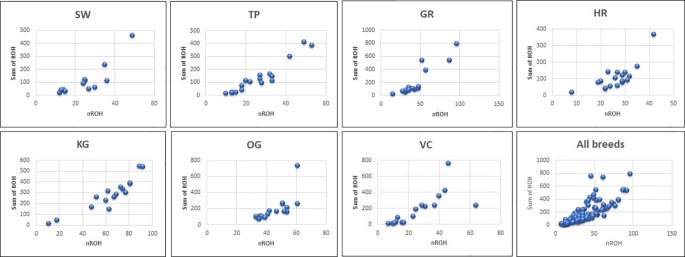
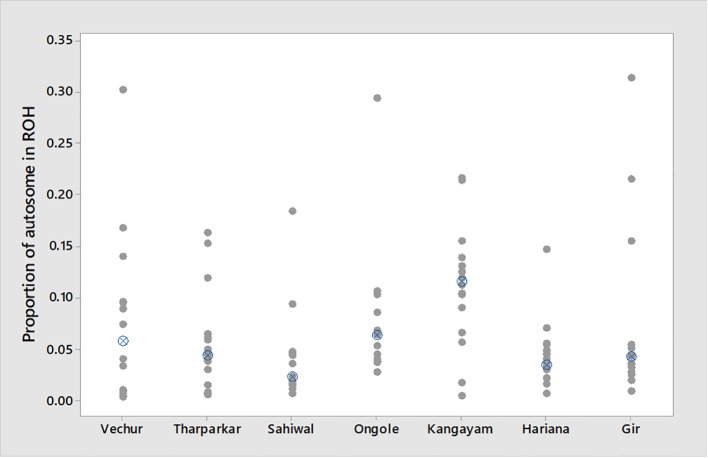
Genome-wide runs of homozygosity (ROH) are suitable for understanding population history, calculating genomic inbreeding, deciphering genetic architecture of complex traits and diseases as well as identifying genes linked with agro-economic traits. Autozygosity and ROH islands, genomic regions with elevated ROH frequencies, were characterized in 112 animals of seven Indian native cattle breeds () using BovineHD BeadChip. In total, 4138 ROH were detected. The average number of ROH per animal was maximum in draft breed, Kangayam (63.62 ± 22.71) and minimum in dairy breed, Sahiwal (24.62 ± 11.03). The mean ROH length was maximum in Vechur (6.97 Mb) and minimum in Hariana (4.04 Mb). Kangayam revealed the highest ROH based inbreeding ( = 0.113 ± 0.059), whereas Hariana ( = 0.042 ± 0.031) and Sahiwal ( = 0.043 ± 0.048) showed the lowest. The high standard deviation observed in each breed highlights a considerable variability in autozygosity. Out of the total autozygous segments observed in each breed except Vechur, > 80% were of short length (< 8 Mb) and contributed almost 50% of the genome proportion under ROH. However, in Vechur cattle, long ROH contributed 75% of the genome proportion under ROH. ROH patterns revealed Hariana and Sahiwal breeds as less consanguineous, while recent inbreeding was apparent in Vechur. Maximum autozygosity observed in Kangayam is attributable to both recent and ancient inbreeding. The ROH islands were harbouring higher proportion of QTLs for production traits (20.68% vs. 14.64%; P≤ 0.05) but lower for reproductive traits (11.49% vs. 15.76%; P≤ 0.05) in dairy breeds compared to draft breed. In draft cattle, genes associated with resistant to diseases/higher immunity ( and ) and stress tolerant () were identified in ROH islands; while in dairy breeds, for milk production ( and ). Significant difference in ROH islands among large and short statured breeds was observed at chromosome 3 and 5 involving genes like and responsible for milk production and stature, respectively. PCA analysis on consensus ROH regions revealed distinct clustering of dairy, draft and short stature cattle breeds.
全基因组纯合子连续片段(ROH)适用于了解种群历史、计算基因组近亲繁殖系数、解读复杂性状和疾病的遗传结构以及鉴定与农业经济性状相关的基因。利用牛HD基因分型芯片对7个印度本土牛品种的112头动物的纯合性和ROH岛(ROH频率升高的基因组区域)进行了特征分析。总共检测到4138个ROH。役用品种康盖亚姆牛每头动物的ROH平均数量最多(63.62±22.71),乳用品种萨希瓦尔牛最少(24.62±11.03)。韦库尔牛的平均ROH长度最长(6.97 Mb),哈里亚纳牛最短(4.04 Mb)。康盖亚姆牛的ROH近亲繁殖系数最高(FROH = 0.113±0.059),而哈里亚纳牛(FROH = 0.042±0.031)和萨希瓦尔牛(FROH = 0.043±0.048)最低。每个品种中观察到的高标准差突出了纯合性的显著变异性。在除韦库尔牛之外的每个品种中观察到的总纯合片段中,超过80%的片段长度较短(<8 Mb),并且在ROH下占基因组比例的近50%。然而,在韦库尔牛中,长ROH在ROH下占基因组比例的75%。ROH模式显示,哈里亚纳牛和萨希瓦尔牛品种的近亲繁殖程度较低,而韦库尔牛中近期近亲繁殖较为明显。在康盖亚姆牛中观察到的最大纯合性归因于近期和古代的近亲繁殖。与役用品种相比,乳用品种的ROH岛中生产性状的QTL比例更高(20.68%对14.64%;P≤0.05),但繁殖性状的QTL比例更低(11.49%对15.76%;P≤0.05)。在役用牛中,在ROH岛中鉴定出与抗病/高免疫力(TLR4和IL1B)和耐应激(HSP90AA1)相关的基因;而在乳用品种中,鉴定出与产奶量(CSN1S1和CSN2)相关的基因。在第3号和第5号染色体上观察到大型和矮小型品种之间ROH岛的显著差异,分别涉及与产奶量和身高相关的GHR和PLAG1等基因。基于共有ROH区域的主成分分析揭示了乳用、役用和矮小型牛品种的明显聚类。