Ryan Thomas D, Border William L, Baker-Smith Carissa, Barac Ana, Bock Matthew J, Canobbio Mary M, Choueiter Nadine F, Chowdhury Devyani, Gambetta Katheryn E, Glickstein Julie S, Kondapalli Lavanya, Mital Seema, Peiris Vasum, Schiff Russell J, Spicer Robert L, Towbin Jeffrey A, Chen Ming Hui
Heart Institute, Cincinnati Children's Hospital, University of Cincinnati College of Medicine, 3333 Burnet Ave, MLC 2003, Cincinnati, OH 45229 USA.
2Children's Sibley Heart Center, Children's Healthcare of Atlanta, Atlanta, GA USA.
Cardiooncology. 2019 Oct 23;5:16. doi: 10.1186/s40959-019-0051-8. eCollection 2019.
To enhance the understanding of cardiovascular care delivery in childhood cancer patients and survivors.
A 20-question survey was created by the Pediatric Cardio-oncology Work Group of the American College of Cardiology (ACC) Cardio-oncology Section to assess the care, management, and surveillance tools utilized to manage pediatric/young adult cardio-oncology patients. The survey distribution was a collaborative effort between Cardio-oncology Section and membership of the Adult Congenital and Pediatric Cardiology Section (ACPC) of the ACC.
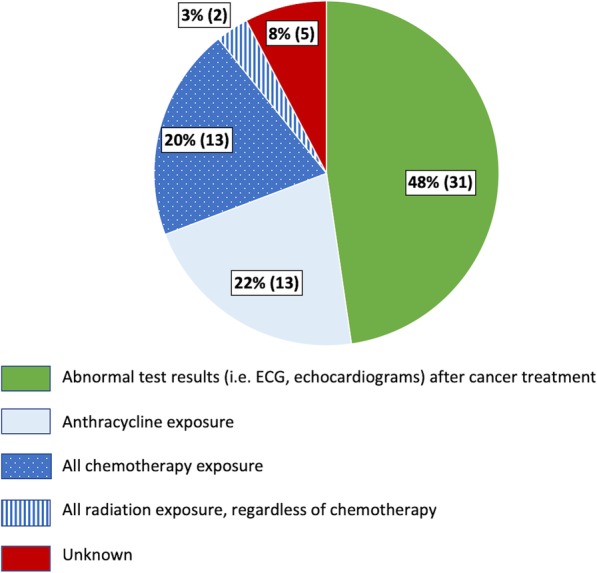
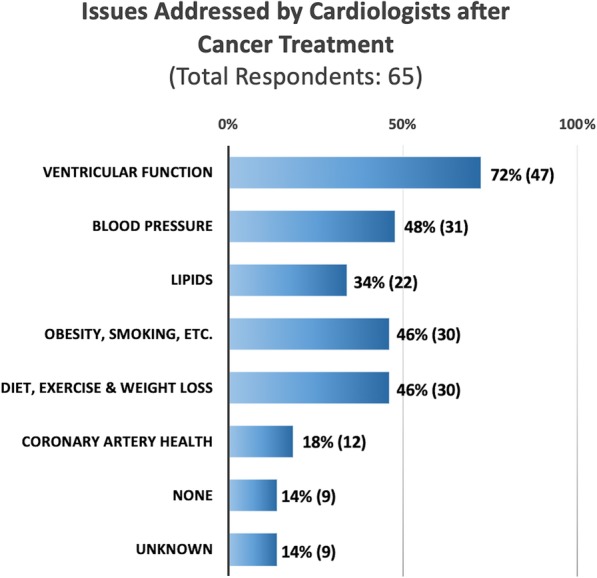
Sixty-five individuals, all self-identified as physicians, responded to the survey. Most respondents ( = 58,89%) indicated childhood cancer patients are regularly screened prior to and during cancer therapy at their centers, predominantly by electrocardiogram (75%), standard echocardiogram (58%) and advanced echocardiogram (50%) (i.e. strain, stress echo). Evaluation by a cardiologist prior to/during therapy was reported by only 8(12%) respondents, as compared to post-therapy which was reported by 28 (43%, < 0.01). The most common indications for referral to cardiology at pediatric centers were abnormal test results ( = 31,48%) and history of chemotherapy exposure ( = 27,42%). Of note, during post-treatment counseling, common cardiovascular risk-factors like blood pressure (31,48%), lipid control (22,34%), obesity & smoking (30,46%) and diet/exercise/weight loss (30,46%) were addressed by fewer respondents than was LV function (72%).
The survey data demonstrates that pediatric cancer patients are being screened by EKG and/or imaging prior to/during therapy at most centers. Our data, however, highlight the potential for greater involvement of a cardiovascular specialist for pre-treatment evaluation process, and for more systematic cardiac risk factor counseling in posttreatment cancer survivors.
增强对儿童癌症患者及其幸存者心血管护理的理解。
美国心脏病学会(ACC)心脏肿瘤学分会的儿科心脏肿瘤学工作组编制了一份包含20个问题的调查问卷,以评估用于管理儿科/青年成人心脏肿瘤学患者的护理、管理和监测工具。该调查问卷的分发是ACC心脏肿瘤学分会与成人先天性和儿科心脏病学分会(ACPC)成员共同努力的结果。
65名均自称医生的人员回复了该调查问卷。大多数受访者(n = 58, 89%)表示,儿童癌症患者在其中心接受癌症治疗之前和期间会定期接受筛查,主要通过心电图(75%)、标准超声心动图(58%)和高级超声心动图(50%)(即应变、负荷超声心动图)。只有8名(12%)受访者报告在治疗前/治疗期间由心脏病专家进行评估,而治疗后由28名(43%,P < 0.01)受访者报告。儿科中心转诊至心脏病科最常见的指征是检查结果异常(n = 31, 48%)和化疗暴露史(n = 27, 42%)。值得注意的是,在治疗后咨询期间,与左心室功能(72%)相比,较少有受访者提及常见的心血管危险因素,如血压(31, 48%)、血脂控制(22, 34%)、肥胖与吸烟(30, 46%)以及饮食/运动/体重减轻(30, 46%)。
调查数据表明,大多数中心在治疗前/治疗期间通过心电图和/或影像学对儿童癌症患者进行筛查。然而,我们的数据凸显了心血管专科医生在治疗前评估过程中更大程度参与的潜力,以及在癌症治疗后幸存者中进行更系统的心脏危险因素咨询的潜力。