Funkquist Anders, Bengtsson Anders, Johansson P M, Svensson Johan, Bjellerup Per, Blennow Kaj, Wandt Birger, Sjöberg Stefan
Dpt. of Medicine, Halland Central Hospital, Halmstad, Sweden.
Dpt. of Medicine, Karolinska Institutet, Karolinska University Hospital Huddinge, Stockholm, Sweden.
J Clin Transl Endocrinol. 2020 Feb 4;19:100218. doi: 10.1016/j.jcte.2020.100218. eCollection 2020 Mar.
BACKGROUND & OBJECTIVE: Patients with mild hypothyroidism often are depressed and have impaired quality of life despite serum free-T4 and T3 within reference values. Therefore, we investigated whether their symptoms were dependent on the concentrations of free -T4 and T3 in the circulation and cerebrospinal fluid (CSF).
Twenty-five newly diagnosed, untreated hypothyroid subjects and as many age- and sex-matched healthy controls were investigated. Blood and CSF sampling was performed in the morning after an overnight fast. Quality of life (QoL) was assessed by a Likert scale. In the hypothyroid subjects, the MADRS rating scale was also used to evaluate symptoms of depression. Furthermore, the results obtained by the questionnaires were related to serum and CSF levels of free- T4 and T3 as well as the ratios between them in CSF and in serum.
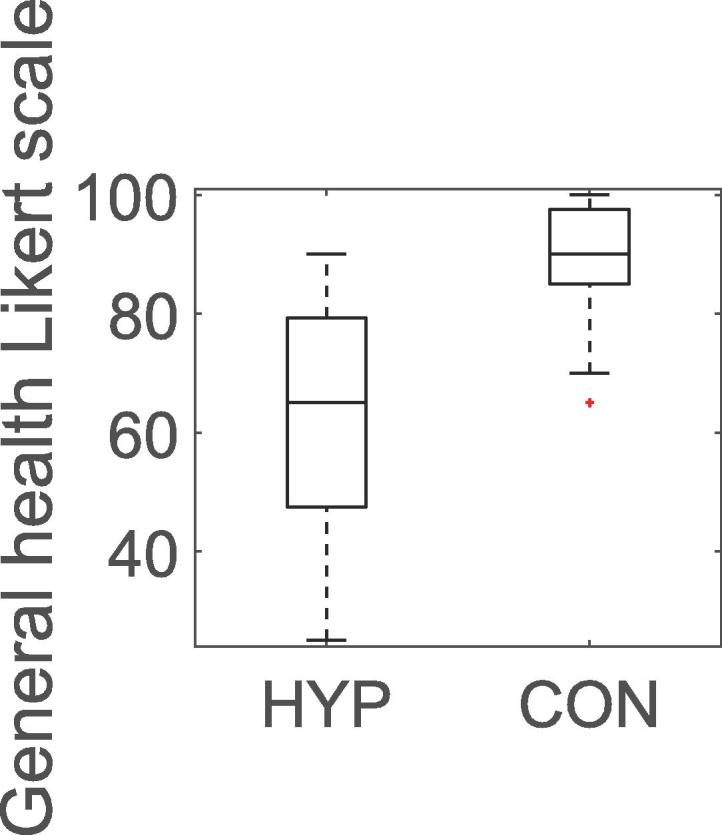
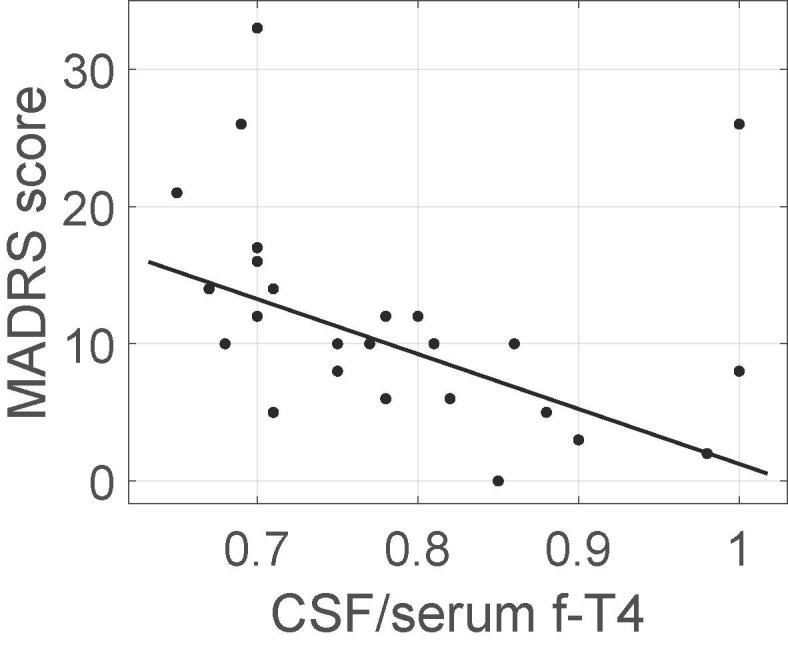
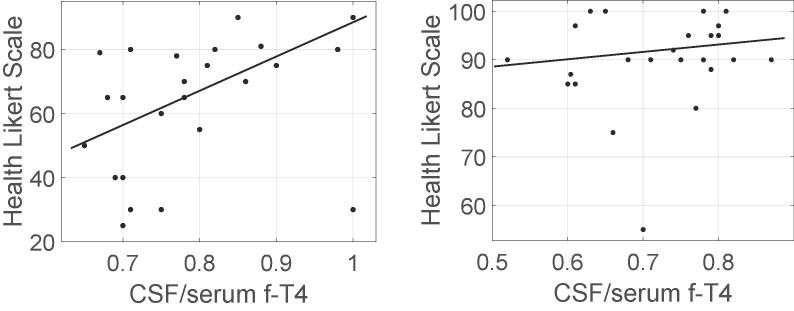
Self-reported health was considerably lower in hypothyroid subjects. MADRS was considerably higher than the normal range for healthy individuals. Low CSF/serum free-T4 ratio was correlated with an increased depressed state according to MADRS (p < 0.01), and in addition, CSF/serum free-T4 ratio correlated positively with the self-reported general health Likert scale (p < 0.05). Concentrations of TSH, or free-T3 in serum or CSF, were not associated with an increased depressed state or self-reported general health.
Low CSF/serum ratio of free-T4 was correlated with impaired general health and mood, in contrast to serum measurements not showing any correlations. These findings might partly explain why some patients with hypothyroidism suffer from mental symptoms, despite adequate serum levels of free-T4. However, the findings need to be confirmed in further and larger studies.
轻度甲状腺功能减退患者尽管血清游离T4和T3在参考值范围内,但常出现抑郁且生活质量受损。因此,我们研究了他们的症状是否取决于循环和脑脊液(CSF)中游离T4和T3的浓度。
对25名新诊断、未治疗的甲状腺功能减退受试者以及25名年龄和性别匹配的健康对照者进行研究。在禁食过夜后的早晨采集血液和脑脊液样本。生活质量(QoL)通过李克特量表进行评估。在甲状腺功能减退受试者中,还使用蒙哥马利-艾森伯格抑郁量表(MADRS)来评估抑郁症状。此外,问卷结果与血清和脑脊液中游离T4和T3的水平以及它们在脑脊液和血清中的比值相关。
甲状腺功能减退受试者自我报告的健康状况明显较低。MADRS评分明显高于健康个体的正常范围。根据MADRS,脑脊液/血清游离T4比值低与抑郁状态增加相关(p<0.01),此外,脑脊液/血清游离T4比值与自我报告的总体健康李克特量表呈正相关(p<0.05)。血清或脑脊液中促甲状腺激素(TSH)或游离T3的浓度与抑郁状态增加或自我报告的总体健康无关。
与血清测量未显示任何相关性相反,脑脊液/血清游离T4比值低与总体健康和情绪受损相关。这些发现可能部分解释了为什么一些甲状腺功能减退患者尽管血清游离T4水平充足,但仍有精神症状。然而,这些发现需要在进一步的大型研究中得到证实。