Livingston Katie, Schlaak Rachel A, Puckett Lindsay L, Bergom Carmen
Department of Radiation Oncology, Medical College of Wisconsin, Milwaukee, WI, United States.
Cancer Center, Medical College of Wisconsin, Milwaukee, WI, United States.
Front Cardiovasc Med. 2020 Feb 21;7:20. doi: 10.3389/fcvm.2020.00020. eCollection 2020.
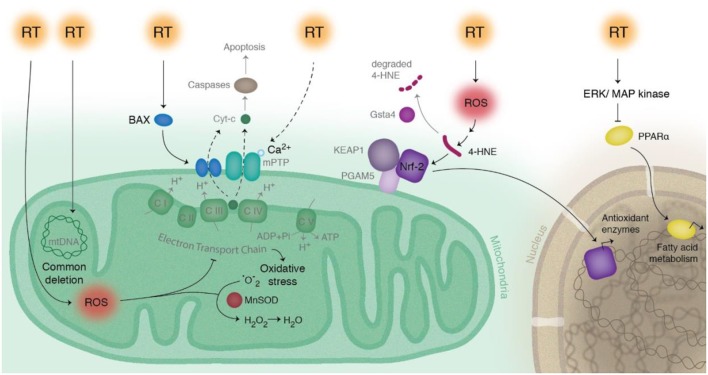
Radiation is a key modality in the treatment of many cancers; however, it can also affect normal tissues adjacent to the tumor, leading to toxic effects. Radiation to the thoracic region, such as that received as part of treatment for breast and lung cancer, can result in incidental dose to the heart, leading to cardiac dysfunction, such as pericarditis, coronary artery disease, ischemic heart disease, conduction defects, and valvular dysfunction. The underlying mechanisms for these morbidities are currently being studied but are not entirely understood. There has been increasing focus on the role of radiation-induced mitochondrial dysfunction and the ensuing impact on various cardiac functions in both preclinical models and in humans. Cardiomyocyte mitochondria are critical to cardiac function, and mitochondria make up a substantial part of a cardiomyocyte's volume. Mitochondrial dysfunction can also alter other cell types in the heart. This review summarizes several factors related to radiation-induced mitochondrial dysfunction in cardiomyocytes and endothelial cells. These factors include mitochondrial DNA mutations, oxidative stress, alterations in various mitochondrial function-related transcription factors, and apoptosis. Through improved understanding of mitochondria-dependent mechanisms of radiation-induced heart dysfunction, potential therapeutic targets can be developed to assist in prevention and treatment of radiation-induced heart damage.
放射治疗是许多癌症治疗的关键手段;然而,它也会影响肿瘤附近的正常组织,从而产生毒性作用。胸部区域的放疗,如作为乳腺癌和肺癌治疗一部分所接受的放疗,会导致心脏受到附带剂量照射,进而引发心脏功能障碍,如心包炎、冠状动脉疾病、缺血性心脏病、传导缺陷和瓣膜功能障碍。目前正在研究这些病症的潜在机制,但尚未完全了解。在临床前模型和人类研究中,人们越来越关注辐射诱导的线粒体功能障碍及其对各种心脏功能的后续影响。心肌细胞线粒体对心脏功能至关重要,线粒体占心肌细胞体积的很大一部分。线粒体功能障碍也会改变心脏中的其他细胞类型。本综述总结了与辐射诱导的心肌细胞和内皮细胞线粒体功能障碍相关的几个因素。这些因素包括线粒体DNA突变、氧化应激、各种线粒体功能相关转录因子的改变以及细胞凋亡。通过更好地理解辐射诱导心脏功能障碍的线粒体依赖性机制,可以开发出潜在的治疗靶点,以协助预防和治疗辐射诱导的心脏损伤。