Schneider-Smith Elisabeth, Salottolo Kristin, Swartwood Claire, Melvin Casey, Madayag Robert M, Bar-Or David
Pharmacy Department, St. Anthony Hospital and Medical Campus, Lakewood, Colorado, USA.
Trauma Research Department, St. Anthony Hospital and Medical Campus, Lakewood, Colorado, USA.
Trauma Surg Acute Care Open. 2020 Feb 9;5(1):e000391. doi: 10.1136/tsaco-2019-000391. eCollection 2020.
To determine whether adjunctive dronabinol, a licensed form of delta-9-tetrahydrocannabinol, reduces opioid consumption when used off-label for managing acute pain following traumatic injury.
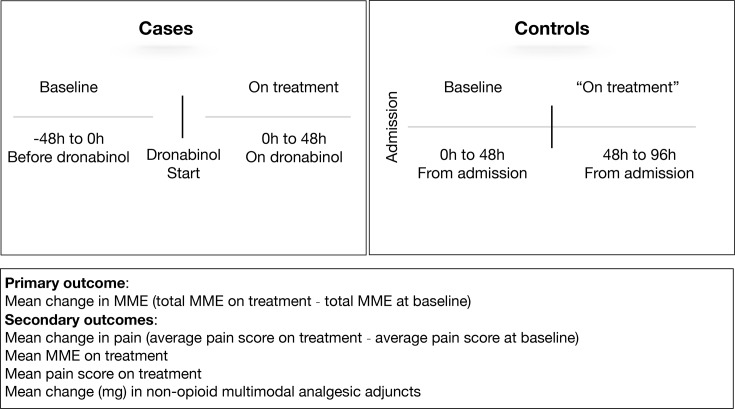
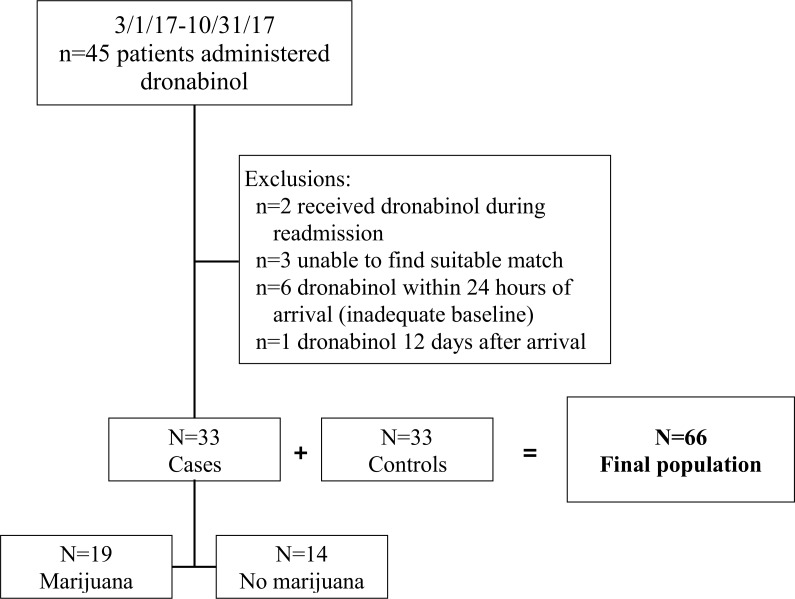
This matched cohort study included patients who were admitted with a traumatic injury between 1 March 2017 and 30 October 2017. The hospital pharmacy database was used to identify patients who received dronabinol (cases), and they were matched 1:1 to patients who did not receive dronabinol (controls) using age, cause of injury and hospital length of stay. The primary outcome, change in opioid consumption, was calculated using morphine milligram equivalents (MME). The change in MME was calculated for cases as total MME over 48 hours with adjunctive dronabinol minus 48 hours prior to dronabinol, and for controls as total MME 48-96 hours from admission minus 0-48 hours from admission. Data are presented as mean and SE or median and IQR. Statistical analysis was performed using paired t-tests and McNemar's tests.
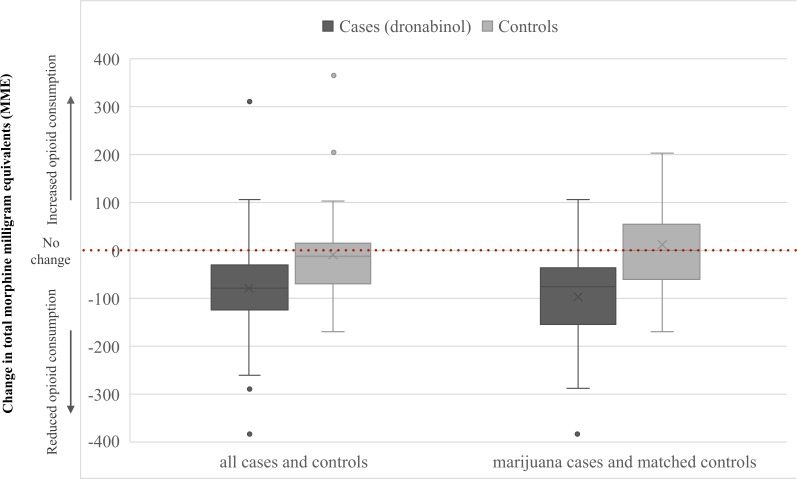
There were 66 patients included: 33 cases and 33 matched controls. Dronabinol was initiated 55 (28-107) hours from admission. Cases and controls were well matched. Cases had a significant reduction in opioid consumption with adjunctive dronabinol (-79 (20) MME, p<0.001), while opioid consumption was unchanged for controls (-9 (20) MME, p=0.63). This resulted in a ninefold greater reduction in opioid consumption for cases versus controls that was statistically different between pairs (p=0.02). Nineteen (58%) cases reported using marijuana; in this subset, opioid consumption was reduced with adjunctive dronabinol (-97 (24) MME, p<0.001) versus a non-significant increase in opioid consumption in matched controls (11 (29) MME, p=0.70); difference between groups, p=0.01.
The results of this study suggest adjunctive dronabinol reduces opioid consumption following traumatic injury. The opioid-sparing effect of dronabinol may be greater in patients who are marijuana users.
III.
确定许可形式的δ-9-四氢大麻酚(屈大麻酚)在用于治疗创伤性损伤后的急性疼痛时,作为辅助用药能否减少阿片类药物的使用量。
这项匹配队列研究纳入了2017年3月1日至2017年10月30日期间因创伤性损伤入院的患者。利用医院药房数据库识别接受屈大麻酚治疗的患者(病例组),并根据年龄、损伤原因和住院时间将他们与未接受屈大麻酚治疗的患者(对照组)1:1匹配。主要结局指标为阿片类药物使用量的变化,使用吗啡毫克当量(MME)进行计算。病例组MME的变化计算为辅助使用屈大麻酚后48小时内的总MME减去使用屈大麻酚前48小时的MME,对照组MME的变化计算为入院后48 - 96小时的总MME减去入院后0 - 48小时的MME。数据以均值和标准误或中位数和四分位间距表示。采用配对t检验和McNemar检验进行统计分析。
共纳入66例患者:33例病例组和33例匹配的对照组。屈大麻酚在入院后55(28 - 107)小时开始使用。病例组和对照组匹配良好。病例组使用辅助屈大麻酚后阿片类药物使用量显著减少(-79(20)MME,p<0.001),而对照组阿片类药物使用量无变化(-9(20)MME,p = 0.63)。这导致病例组阿片类药物使用量的减少幅度比对照组大9倍,两组之间差异有统计学意义(p = 0.02)。19例(58%)病例报告使用大麻;在这个亚组中,辅助使用屈大麻酚后阿片类药物使用量减少(-97(24)MME,p<0.001),而匹配对照组阿片类药物使用量无显著增加(11(29)MME,p = 0.70);两组之间差异,p = 0.01。
本研究结果表明,辅助使用屈大麻酚可减少创伤性损伤后的阿片类药物使用量。屈大麻酚的阿片类药物节省效应在大麻使用者中可能更大。
III级