Freedman Barry I, Moxey-Mims Marva M, Alexander Amir A, Astor Brad C, Birdwell Kelly A, Bowden Donald W, Bowen Gordon, Bromberg Jonathan, Craven Timothy E, Dadhania Darshana M, Divers Jasmin, Doshi Mona D, Eidbo Elling, Fornoni Alessia, Gautreaux Michael D, Gbadegesin Rasheed A, Gee Patrick O, Guerra Giselle, Hsu Chi-Yuan, Iltis Ana S, Jefferson Nichole, Julian Bruce A, Klassen David K, Koty Patrick P, Langefeld Carl D, Lentine Krista L, Ma Lijun, Mannon Roslyn B, Menon Madhav C, Mohan Sumit, Moore J Brian, Murphy Barbara, Newell Kenneth A, Odim Jonah, Ortigosa-Goggins Mariella, Palmer Nicholette D, Park Meyeon, Parsa Afshin, Pastan Stephen O, Poggio Emilio D, Rajapakse Nishadi, Reeves-Daniel Amber M, Rosas Sylvia E, Russell Laurie P, Sawinski Deirdre, Smith S Carrie, Spainhour Mitzie, Stratta Robert J, Weir Matthew R, Reboussin David M, Kimmel Paul L, Brennan Daniel C
Department of Internal Medicine, Section on Nephrology, Wake Forest School of Medicine, Winston-Salem, North Carolina, USA.
Division of Nephrology, Children's National Health System, Washington, DC, USA.
Kidney Int Rep. 2019 Dec 13;5(3):278-288. doi: 10.1016/j.ekir.2019.11.022. eCollection 2020 Mar.
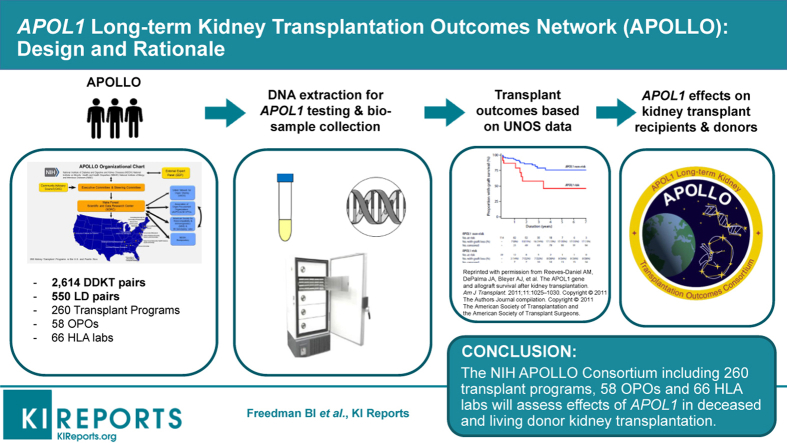
Much of the higher risk for end-stage kidney disease (ESKD) in African American individuals relates to ancestry-specific variation in the apolipoprotein L1 gene (). Relative to kidneys from European American deceased-donors, kidneys from African American deceased-donors have shorter allograft survival and African American living-kidney donors more often develop ESKD. The National Institutes of Health (NIH)-sponsored Long-term Kidney Transplantation Outcomes Network (APOLLO) is prospectively assessing kidney allograft survival from donors with recent African ancestry based on donor and recipient genotypes.
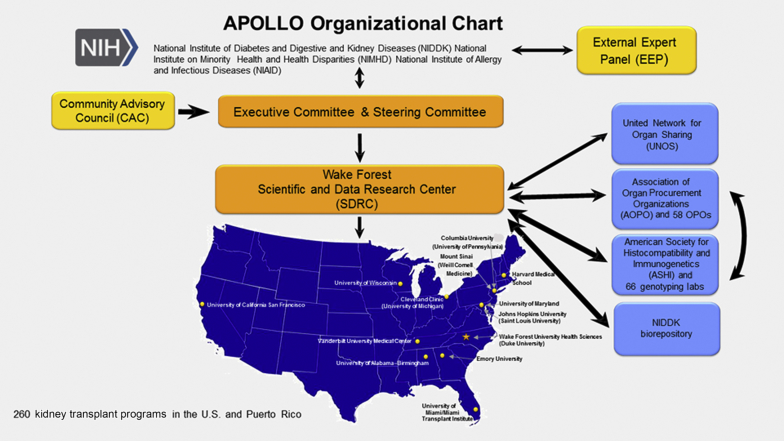
APOLLO will evaluate outcomes from 2614 deceased kidney donor-recipient pairs, as well as additional living-kidney donor-recipient pairs and unpaired deceased-donor kidneys.
The United Network for Organ Sharing (UNOS), Association of Organ Procurement Organizations, American Society of Transplantation, American Society for Histocompatibility and Immunogenetics, and nearly all U.S. kidney transplant programs, organ procurement organizations (OPOs), and histocompatibility laboratories are participating in this observational study. APOLLO employs a central institutional review board (cIRB) and maintains voluntary partnerships with OPOs and histocompatibility laboratories. A Community Advisory Council composed of African American individuals with a personal or family history of kidney disease has advised the NIH Project Office and Steering Committee since inception. UNOS is providing data for outcome analyses.
This article describes unique aspects of the protocol, design, and performance of APOLLO. Results will guide use of genotypic data to improve the assessment of quality in deceased-donor kidneys and could increase numbers of transplanted kidneys, reduce rates of discard, and improve the safety of living-kidney donation.
非裔美国人终末期肾病(ESKD)的高风险很大程度上与载脂蛋白L1基因()中特定于祖先的变异有关。相对于来自欧美已故供体的肾脏,来自非裔美国已故供体的肾脏移植存活率较低,并且非裔美国活体肾脏供体更常发展为ESKD。美国国立卫生研究院(NIH)资助的长期肾脏移植结果网络(APOLLO)正在基于供体和受体的基因型,前瞻性地评估具有近期非洲血统供体的肾脏移植存活率。
APOLLO将评估2614对已故肾脏供体 - 受体对以及额外的活体肾脏供体 - 受体对和未配对的已故供体肾脏的结果。
器官共享联合网络(UNOS)、器官采购组织协会、美国移植学会、美国组织相容性与免疫遗传学学会以及几乎所有美国肾脏移植项目、器官采购组织(OPO)和组织相容性实验室都参与了这项观察性研究。APOLLO采用中央机构审查委员会(cIRB),并与OPO和组织相容性实验室保持自愿合作关系。自项目启动以来,一个由有个人或家族肾病病史的非裔美国人组成的社区咨询委员会一直在为NIH项目办公室和指导委员会提供建议。UNOS正在提供用于结果分析的数据。
本文描述了APOLLO方案、设计和实施的独特方面。研究结果将指导基因型数据的使用,以改善对已故供体肾脏质量的评估,并可能增加移植肾脏的数量、降低丢弃率以及提高活体肾脏捐赠的安全性。