Division of Cardiology, Kangnam Sacred Heart Hospital, Hallym University Medical Center, Seoul, South Korea.
Division of Infection, Kangnam Sacred Heart Hospital, Hallym University Medical Center, Seoul, South Korea.
PLoS One. 2020 Mar 10;15(3):e0229563. doi: 10.1371/journal.pone.0229563. eCollection 2020.
Sepsis-induced cardiomyopathy (SIC) is known to show cardiac dysfunction in patients with sepsis. Both a decrease or an increase in ejection fraction (EF), an indicator of cardiac function, can occur. The purpose of this study was to identify factors associated with abnormal left ventricular (LV) function measured by EF in patients with sepsis in the intensive care unit (ICU).
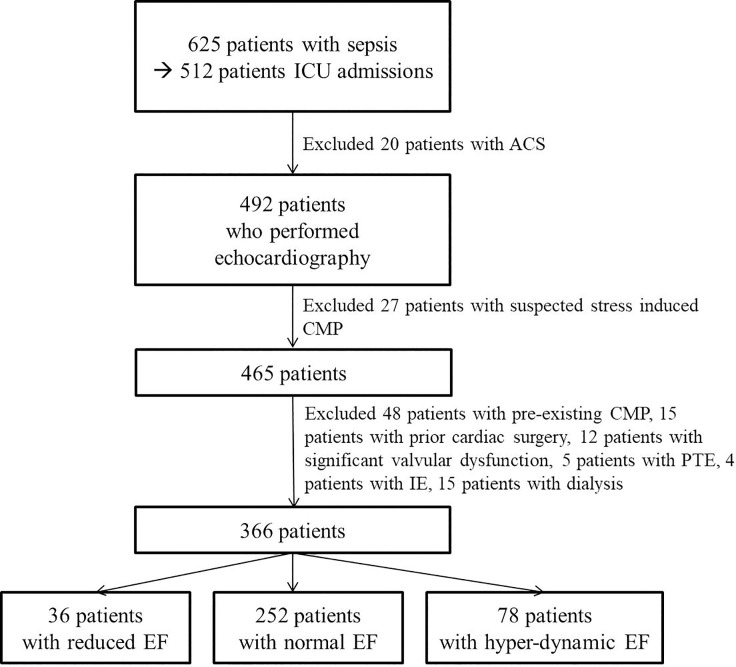
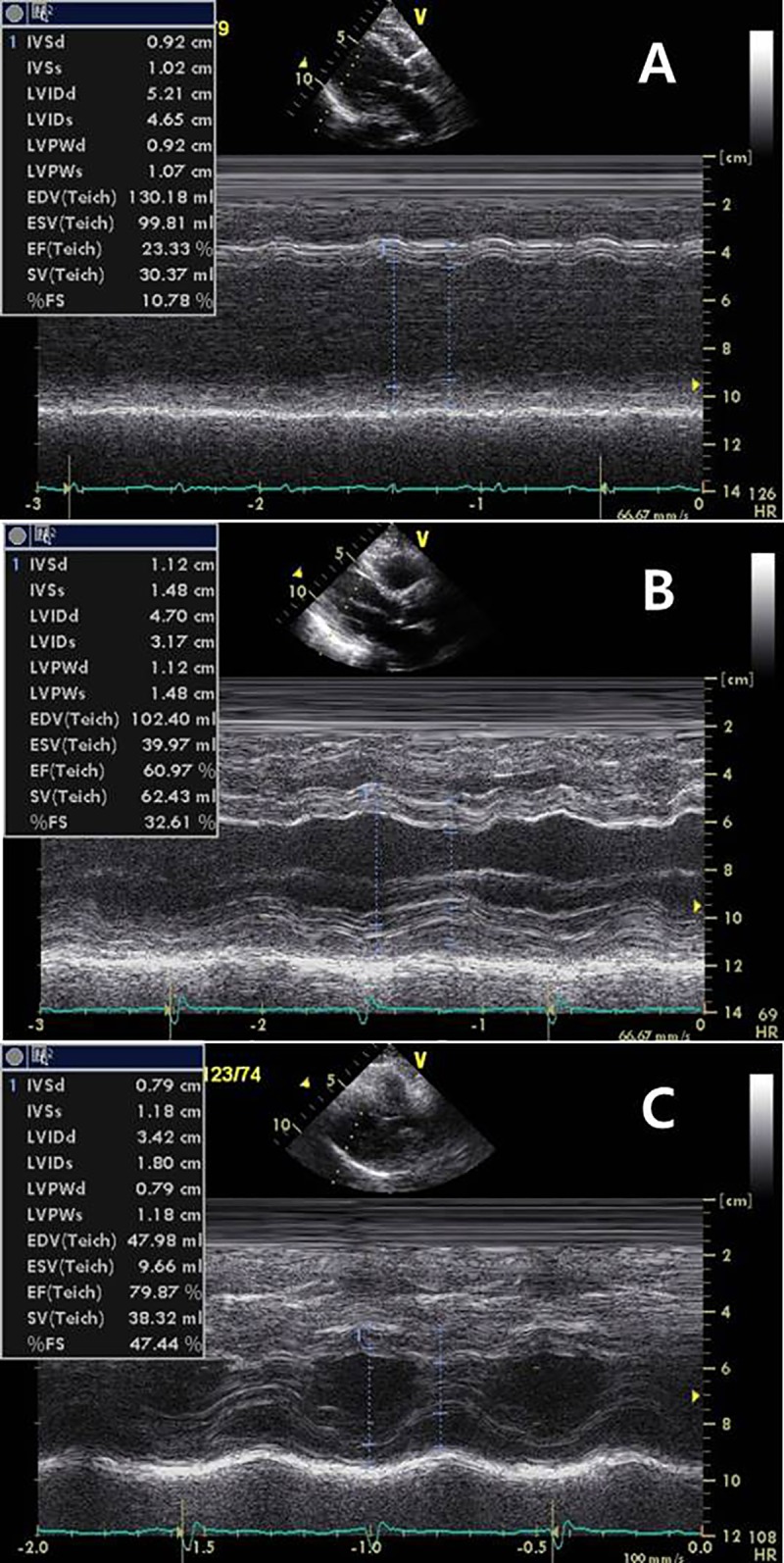
This was a retrospective study performed from November 2016 to December 2018. Three-hundred and sixty-six patients (mean age, 73 ± 13 years; 191 [52%] men) admitted to the ICU with sepsis were included. Patients were classified into three categories according to LV EF (group 1 -[EF<50%, n = 36], group 2 -[50≤EF<70%, n = 252], and group 3 -[EF≥70%, n = 78]). Echocardiographic assessment was performed within 48 hours of diagnosis of sepsis. We analyzed clinical factors including mortality, echocardiographic findings, and laboratory parameters.
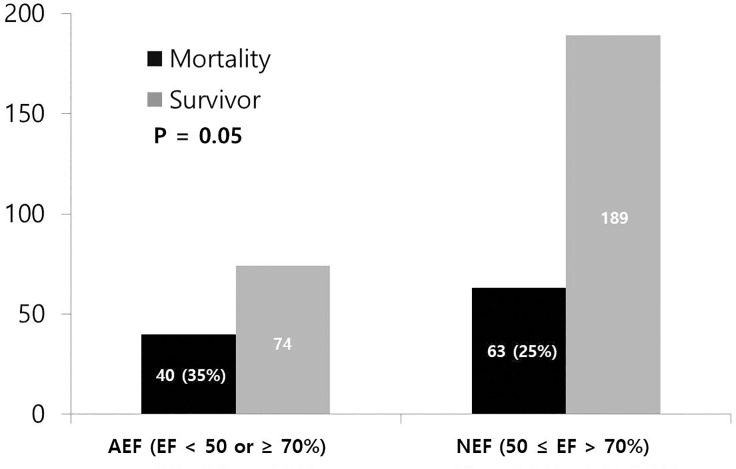
Decreased LV EF occurred in 36 (10%) patients and hyper-dynamic EF developed in 78 (21%) patients. Of 366 patients, 103 (28%) patients died. Baseline characteristics were similar in the three groups, except female sex an indicator of abnormal EF. Mortality rates were also similar in the three groups; however, mortality rates were significantly higher in patients with abnormal EF (decreased or increased vs. normal). Echocardiographic parameters were significantly different in the three groups, in terms of LV systolic parameters and chamber size. Small left atrium (LA) and small LV were significantly associated with abnormal EF (especially in patients with increased EF). High brain natriuretic peptide was associated with decreased EF. Among these factors, female sex and small LA were significantly associated with abnormal EF in the multiple regression analysis.
Our findings highlight that female sex and small cardiac size are associated with abnormal EF, and therefore, death. Therefore, female patients and patients with small LA should be monitored closely when they present with sepsis.
败血症性心肌病(SIC)是一种已知的败血症患者心功能障碍的疾病。射血分数(EF),即心功能的一个指标,可能会降低或升高。本研究的目的是确定 ICU 败血症患者 EF 测量的左心室(LV)功能异常相关因素。
这是一项回顾性研究,于 2016 年 11 月至 2018 年 12 月进行。共纳入 366 例(平均年龄 73 ± 13 岁;191[52%]例男性)因败血症入住 ICU 的患者。根据 LV EF 将患者分为三组(组 1-[EF<50%,n = 36]、组 2-[50≤EF<70%,n = 252]和组 3-[EF≥70%,n = 78])。败血症诊断后 48 小时内进行超声心动图评估。我们分析了包括死亡率、超声心动图发现和实验室参数在内的临床因素。
36(10%)例患者出现 LV EF 降低,78(21%)例患者出现高动力 EF。366 例患者中,103(28%)例患者死亡。三组患者的基线特征相似,除女性是异常 EF 的指标外。三组患者的死亡率相似,但 EF 异常(降低或升高与正常相比)患者的死亡率明显更高。三组患者的超声心动图参数,包括 LV 收缩参数和心室大小,均有显著差异。小左心房(LA)和小左心室与 EF 异常(尤其是 EF 升高的患者)显著相关。高脑利钠肽与 EF 降低相关。在这些因素中,多因素回归分析显示,女性和小 LA 与 EF 异常显著相关。
我们的研究结果表明,女性和心脏小是 EF 异常的相关因素,因此也是死亡的相关因素。因此,女性患者和 LA 较小的患者出现败血症时应密切监测。