Department of Emergency Medicine, Hualien Tzu Chi Hospital, Buddhist Tzu Chi Medical Foundation, Hualien, Taiwan.
Department of Emergency Medicine, Lin-Kou Medical Center, Chang Gung Memorial Hospital and College of Medicine, Chang Gung University, Taoyuan, Taiwan.
World J Emerg Surg. 2020 Mar 11;15(1):20. doi: 10.1186/s13017-020-00296-2.
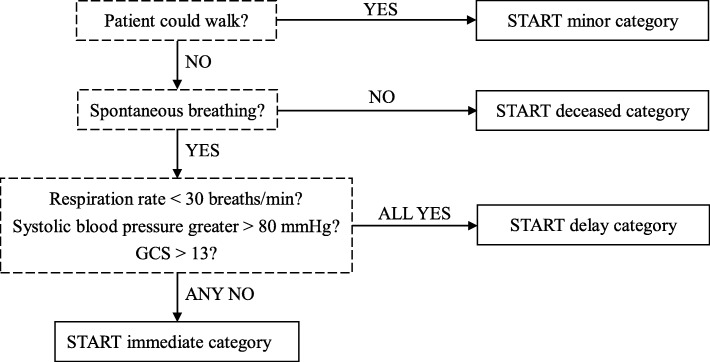
Triage plays a crucial role in the emergency department (ED) management of mass casualty incidents (MCIs) when resources are limited. This study aimed to compare the performance of simple triage and rapid treatment (START) with that of the Taiwan Triage and Acuity Scale (TTAS) for the ED triage of victims following an earthquake-related MCI.
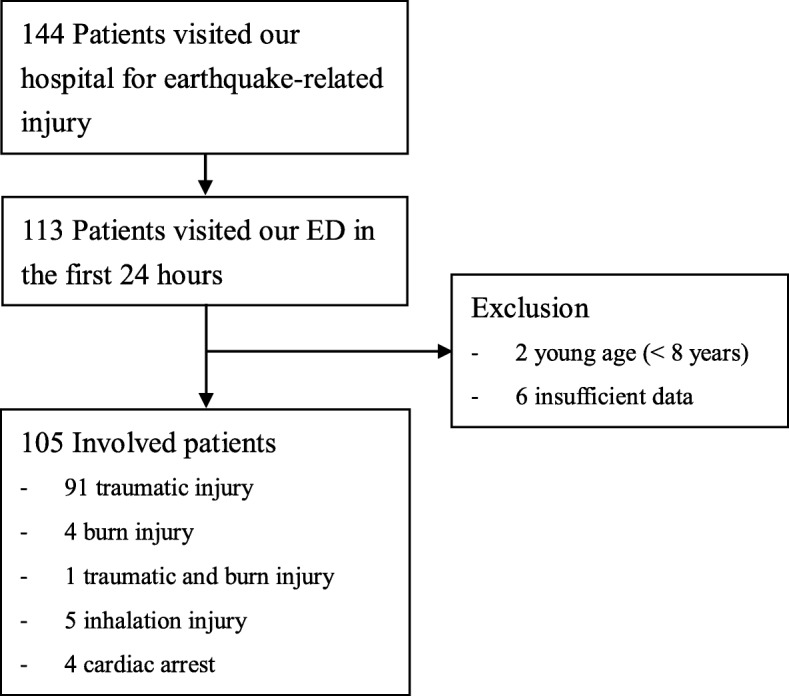
We retrospectively reviewed the records of victims presenting at our ED with earthquake-related injuries within 24 h of a large-scale earthquake. TTAS was initially used at our ED for this event, and START was performed by retrospectively reviewing the patient records in a blinded manner. Area under the receiver operating characteristic curve (AUC), sensitivity, and specificity of START and TTAS were determined for predicting ED discharge.
We enrolled 105 patients (predominantly women, 60.0%; median age, 45.0 years) in this study; most of them presented with traumatic injuries and were initially triaged as TTAS level III (78.1%), followed by TTAS level II (11.4%). Although the majority of the victims (81.0%) were discharged, four deaths occurred. A moderate agreement in differentiating emergency from nonemergency patients was observed between START and TTAS. Furthermore, both the triage systems showed similar predictions for ED disposition (START AUC/sensitivity/specificity: 0.709/82.35%/55.00%; TTAS AUC/sensitivity/specificity: 0.709/90.59%/45.00%).
The present study demonstrated that START and TTAS have similar triage accuracy and ability to predict ED disposition. Our findings demonstrate that START may be used as an alternative to TTAS for the ED triage of victims following earthquake-related MCIs.
在资源有限的情况下,分诊在急诊部门(ED)处理大规模伤亡事件(MCI)中起着至关重要的作用。本研究旨在比较简单分诊和快速治疗(START)与台湾分诊和严重度分级量表(TTAS)在地震相关 MCI 后 ED 分诊中的表现。
我们回顾性地审查了在大规模地震后 24 小时内,因地震受伤而到我们 ED 就诊的患者的记录。在这次事件中,TTAS 最初用于我们的 ED,而 START 则通过回顾性地以盲法审查患者的病历来进行。确定了 START 和 TTAS 预测 ED 出院的曲线下面积(AUC)、灵敏度和特异性。
本研究共纳入 105 名患者(主要为女性,占 60.0%;中位年龄为 45.0 岁);他们大多数因创伤而就诊,最初分诊为 TTAS 三级(78.1%),其次是 TTAS 二级(11.4%)。尽管大多数患者(81.0%)出院,但仍有 4 人死亡。START 和 TTAS 在区分急症和非急症患者方面具有中等程度的一致性。此外,两种分诊系统对 ED 处置的预测结果相似(START AUC/灵敏度/特异性:0.709/82.35%/55.00%;TTAS AUC/灵敏度/特异性:0.709/90.59%/45.00%)。
本研究表明,START 和 TTAS 具有相似的分诊准确性和预测 ED 处置的能力。我们的研究结果表明,在地震相关 MCI 后,START 可作为 TTAS 的替代方法用于 ED 分诊。