State Key Laboratory of Bioactive Substance and Function of Natural Medicines and Beijing Key Laboratory of Drug Target and Screening Research, Institute of Materia Medica of Peking Union Medical College, Beijing, 100050, China.
State Key Laboratory of Pharmaceutical Biotechnology, School of Biological Sciences, The University of Hong Kong, Hong Kong, China.
Biol Sex Differ. 2020 Mar 10;11(1):9. doi: 10.1186/s13293-020-00287-7.
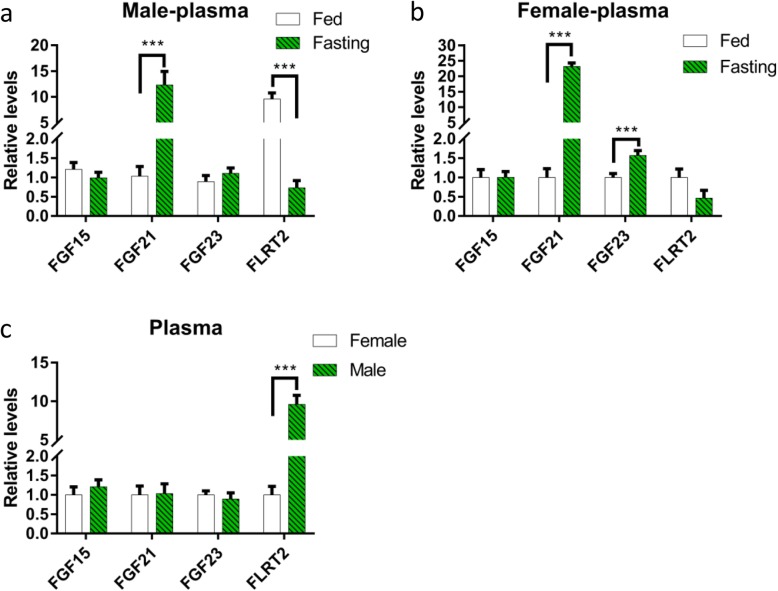
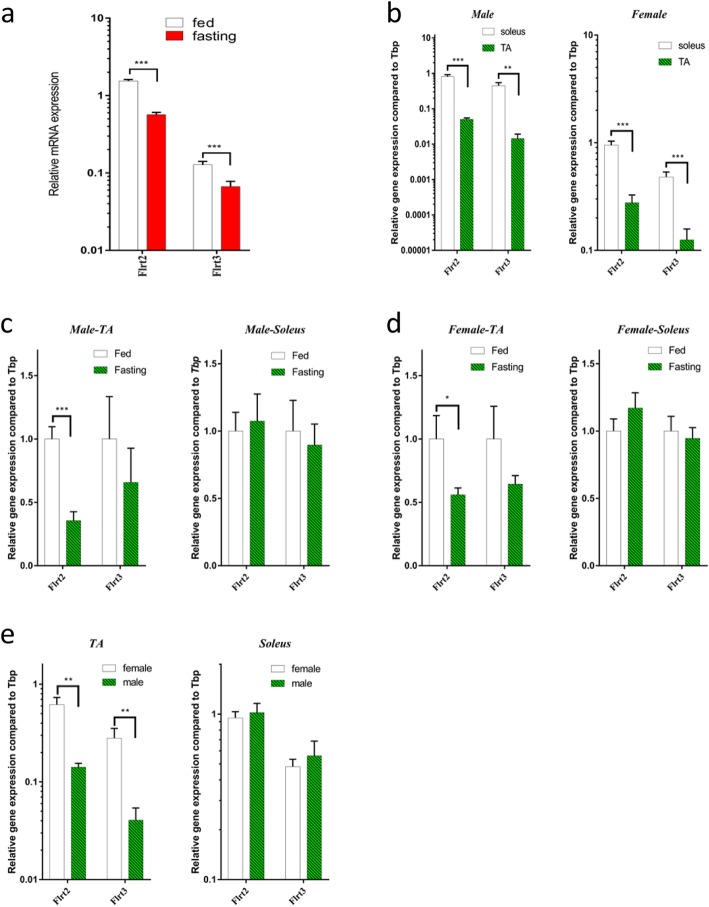
Fibroblast growth factors (FGFs) belong to a large family comprising 22 FGF polypeptides that are widely expressed in tissues. Most of the FGFs can be secreted and involved in the regulation of skeletal muscle function and structure. However, the role of fasting on FGF expression pattern in skeletal muscles remains unknown. In this study, we combined bioinformatics analysis and in vivo studies to explore the effect of 24-h fasting on the expression of Fgfs in slow-twitch soleus and fast-twitch tibialis anterior (TA) muscle from male and female C57BL/6 mice. We found that fasting significantly affected the expression of many Fgfs in mouse skeletal muscle. Furthermore, skeletal muscle fibre type and sex also influenced Fgf expression and response to fasting. We observed that in both male and female mice fasting reduced Fgf6 and Fgf11 in the TA muscle rather than the soleus. Moreover, fasting reduced Fgf8 expression in the soleus and TA muscles in female mice rather than in male mice. Fasting also increased Fgf21 expression in female soleus muscle and female and male plasma. Fasting reduced Fgf2 and Fgf18 expression levels without fibre-type and sex-dependent effects in mice. We further found that fasting decreased the expression of an FGF activation marker gene-Flrt2 in the TA muscle but not in the soleus muscle in both male and female mice. This study revealed the expression profile of Fgfs in different skeletal muscle fibre types and different sexes and provides clues to the interaction between the skeletal muscle and other organs, which deserves future investigations.
成纤维细胞生长因子(FGFs)属于一个大家族,包含 22 种广泛表达于组织中的 FGF 多肽。大多数 FGF 可分泌,并参与调节骨骼肌功能和结构。然而,禁食对骨骼肌中 FGF 表达模式的影响尚不清楚。在本研究中,我们结合生物信息学分析和体内研究,探讨了 24 小时禁食对雄性和雌性 C57BL/6 小鼠慢收缩比目鱼肌和快收缩胫骨前肌(TA)中 Fgfs 表达的影响。我们发现禁食显著影响了小鼠骨骼肌中许多 Fgfs 的表达。此外,骨骼肌纤维类型和性别也影响 Fgf 表达和对禁食的反应。我们观察到,在雄性和雌性小鼠中,禁食都降低了 TA 肌肉而非比目鱼肌中的 Fgf6 和 Fgf11。此外,禁食降低了雌性比目鱼肌和 TA 肌肉中的 Fgf8 表达,而不是雄性小鼠。禁食还增加了雌性比目鱼肌和雌性和雄性血浆中的 Fgf21 表达。禁食降低了 Fgf2 和 Fgf18 的表达水平,而不受纤维类型和性别依赖性影响。我们进一步发现,禁食降低了雄性和雌性小鼠 TA 肌肉中 FGF 激活标记基因 Flrt2 的表达,但不影响比目鱼肌。本研究揭示了不同骨骼肌纤维类型和不同性别中 Fgfs 的表达谱,为研究骨骼肌与其他器官之间的相互作用提供了线索,值得进一步研究。