Department of Neurosurgery, University of Helsinki and Helsinki University Hospital, Topeliuksenkatu 5, PO. Box 266, 00029, Helsinki, Finland.
Department of Orthopaedics and Traumatology, University of Helsinki and Helsinki University Hospital, Helsinki, Finland.
Acta Neurochir (Wien). 2020 Jun;162(6):1445-1453. doi: 10.1007/s00701-020-04279-9. Epub 2020 Mar 10.
Blunt cerebrovascular injuries (BCVIs) and cervical spinal injuries (CSIs) are not uncommon injuries in patients with severe head injury and may affect patient recovery. We aimed to assess the independent relationship between BCVI, CSI, and outcome in patients with severe head injury.
We identified patients with severe head injury from the Helsinki Trauma Registry treated during 2015-2017 in a large level 1 trauma hospital. We assessed the association between BCVI and SCI using multivariable logistic regression, adjusting for injury severity. Our primary outcome was functional outcome at 6 months, and our secondary outcome was 6-month mortality.
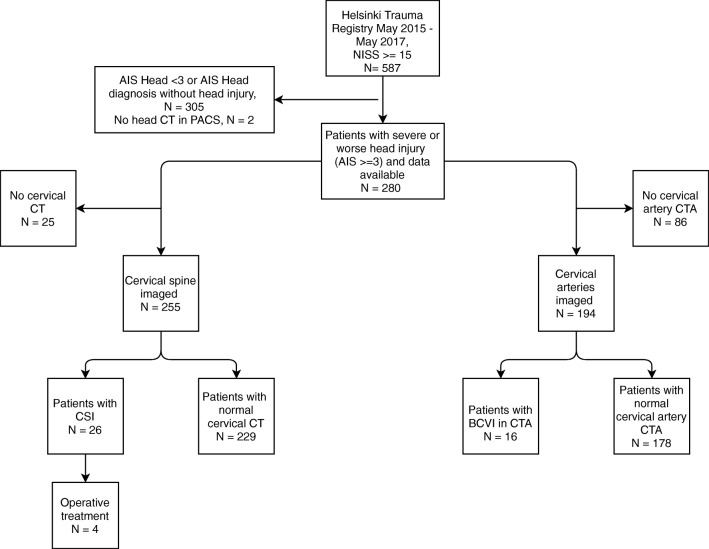
Of 255 patients with a cervical spine CT, 26 patients (10%) had a CSI, and of 194 patients with cervical CT angiography, 16 patients (8%) had a BCVI. Four of the 16 BCVI patients had a BCVI-related brain infarction, and four of the CSI patients had some form of spinal cord injury. After adjusting for injury severity in multivariable logistic regression analysis, BCVI associated with poor functional outcome (odds ratio [OR] = 6.0, 95% CI [confidence intervals] = 1.4-26.5) and mortality (OR = 7.9, 95% CI 2.0-31.4). We did not find any association between CSI and outcome.
We found that BCVI with concomitant head injury was an independent predictor of poor outcome in patients with severe head injury, but we found no association between CSI and outcome after severe head injury. Whether the association between BCVI and poor outcome is an indirect marker of a more severe injury or a result of treatment needs further investigations.
钝性脑血管损伤(BCVI)和颈椎脊髓损伤(CSIs)在重型颅脑损伤患者中并不少见,可能影响患者的恢复。我们旨在评估 BCVI、CSI 与重型颅脑损伤患者预后的独立关系。
我们从大型 1 级创伤医院的赫尔辛基创伤登记处确定了 2015-2017 年期间治疗的重型颅脑损伤患者。我们使用多变量逻辑回归评估 BCVI 和 SCI 之间的关联,并调整损伤严重程度。我们的主要结局是 6 个月时的功能结局,次要结局是 6 个月时的死亡率。
在 255 例颈椎 CT 患者中,26 例(10%)有 CSI,在 194 例颈椎 CT 血管造影患者中,16 例(8%)有 BCVI。16 例 BCVI 患者中有 4 例出现与 BCVI 相关的脑梗死,4 例 CSI 患者有某种形式的脊髓损伤。在多变量逻辑回归分析中调整损伤严重程度后,BCVI 与不良功能结局(比值比[OR] = 6.0,95%CI [置信区间] = 1.4-26.5)和死亡率(OR = 7.9,95%CI 2.0-31.4)相关。我们没有发现 CSI 与结局之间的任何关联。
我们发现,伴有头部损伤的 BCVI 是重型颅脑损伤患者预后不良的独立预测因素,但我们没有发现 CSI 与重型颅脑损伤后结局之间的关联。BCVI 与不良预后之间的关联是更严重损伤的间接标志物还是治疗结果需要进一步研究。