Department of Ultrasound, China-Japan Union Hospital of Jilin University, Changchun, China.
Department of Cardiovascular, China-Japan Union Hospital of Jilin University, Changchun, China.
J Clin Lab Anal. 2020 Jul;34(7):e23293. doi: 10.1002/jcla.23293. Epub 2020 Mar 10.
Atherosclerosis is the most frequent pathological process that causes cardiovascular diseases.
The present study aimed to confirm miRNAs associated with atherosclerosis and explore the molecular mechanism of miR-34c and its target high mobility group box protein 1 (HMGB1) in the control of growth of smooth muscle cells in the development of atherosclerosis.
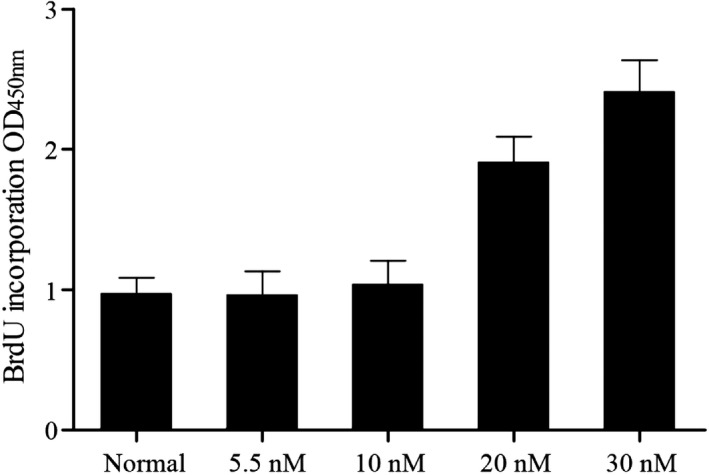
Real-time PCR was firstly performed to confirm miRNA correlation with atherosclerosis, and computational analysis and luciferase assay were performed to explore the target of miR-34c, Western blot, and real-time PCR were also utilized to reveal the effect of whether high glucose (HG) and miR-34c affect miR-34c, HMGB1 levels, NF-κB p65 and TNF-α levels, and the role of miR-34c on vascular smooth muscle cells (VSMCs) viability induced by HG. Students' unpaired t test was performed to compare data between two groups.
MiR-34c level was associated with atherosclerosis with different expression between VSMCs treated with high glucose or normal VSMCs. Then, HMGB1 is a virtual target of miR-34c with predicted binding site resided in HMGB1 3'UTR and further verified by that miR-34c remarkably reduced luciferase activity of wild HMGB1 3'UTR under a concentration-dependent fashion, and miR-34c cannot influence luciferase activity of mutant HMGB1 3'UTR.
The results suggested miR-34c might be a novel therapeutic strategy in the management of atherosclerosis by suppressing the expression of HGMB1 and its downstream effectors.
动脉粥样硬化是导致心血管疾病最常见的病理过程。
本研究旨在证实与动脉粥样硬化相关的 miRNA,并探讨 miR-34c 及其靶基因高迁移率族蛋白 1(HMGB1)在控制动脉粥样硬化平滑肌细胞生长中的分子机制。
首先通过实时 PCR 证实与动脉粥样硬化相关的 miRNA,通过计算分析和荧光素酶报告基因实验探索 miR-34c 的靶基因,同时利用 Western blot 和实时 PCR 揭示高糖(HG)和 miR-34c 对 miR-34c、HMGB1 水平、NF-κB p65 和 TNF-α水平的影响,以及 miR-34c 对 HG 诱导的血管平滑肌细胞(VSMCs)活力的作用。采用学生的独立样本 t 检验比较两组间的数据。
miR-34c 水平与动脉粥样硬化相关,高糖处理的 VSMCs 与正常 VSMCs 之间的表达不同。然后,HMGB1 是 miR-34c 的虚拟靶基因,预测的结合位点位于 HMGB1 3'UTR 中,并通过 miR-34c 以浓度依赖的方式显著降低野生型 HMGB1 3'UTR 的荧光素酶活性,以及 miR-34c 不能影响突变型 HMGB1 3'UTR 的荧光素酶活性得到进一步验证。
研究结果表明,miR-34c 通过抑制 HGMB1 及其下游效应物的表达,可能成为治疗动脉粥样硬化的一种新策略。