Huang Zhimei, Zuo Mengxuan, Ni Jiayan, Gu Yangkui, Zhang Tianqi, Jiang Yiquan, Zhuo Shuiqing, An Chao, Huang Jinhua
Department of Minimal Invasive Intervention, Sun Yat-Sen University Cancer Center, State Key Laboratory of Oncology in South China, Collaborative Innovation Center for Cancer Medicine, Guangzhou, People's Republic of China.
Department of Radiology, Sun Yat-Sen University Cancer Center, State Key Laboratory of Oncology in South China; Collaborative Innovation Center for Cancer Medicine, Guangzhou, People's Republic of China.
Cancer Manag Res. 2020 Feb 25;12:1373-1385. doi: 10.2147/CMAR.S234116. eCollection 2020.
Based on the albumin-bilirubin (ALBI) and platelet-albumin-bilirubin (PALBI) grade to assess the long-term outcomes of patients with large hepatocellular carcinoma (HCC) after transarterial chemoembolization combined with cryoablation (TACE-CRA).
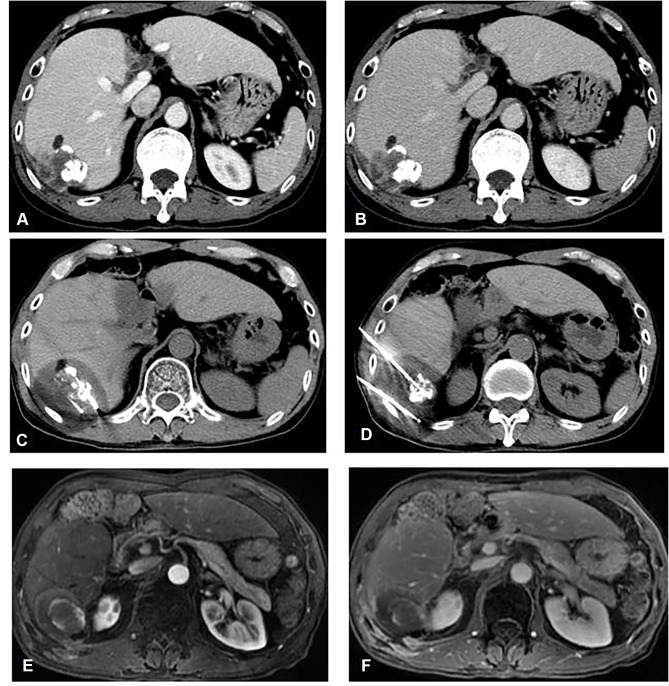
We studied 86 patients with HCC nodules (up to 3 HCCs with maximum diameters of 4.1-12.0 cm) who subsequently underwent TACE-CRA from July 2007 to August 2018. The overall survival (OS) was compared between groups classified by ALBI and PALBI grade. Baseline characteristics were collected to identify the risk factors for determination of poor OS after TACE-CRA. The prognostic performances of CTP class, ALBI and PALBI grade were compared.
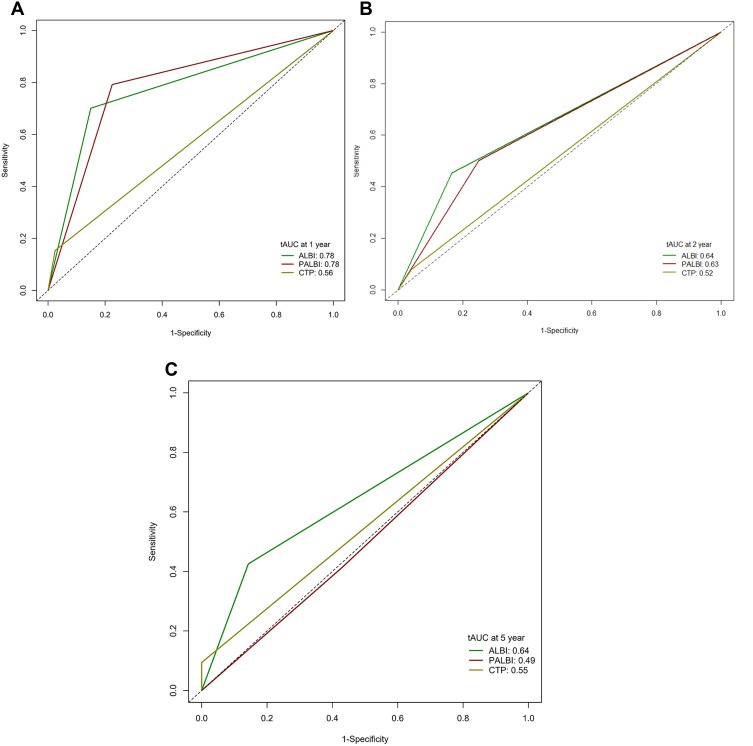
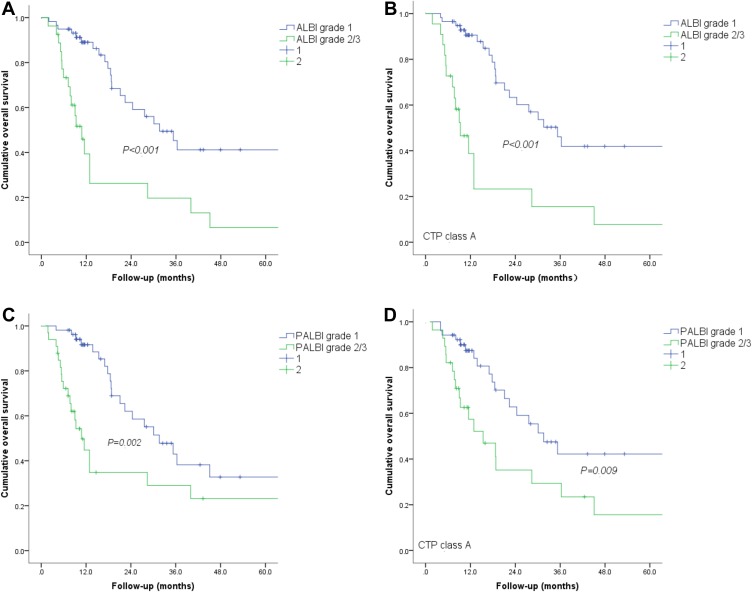
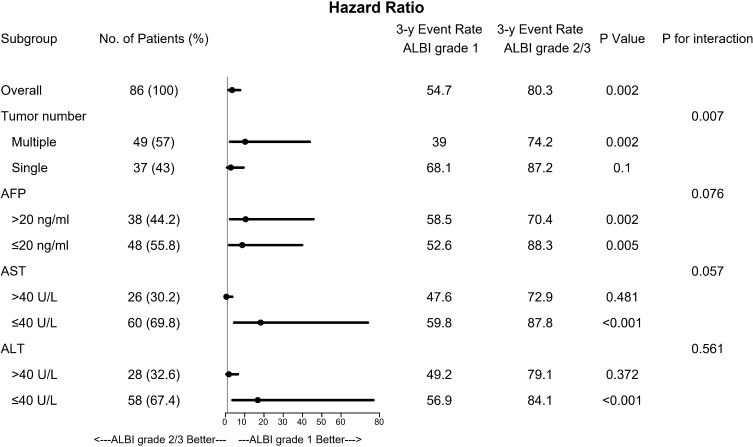
After a median follow-up time of 33.8 months, 41 patients had died. The cumulative1-, 3- and 5-year OS rates were 74.5%, 38.0% and 29.3%, respectively. Stratified according to ALBI grade, the cumulative 3- and 5-year OS rates were 41.2% and 41.2% in grade 1, respectively, and 20.9% and 9.8% in grades 2-3, respectively ( < 0.001). Stratified according to PALBI grade, the cumulative 3- and 5-year OS rates were 41.2% and 37.5% in grade 1, respectively, and 36.3% and 21.2% in grades 2-3, respectively ( = 0.002). Multivariate analysis results showed that older age, and ALBI grade 2-3 were associated with overall mortality. ALBI grade demonstrated significantly greater area under the curve values than CTP class and PALBI in predicting 1-, 3- and 5-year OS.
ALBI grade offers accurate prediction of long-term outcome for patients with HCC (diameter > 4 cm) after TACE-CRA.
基于白蛋白-胆红素(ALBI)分级和血小板-白蛋白-胆红素(PALBI)分级评估经动脉化疗栓塞联合冷冻消融(TACE-CRA)治疗大肝细胞癌(HCC)患者的长期预后。
我们研究了86例HCC结节患者(最多3个HCC,最大直径4.1-12.0 cm),这些患者于2007年7月至2018年8月接受了TACE-CRA治疗。比较了根据ALBI和PALBI分级分组的患者的总生存期(OS)。收集基线特征以确定TACE-CRA后OS不佳的危险因素。比较了CTP分级、ALBI分级和PALBI分级的预后性能。
中位随访时间33.8个月后,41例患者死亡。1年、3年和5年的累积OS率分别为74.5%、38.0%和29.3%。根据ALBI分级分层,1级患者的3年和5年累积OS率分别为41.2%和41.2%,2-3级患者分别为20.9%和9.8%(P<0.001)。根据PALBI分级分层,1级患者的3年和5年累积OS率分别为41.2%和37.5%,2-3级患者分别为36.3%和21.2%(P=0.002)。多因素分析结果显示,年龄较大和ALBI 2-3级与总体死亡率相关。在预测1年、3年和5年OS方面,ALBI分级的曲线下面积值显著大于CTP分级和PALBI分级。
ALBI分级可为TACE-CRA治疗后HCC(直径>4 cm)患者的长期预后提供准确预测。