Division of Hepatology, Department of Internal Medicine, College of Medicine, The Catholic University of Korea, Seoul, Republic of Korea.
Korean Liver Cancer Study Group, Seoul, Republic of Korea.
PLoS One. 2019 May 2;14(5):e0216173. doi: 10.1371/journal.pone.0216173. eCollection 2019.
We evaluated the ability of various grading scales including platelet-albumin-bilirubin (PALBI) and albumin-bilirubin (ALBI) grades to predict overall survival (OS) according to treatment modality in patients with hepatocellular carcinoma (HCC).
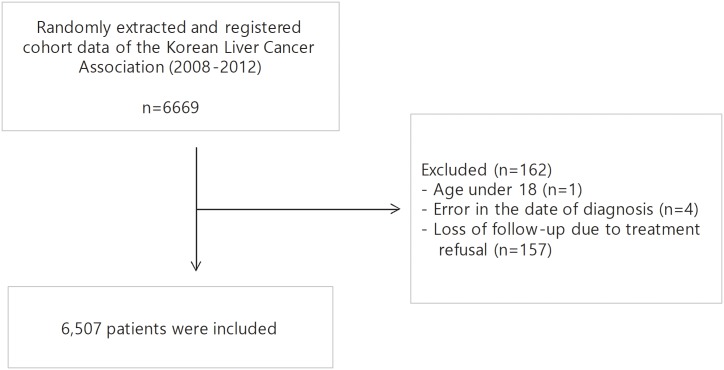
The cohort of 6,669 patients with HCC was selected randomly from the 2008-2012 national cohort of the Korean Central Cancer Registry. The OS of 6,507 of these patients was evaluated using the Child-Turcotte-Pugh (CTP) class, Model for End-stage Liver Disease (MELD) score, and ALBI and PALBI grades.
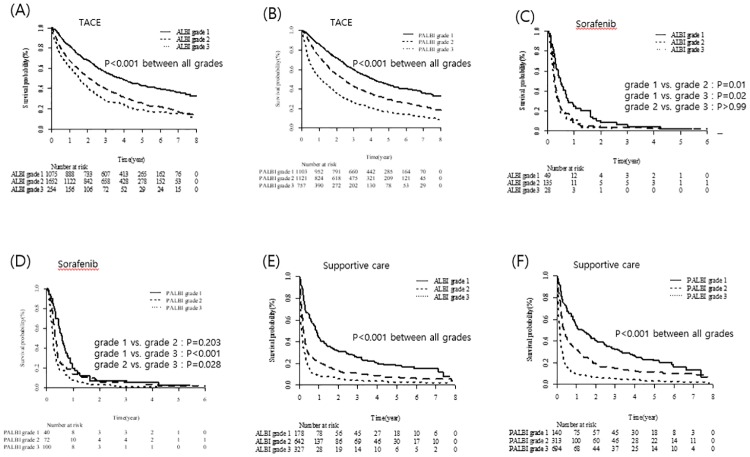
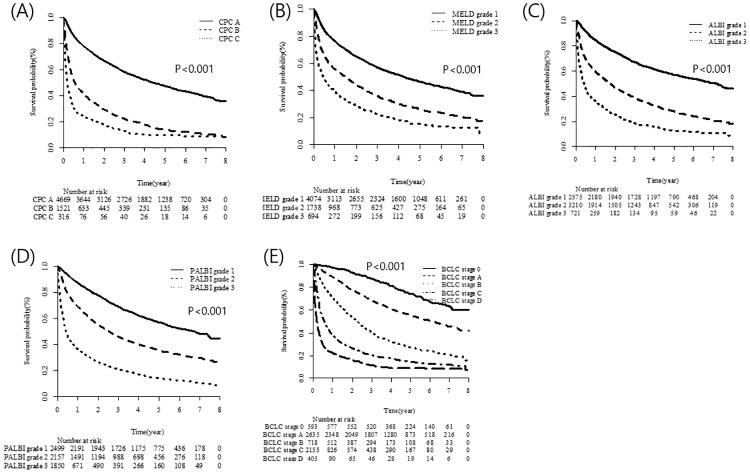
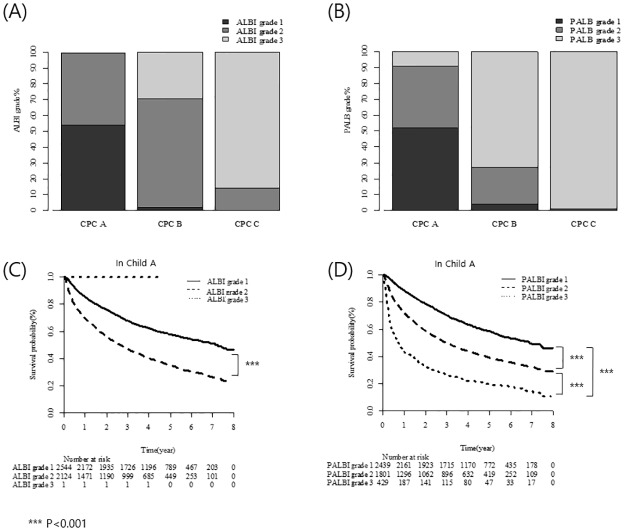
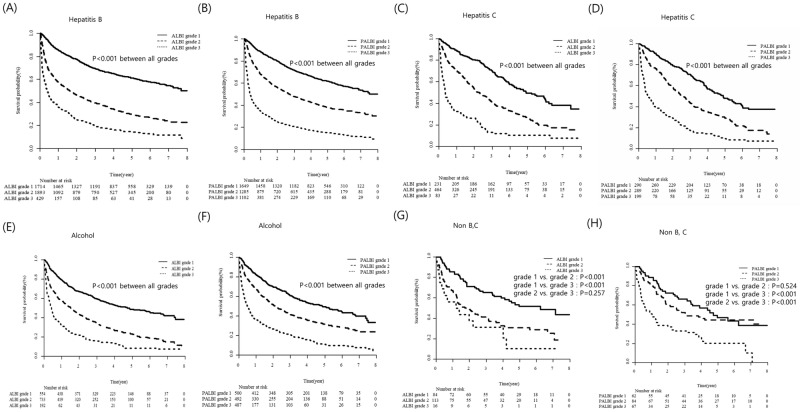
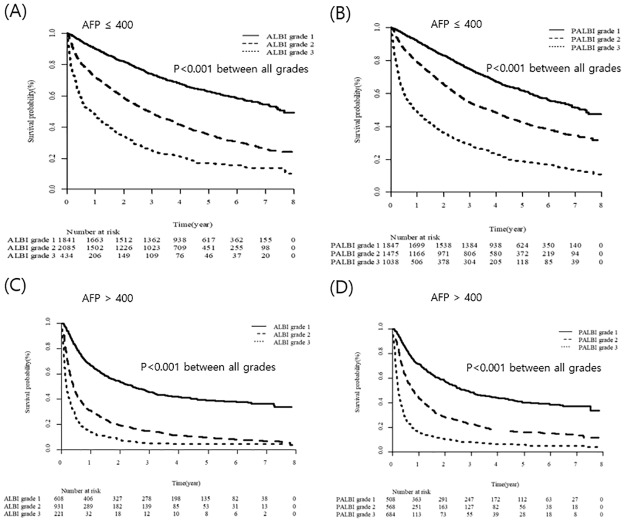
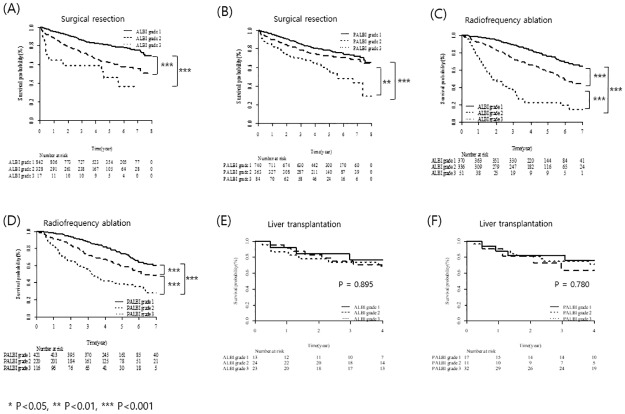
The patient's mean age was 59.7 years. The most patients were hepatitis B virus (63.4%) and CTP class A (71.8%). The median OS durations of PALBI grade1 (38.4%), grade2 (33.2%), and grade3 (28.4%) patients were 81, 30, and 5 months, respectively (P<0.001). The PALBI grade had a larger area under the receiver operator characteristic curve (AUC) than did the CTP class, MELD score, and ALBI grade (overall AUC: 0.675 vs. 0.633, 0.645, and 0.642, respectively; P < 0.001). Moreover, the PALBI and ALBI grades enabled sub-classification of CTP A patients (P < 0.001). In a multivariate analysis, the PALBI and ALBI grades were significant risk factors for OS (P < 0.05). According to treatment modality, the PALBI grade was predictive of OS in patients receiving transarterial chemoembolization or supportive care. The ALBI grade was predictive of OS in patients undergoing surgical resection or radiofrequency ablation.
The PALBI and ALBI grades are more reliable for accessing liver function and predicting OS in patients with HCC. Moreover, according to treatment modality, appropriate use of the ALBI and PALBI grades will enable accurate determination of the prognosis of patients with HCC.
我们评估了包括血小板-白蛋白-胆红素(PALBI)和白蛋白-胆红素(ALBI)分级在内的各种分级系统的能力,以根据治疗方式预测肝细胞癌(HCC)患者的总生存率(OS)。
从 2008-2012 年韩国中央癌症登记处的全国队列中随机选择了 6669 例 HCC 患者的队列。使用 Child-Turcotte-Pugh(CTP)分级、终末期肝病模型(MELD)评分以及 ALBI 和 PALBI 分级评估了其中 6507 例患者的 OS。
患者的平均年龄为 59.7 岁。大多数患者为乙型肝炎病毒(63.4%)和 CTP 分级 A(71.8%)。PALBI 分级 1(38.4%)、2(33.2%)和 3(28.4%)患者的中位 OS 时间分别为 81、30 和 5 个月(P<0.001)。PALBI 分级的受试者工作特征曲线(ROC)下面积(AUC)大于 CTP 分级、MELD 评分和 ALBI 分级(总体 AUC:0.675 与 0.633、0.645 和 0.642,P<0.001)。此外,PALBI 和 ALBI 分级能够对 CTP A 患者进行亚分类(P<0.001)。多变量分析显示,PALBI 和 ALBI 分级是 OS 的显著危险因素(P<0.05)。根据治疗方式,PALBI 分级可预测接受经动脉化疗栓塞或支持性治疗的患者的 OS。ALBI 分级可预测接受手术切除或射频消融治疗的患者的 OS。
PALBI 和 ALBI 分级在评估 HCC 患者肝功能和预测 OS 方面更可靠。此外,根据治疗方式,适当使用 ALBI 和 PALBI 分级将能够准确确定 HCC 患者的预后。