Burholt Vanessa, Winter Bethan, Aartsen Marja, Constantinou Costas, Dahlberg Lena, Feliciano Villar, De Jong Gierveld Jenny, Van Regenmortel Sofie, Waldegrave Charles
1Centre for Innovative Ageing, Swansea University, Swansea, Wales UK.
2Centre for Welfare and Labour Research, OsloMet Oslo Metropolitan University, Oslo, Norway.
Eur J Ageing. 2019 Feb 20;17(1):3-19. doi: 10.1007/s10433-019-00506-0. eCollection 2020 Mar.
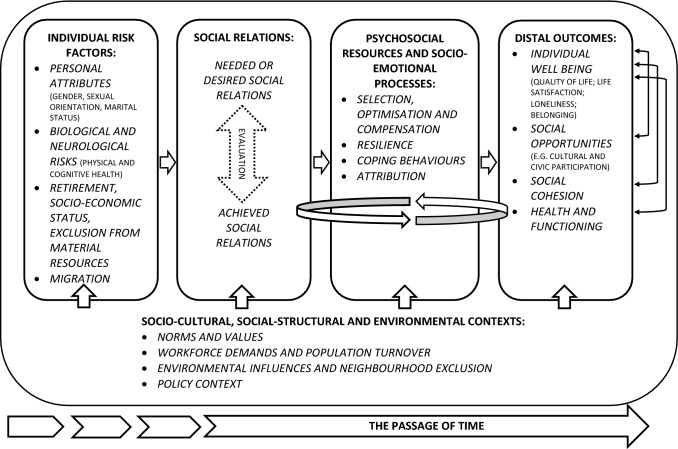
Social exclusion is complex and dynamic, and it leads to the non-realization of social, economic, political or cultural rights or participation within a society. This critical review takes stock of the literature on exclusion of social relations. Social relations are defined as comprising social resources, social connections and social networks. An evidence review group undertook a critical review which integrates, interprets and synthesizes information across studies to develop a conceptual model of exclusion from social relations. The resulting model is a subjective interpretation of the literature and is intended to be the starting point for further evaluations. The conceptual model identifies individual risks for exclusion from social relations (personal attributes, biological and neurological risk, retirement, socio-economic status, exclusion from material resources and migration). It incorporates the evaluation of social relations, and the influence of psychosocial resources and socio-emotional processes, sociocultural, social-structural, environmental and policy contextual influences on exclusion from social relations. It includes distal outcomes of exclusion from social relations, that is, individual well-being, health and functioning, social opportunities and social cohesion. The dynamic relationships between elements of the model are also reported. We conclude that the model provides a subjective interpretation of the data and an excellent starting point for further phases of conceptual development and systematic evaluation(s). Future research needs to consider the use of sophisticated analytical tools and an interdisciplinary approach in order to understand the underlying biological and ecopsychosocial associations that contribute to individual and dynamic differences in the experience of exclusion from social relations.
社会排斥是复杂且动态的,它会导致社会、经济、政治或文化权利无法实现,或使人无法参与社会生活。本综述对关于社会关系排斥的文献进行了评估。社会关系被定义为包括社会资源、社会联系和社会网络。一个证据审查小组进行了一项批判性综述,整合、解释并综合了各项研究中的信息,以构建一个社会关系排斥的概念模型。所得出的模型是对文献的主观解读,旨在作为进一步评估的起点。该概念模型确定了社会关系排斥的个体风险(个人属性、生物和神经学风险、退休、社会经济地位、物质资源排斥和移民)。它纳入了对社会关系的评估,以及心理社会资源和社会情感过程、社会文化、社会结构、环境和政策背景因素对社会关系排斥的影响。它包括社会关系排斥的远端结果,即个体幸福感、健康和功能、社会机会以及社会凝聚力。还报告了模型各要素之间的动态关系。我们得出结论,该模型对数据进行了主观解读,是概念发展和系统评估后续阶段的一个绝佳起点。未来的研究需要考虑使用精密的分析工具和跨学科方法,以理解导致社会关系排斥体验中个体和动态差异的潜在生物及生态心理社会关联。