Rocco Joseph M, York Zachary, Shen Chengli, Shiboski Caroline, Cyriaque-Webster Jennifer, McLaughlin Janet, Borowski Luann, Chen Huichao, Aberg Judith A, Dittmer Dirk P, Ghannoum Mahmoud, Rinaldo Charles R, Macatangay Bernard
University of Pittsburgh, Pittsburgh, Pennsylvania, USA.
University of Wisconsin-Madison, Madison, Wisconsin, USA.
Open Forum Infect Dis. 2020 Feb 13;7(3):ofaa047. doi: 10.1093/ofid/ofaa047. eCollection 2020 Mar.
We determined the levels of 11 soluble immune mediators in oral washings of AIDS Clinical Trials Group A5254 participants with varying degrees of plasma viremia and CD4 T-cell counts to characterize the mucosal immune response at different stages of HIV-1 infection.
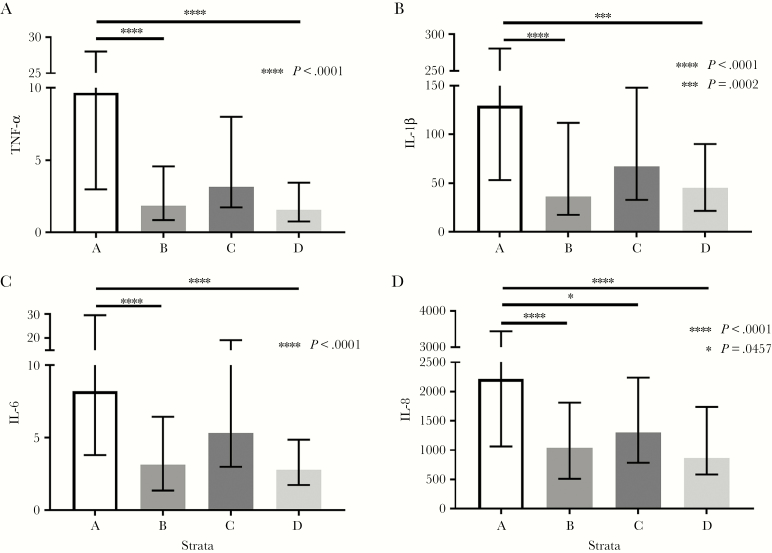
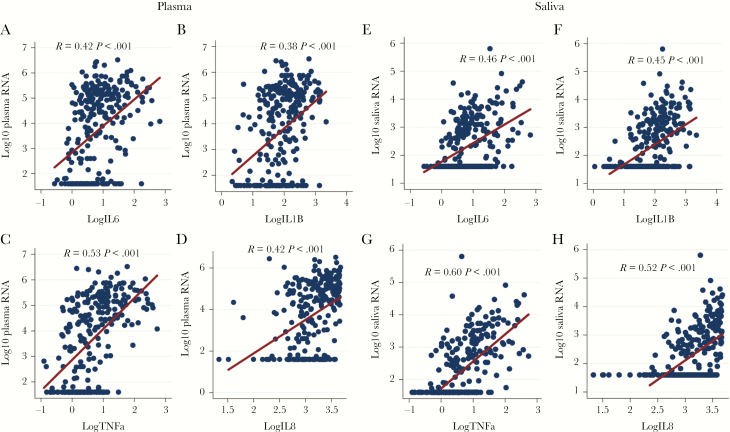
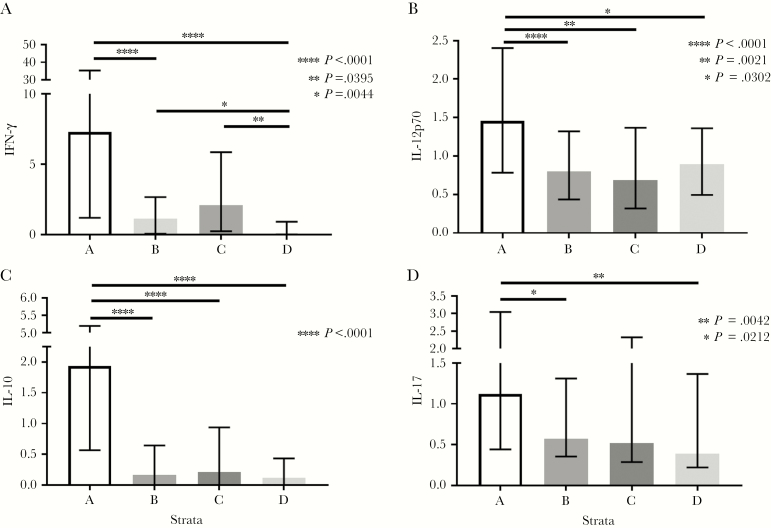
A5254 was a multicenter, cross-sectional study in people with HIV (PWH) recruited into 4 strata based on CD4 count and levels of plasma viremia: stratum (St) A: CD4 ≤200 cells/mm, HIV-1 RNA (viral load [VL]) >1000 cps/mL; St B: CD4 ≤200, VL ≤1000; St C: CD4 >200, VL >1000; St D: CD4 >200, VL ≤1000. Oral/throat washings were obtained from all participants. Soluble markers were tested in oral/throat washings using a multibead fluorescent platform and were compared across strata. Linear regression was used to determine the associations between cytokines and HIV-1 in plasma and oral fluid.
St A participants had higher levels of interleukin (IL)-1β, IL-6, IL-17, tumor necrosis factor alpha (TNFα), and interferon gamma (IFNγ) compared with St B and D ( = .02; < .0001) but were not different from St C. IL-8, IL-10, and IL-12 were elevated in St A compared with the other 3 strata ( = .046; < .0001). Linear regression demonstrated that oral HIV-1 levels were associated with IL-1β, IL-6, IL-8, and TNFα production ( > .40; < .001) when controlling for CD4 count and opportunistic infections.
Our results show that high levels of oral HIV-1, rather than low CD4 counts, were linked to the production of oral immune mediators. Participants with AIDS and uncontrolled viremia demonstrated higher levels of pro- and anti-inflammatory soluble immune mediators compared with participants with lower HIV-1 RNA. The interplay of HIV-1 and these immune mediators could be important in the oral health of PWH.
我们测定了艾滋病临床试验组A5254参与者口腔冲洗液中11种可溶性免疫介质的水平,这些参与者具有不同程度的血浆病毒血症和CD4 T细胞计数,以表征HIV-1感染不同阶段的黏膜免疫反应。
A5254是一项针对HIV感染者(PWH)的多中心横断面研究,根据CD4计数和血浆病毒血症水平分为4个层次:A层(St A):CD4≤200个细胞/mm³,HIV-1 RNA(病毒载量[VL])>1000拷贝数/mL;B层(St B):CD4≤200,VL≤1000;C层(St C):CD4>200,VL>1000;D层(St D):CD4>200,VL≤1000。从所有参与者中获取口腔/咽喉冲洗液。使用多珠荧光平台检测口腔/咽喉冲洗液中的可溶性标志物,并在各层次间进行比较。采用线性回归确定血浆和口腔液中细胞因子与HIV-1之间的关联。
与B层和D层相比,A层参与者的白细胞介素(IL)-1β、IL-6、IL-17、肿瘤坏死因子α(TNFα)和干扰素γ(IFNγ)水平更高(P = 0.02;P < 0.0001),但与C层无差异。与其他3个层次相比,A层的IL-8、IL-10和IL-12升高(P = 0.046;P < 0.0001)。线性回归表明,在控制CD4计数和机会性感染时,口腔HIV-1水平与IL-1β、IL-6、IL-8和TNFα的产生相关(P > 0.40;P < 0.001)。
我们的结果表明,口腔HIV-1水平高而非CD4计数低与口腔免疫介质的产生有关。与HIV-1 RNA水平较低的参与者相比,患有艾滋病且病毒血症未得到控制的参与者表现出更高水平的促炎和抗炎可溶性免疫介质。HIV-1与这些免疫介质之间的相互作用可能对PWH的口腔健康很重要。