Department of Brain and Cognitive Sciences, Daegu Gyeongbuk Institute of Science and Technology (DGIST), Daegu, 42988, Korea.
Department of Biomedical Sciences, College of Medicine, Korea University, Seoul, 02841, Korea.
Exp Mol Med. 2020 Mar;52(3):473-484. doi: 10.1038/s12276-020-0398-9. Epub 2020 Mar 11.
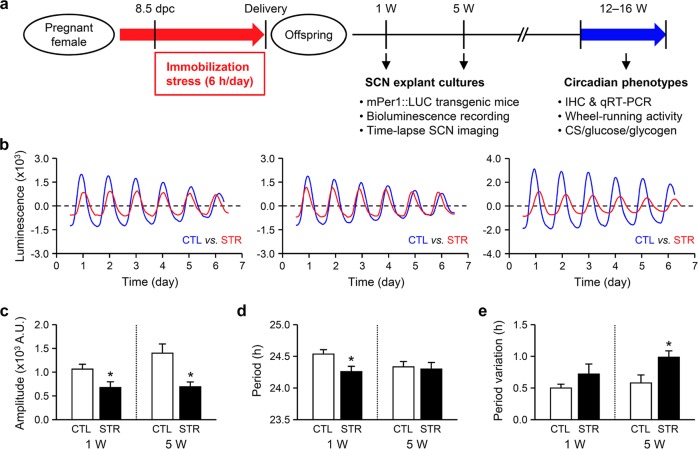
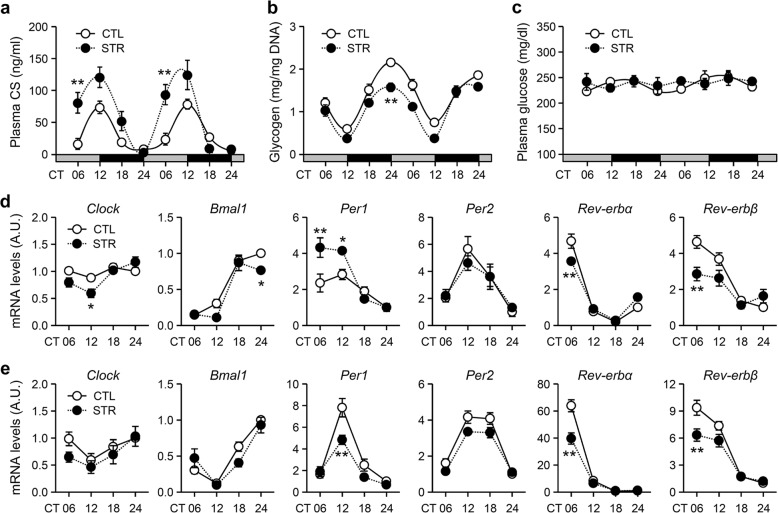
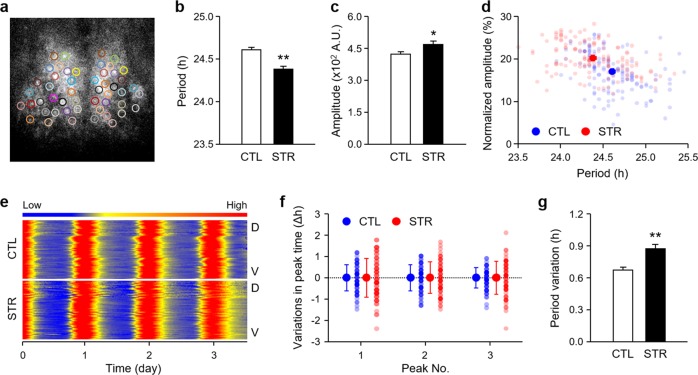
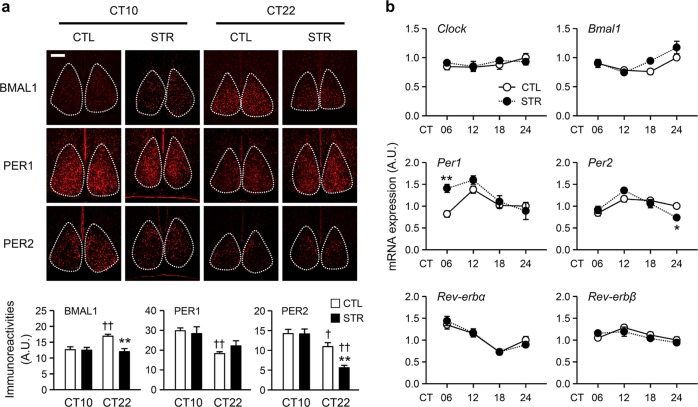
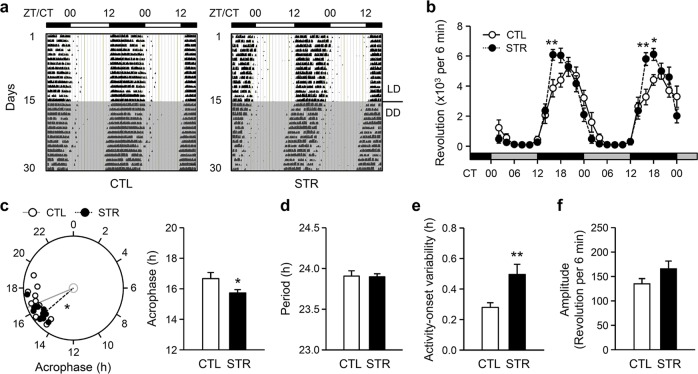
Maternal stress has long-lasting influences on the brain functions of offspring, and several brain regions have been proposed to mediate such programming. Although perinatal programming of crosstalk between the circadian and stress systems has been proposed, the functional consequences of prenatal stress on the circadian system and the underlying mechanisms remain largely unknown. Therefore, we investigated whether exposing pregnant mice to chronic restraint stress had prolonged effects on the suprachiasmatic nucleus (SCN), which bears the central pacemaker for mammalian circadian rhythms, of offspring. SCN explants from maternally stressed mice exhibited altered cyclic expression patterns of a luciferase reporter under control of the mouse Per1 promoter (mPer1::LUC), which manifested as a decreased amplitude and impaired stability of the rhythm. Bioluminescence imaging at the single-cell level subsequently revealed that impaired synchrony among individual cells was responsible for the impaired rhythmicity. These intrinsic defects appeared to persist during adulthood. Adult male offspring from stressed mothers showed advanced-phase behavioral rhythms with impaired stability as well as altered clock gene expression in the SCN. In addition to affecting the central rhythm, maternal stress also had prolonged influences on the circadian characteristics of the adrenal gland and liver, as determined by circulating corticosterone levels and hepatic glycogen content, and on canonical clock gene mRNA expression in those tissues. Taken together, our findings suggest that the SCN is a key target of the programming effects of maternal stress. The widespread effects of circadian disruptions caused by a misprogrammed clock may have further impacts on metabolic and mental health in later life.
母体应激对后代的大脑功能有持久的影响,有几个大脑区域被认为介导了这种编程。虽然已经提出了围产期昼夜节律和应激系统之间串扰的编程,但产前应激对昼夜节律系统的功能后果和潜在机制在很大程度上仍然未知。因此,我们研究了是否使怀孕的老鼠经历慢性束缚应激会对后代的视交叉上核(SCN)产生长期影响,SCN 是哺乳动物昼夜节律的中央起搏器。来自母体应激的老鼠的 SCN 外植体显示出受小鼠 Per1 启动子(mPer1::LUC)控制的荧光素酶报告基因的周期性表达模式发生改变,表现为振幅降低和节律稳定性受损。随后在单细胞水平进行的生物发光成像显示,个体细胞之间的同步性受损是节律性受损的原因。这些内在缺陷似乎在成年期仍然存在。来自应激母亲的成年雄性后代表现出行为节律的提前相位,稳定性受损,以及 SCN 中时钟基因表达的改变。除了影响中央节律外,母体应激还对肾上腺和肝脏的昼夜节律特征产生持久影响,这可通过循环皮质酮水平和肝糖原含量以及这些组织中典型时钟基因 mRNA 表达来确定。总之,我们的研究结果表明,SCN 是母体应激编程效应的关键靶标。时钟错误编程引起的昼夜节律紊乱的广泛影响可能会对以后的生活中的代谢和心理健康产生进一步的影响。