Lu Tianzhu, Chen Yiping, Li Jieyu, Guo Qiaojuan, Lin Wansong, Zheng Yuhong, Su Ying, Zong Jingfeng, Lin Shaojun, Ye Yunbin, Pan Jianji
The School of Clinical Medicine, Fujian Medical University, Fuzhou, People's Republic of China.
Department of Radiation Oncology, Fujian Cancer Hospital, Fujian Medical University, Fuzhou, People's Republic of China.
Onco Targets Ther. 2020 Feb 26;13:1757-1765. doi: 10.2147/OTT.S242517. eCollection 2020.
Immune checkpoint proteins in the tumor microenvironment can enter the blood circulation and are potential markers for liquid biopsy. The aims of this study were to explore differences in immune checkpoint protein expression between patients with nasopharyngeal carcinoma (NPC) and healthy controls and to investigate the prognostic value of the soluble form of programmed death-ligand 1 (sPD-L1) in NPC.
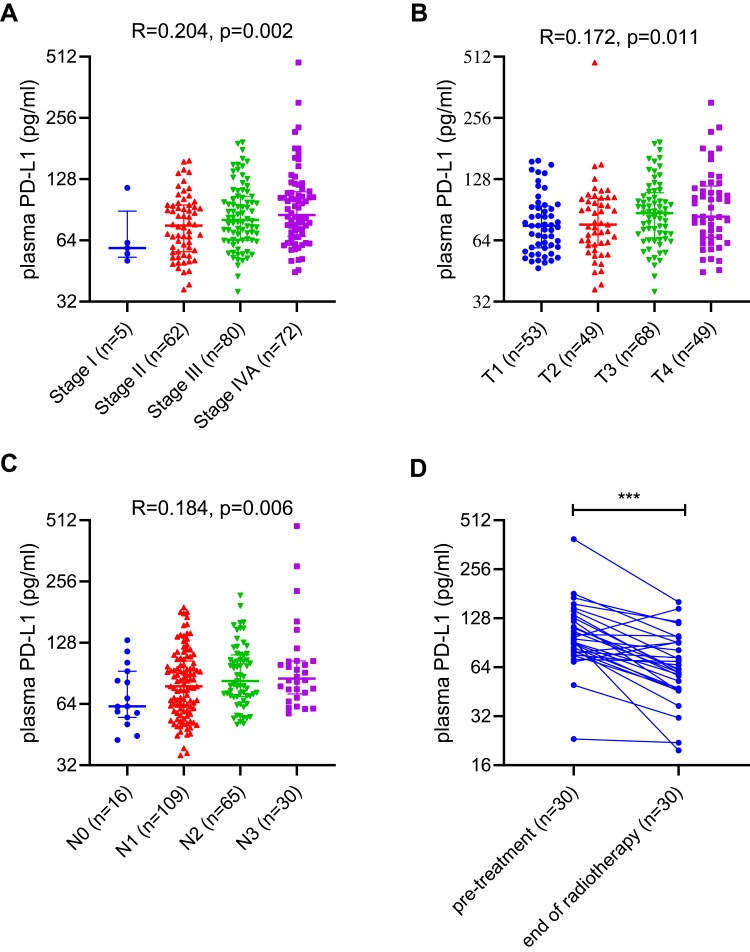
In total, 242 patients were included in the disease group. Plasma samples from 23 NPC patients and 15 healthy control were used for immune checkpoint protein panel assays. Samples from 219 patients with NPC including 30 paired pre-treatment and post-radiotherapy samples were evaluated by enzyme-linked immunosorbent assay to determine sPD-L1 levels.
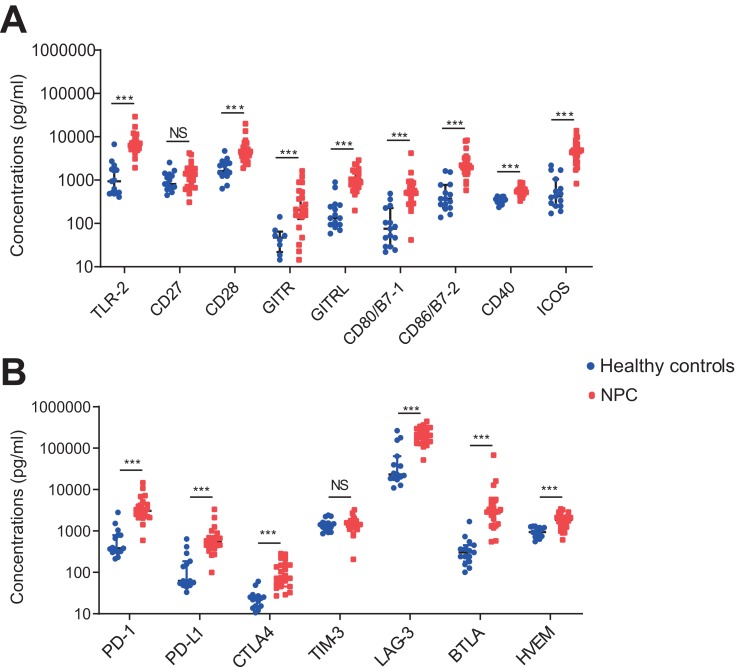
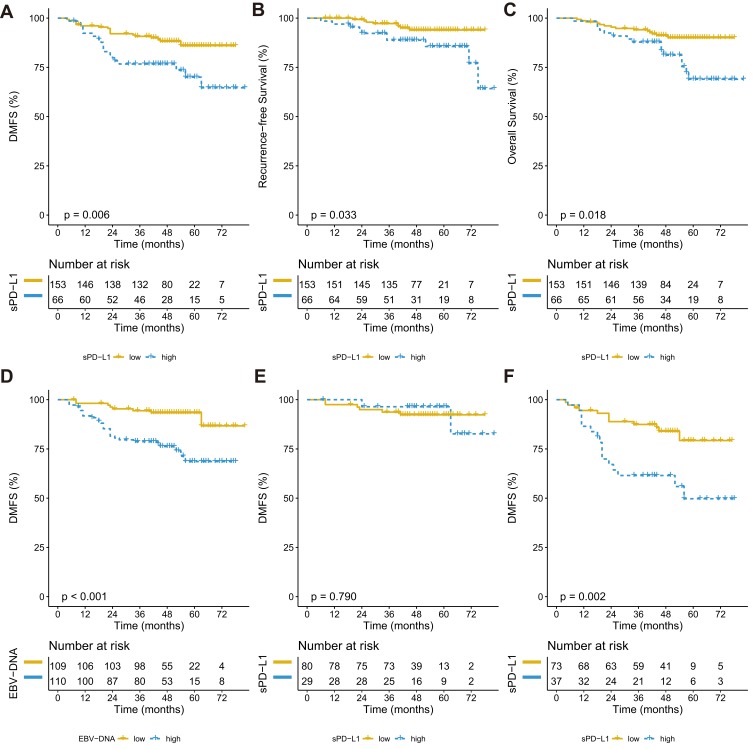
A total of 14 immune checkpoint proteins, including sPD-L1were upregulated in 23 patients with NPC (all p<0.001) compared with 15 healthy controls. Among 219 patients, the median follow-up time was 50 months (7-82 months). Based on the optimal cutoff value of 93.7 pg/mL, patients with high expression of sPD-L1 had worse distant metastasis-free survival (87.5% vs 74.0%, p=0.006) than those of patients with low expression. Multivariate analysis showed that sPD-L1 (HR=1.99, =0.048) and EBV-DNA (HR=2.51, =0.030) were poor prognostic factors for DMFS. In the group with high EBV-DNA expression, DMFS was worse for patients with high sPD-L1 expression than those with low sPD-L1 expression (56.4% vs 82.6%, p=0.002).
Plasma immune checkpoint protein expression differed significantly between patients with NPC and healthy donors. Plasma sPD-L1 levels are a candidate prognostic biomarker, especially when combined with EBV-DNA.
肿瘤微环境中的免疫检查点蛋白可进入血液循环,是液体活检的潜在标志物。本研究旨在探讨鼻咽癌(NPC)患者与健康对照者免疫检查点蛋白表达的差异,并研究可溶性程序性死亡配体1(sPD-L1)在NPC中的预后价值。
疾病组共纳入242例患者。采用23例NPC患者和15例健康对照者的血浆样本进行免疫检查点蛋白组检测。采用酶联免疫吸附测定法对219例NPC患者的样本(包括30对治疗前和放疗后的样本)进行评估,以确定sPD-L1水平。
与15例健康对照者相比,23例NPC患者中共有14种免疫检查点蛋白(包括sPD-L1)上调(所有p<0.001)。219例患者的中位随访时间为50个月(7 - 82个月)。基于93.7 pg/mL的最佳临界值,sPD-L1高表达患者的无远处转移生存期(87.5%对74.0%,p = 0.006)比低表达患者差。多因素分析显示,sPD-L1(HR = 1.99,p = 0.048)和EBV-DNA(HR = 2.51,p = 0.030)是无远处转移生存期的不良预后因素。在EBV-DNA高表达组中,sPD-L1高表达患者的无远处转移生存期比低表达患者差(56.4%对82.6%,p = 0.002)。
NPC患者与健康供者的血浆免疫检查点蛋白表达存在显著差异。血浆sPD-L1水平是一种候选的预后生物标志物,尤其是与EBV-DNA联合使用时。