Parra Luis Armando, Hastings Paul David
Department of Human Ecology, University of California, Davis, Davis, CA, United States.
Center for Mind and Brain, University of California, Davis, Davis, CA, United States.
Front Psychol. 2020 Feb 25;11:228. doi: 10.3389/fpsyg.2020.00228. eCollection 2020.
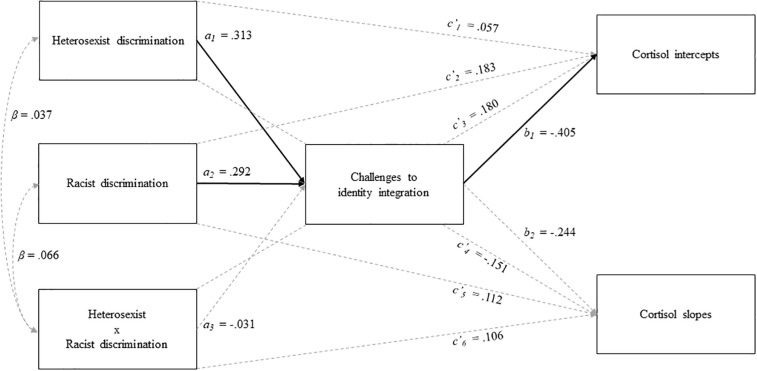
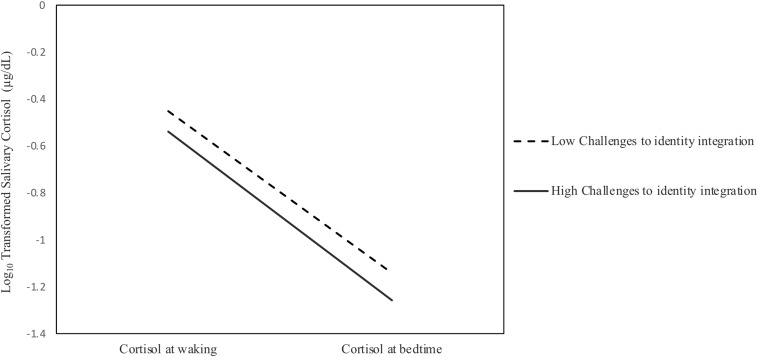
Heterosexist and racist discrimination may adversely impact neurobiological processes implicated in the physical and psychosocial well-being of sexually diverse Latinx people. Yet, little is known about how experiences of both heterosexist and racist discrimination are associated with adrenocortical and psychological functioning in groups of people with multiply marginalized social group identities. Through the application of the intersectionality, minority stress, and allostatic load frameworks, it was hypothesized that experiences of heterosexist and racist discrimination would be associated with disruptions to diurnal salivary cortisol patterns and challenges to identity integration. A group of sexually diverse (self-identified lesbian, gay, bisexual, and queer) Latinx emerging adults ( = 51; ages 18-29, = 24.06 years; = 2.73) provided saliva samples and completed a series of questionnaires during a four-day testing protocol. Heterosexist and racist discrimination were both positively associated with challenges to identity integration. Challenges to identity integration, in turn, were associated with lower intercepts of diurnal cortisol slopes, and heterosexist and racist discrimination were indirectly associated with lower cortisol intercepts via challenges to identity integration. These findings suggest that experiences of heterosexist and racist discrimination may interconnect by challenging sexual and ethnic/racial identity integration and disrupting adaptive adrenocortical regulation among sexually diverse Latinx emerging adults.
异性恋主义和种族主义歧视可能会对性取向多元的拉丁裔人群的身心健康所涉及的神经生物学过程产生不利影响。然而,对于异性恋主义和种族主义歧视的经历如何与具有多重边缘化社会群体身份的人群的肾上腺皮质功能及心理功能相关联,我们却知之甚少。通过运用交叉性、少数群体压力和适应性负荷框架,我们假设异性恋主义和种族主义歧视的经历会与昼夜唾液皮质醇模式的紊乱以及身份认同整合方面的挑战相关联。一组性取向多元(自我认同为女同性恋、男同性恋、双性恋和酷儿)的拉丁裔新兴成年人(n = 51;年龄18 - 29岁,M = 24.06岁;SD = 2.73)在为期四天的测试方案中提供了唾液样本并完成了一系列问卷调查。异性恋主义和种族主义歧视都与身份认同整合方面的挑战呈正相关。反过来,身份认同整合方面的挑战又与昼夜皮质醇斜率的较低截距相关联,并且异性恋主义和种族主义歧视通过身份认同整合方面的挑战与较低的皮质醇截距间接相关。这些发现表明,异性恋主义和种族主义歧视的经历可能通过挑战性取向和族裔/种族身份认同整合以及扰乱性取向多元的拉丁裔新兴成年人的适应性肾上腺皮质调节而相互关联。