Rajankar Mayooreshwar P, Ravindranathan Sapna, Rajamohanan P R, Raghunathan Anu
Chemical Engineering Division, CSIR-National Chemical Laboratory, Dr. Homi Bhabha Road, Pune, India.
Central NMR Facility, CSIR-National Chemical Laboratory, Dr. Homi Bhabha Road, Pune, India.
Biol Methods Protoc. 2018 Aug 8;3(1):bpy007. doi: 10.1093/biomethods/bpy007. eCollection 2018.
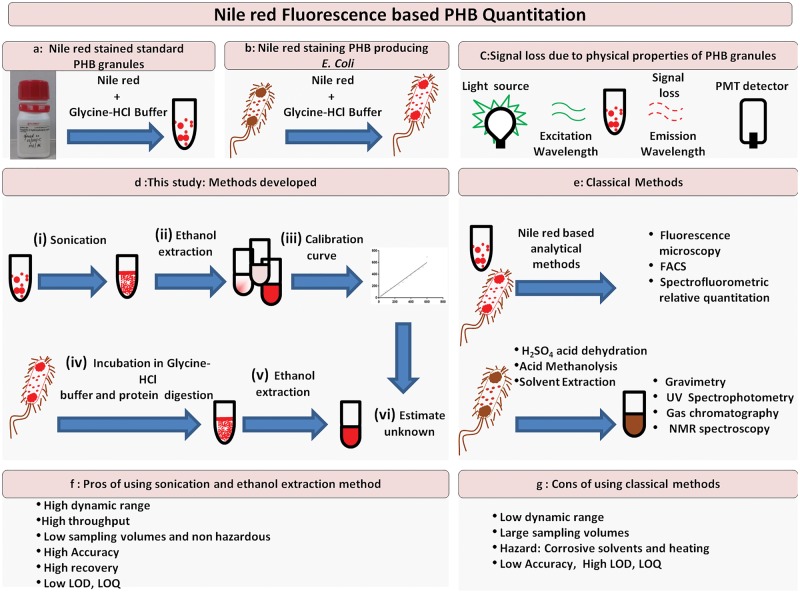
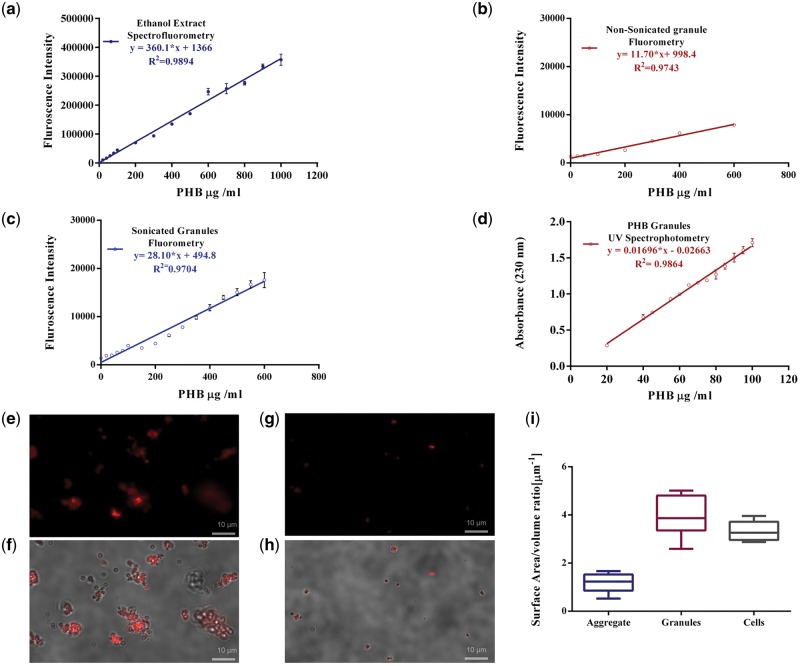
Poly(R)-3-hydroxybutyric acid (PHB) is a biodegradable natural polymer produced by microorganisms and plants under nitrogen deprivation and physiological stress. Metabolic engineering and synthetic biology approaches are underway to develop strains that can produce PHB and its co-polymers. One of the major limitations to the scaling and success of strain development for biosynthesis of PHB is the absence of fast, accurate, quantitative and scalable methods to estimate PHB in polymer producing cells. In this study, a Nile red-based spectrofluorometric method is developed for absolute quantitation of PHB in recombinant . The method is a modification of an existing Nile red-based method currently only used for relative quantitation. The two added steps of sonication and ethanol extraction increase the dynamic range of the assay and limit of detection/quantitation. Sonication of PHB standards provides uniform distribution of surface area to volume ratios. This ensures reproducibility and accuracy (lower %relative error) of quantitative staining of granules by Nile red even in a higher dynamic concentration range of 125-1000 µg/ml. Ethanolic extraction of the PHB bound Nile red allows higher recovery and accurate absolute quantitation. To reproduce high recovery and ensure accuracy and precision of the analytical method directly using cells, a protein digestion step was added. This accounted for fluorescence from over-expressed protein and resulted in screening of nonproducers of PHB amongst samples. Thus, the method developed is rapid, accurate, and reproducible, requires low sample volumes and processing compared to other conventional methods. This method is scalable to other PHA's and diverse plastics.
聚(R)-3-羟基丁酸酯(PHB)是一种可生物降解的天然聚合物,由微生物和植物在氮缺乏和生理胁迫条件下产生。代谢工程和合成生物学方法正在用于开发能够生产PHB及其共聚物的菌株。PHB生物合成菌株开发扩大规模和取得成功的主要限制之一是缺乏快速、准确、定量且可扩展的方法来估计聚合物生产细胞中的PHB。在本研究中,开发了一种基于尼罗红的荧光分光光度法用于绝对定量重组体中的PHB。该方法是对现有的仅用于相对定量的基于尼罗红的方法的改进。添加的超声处理和乙醇提取这两个步骤增加了测定的动态范围以及检测/定量限。对PHB标准品进行超声处理可使表面积与体积比均匀分布。这确保了即使在125 - 1000µg/ml的较高动态浓度范围内,尼罗红对颗粒进行定量染色的重现性和准确性(较低的相对误差百分比)。对与PHB结合的尼罗红进行乙醇提取可实现更高的回收率和准确的绝对定量。为了直接使用细胞重现高回收率并确保分析方法的准确性和精密度,添加了蛋白质消化步骤。这消除了过量表达蛋白质产生的荧光,并导致在样品中筛选出不产生PHB的菌株。因此,所开发的方法快速、准确且可重现,与其他传统方法相比,所需样品体积和处理量较低。该方法可扩展应用于其他聚羟基脂肪酸酯和多种塑料。