Fomina Tatiana, Burmistrova-Savenkova Angelika, Morosanova Varvara
Psychological Institute of the Russian Academy of Education, Mokhovaya st. 9, bld.4, Moscow 125009, Russia.
Behav Sci (Basel). 2020 Mar 10;10(3):67. doi: 10.3390/bs10030067.
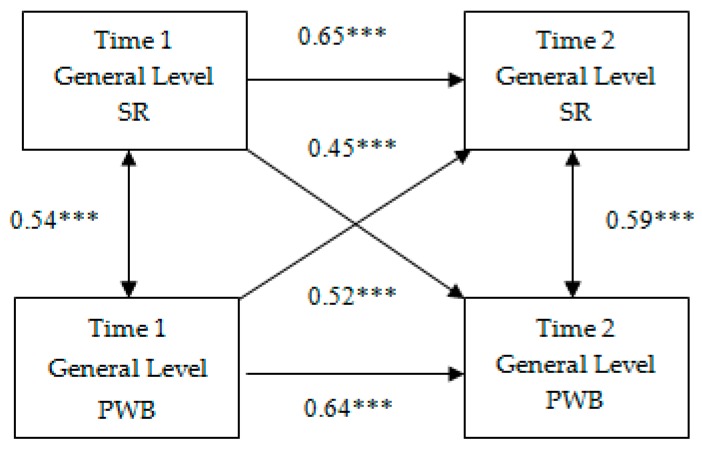
This paper addresses the question of whether self-regulation capacities are a significant psychological resource of schoolchildren's psychological well-being. The study contributes to the search of significant predictors of the students' psychological well-being. Moscow secondary schools pupils (N = 239) participated in a two-wave longitudinal study, the procedure being made in the 4th grade and repeated in the 5th grade, six months after the first measurement. The results are presented describing the dynamics of manifestations of the psychological well-being and the conscious self-regulation of the schoolchildren during their transition from the primary to the middle school. Using the cross-lagged panel analysis allowed concluding that the level of conscious self-regulation of the learning activity of the 4th graders significantly predicts their psychological well-being not only in the 4th grade, but also in the 5th grade. The study revealed the specific regulatory predictors characteristic of different manifestations of the schoolchildren' psychological well-being. The obtained results highlight the significance of research on the conscious self-regulation of learning activities as a resource for pupils' psychological well-being, which is predictive for its maturation in the subsequent ages.
本文探讨了自我调节能力是否是小学生心理健康的重要心理资源这一问题。该研究有助于寻找学生心理健康的重要预测因素。莫斯科中学的学生(N = 239)参与了一项两阶段的纵向研究,该程序在四年级进行,并在第一次测量六个月后的五年级重复进行。研究结果呈现了小学生从小学过渡到中学期间心理健康和有意识自我调节表现的动态变化。使用交叉滞后面板分析可以得出结论,四年级学生学习活动的有意识自我调节水平不仅能显著预测他们四年级时的心理健康,还能预测五年级时的心理健康。该研究揭示了小学生心理健康不同表现所特有的特定调节预测因素。所得结果凸显了将学习活动的有意识自我调节作为学生心理健康资源进行研究的重要性,这对其在后续年龄段的成熟具有预测作用。