Department of Microbiology and Immunology, Institute of Endemic Disease, Seoul National University College of Medicine, Seoul, Korea.
Department of Internal Medicine, Seoul National University College of Medicine, Seoul, Korea.
Korean J Intern Med. 2020 Nov;35(6):1400-1410. doi: 10.3904/kjim.2019.038. Epub 2020 Mar 13.
BACKGROUND/AIMS: Angiotensin II in the failing heart initially helps to maintain cardiac output and blood pressure, but ultimately accelerates its deterioration. In this study, we established a model of arrhythmia-induced heart failure (HF) in zebrafish and investigated the role of renin-angiotensin-aldosterone system (RAAS) modulation by using an angiotensin II type 1 receptor blocker, fimasartan, through the assessment of cellular and physiologic responses, morbidity, and mortality.
HF was induced in zebrafish larvae by exposure to 20 μM terfenadine. Morphologic, physiologic, and functional parameters were assessed in the presence or absence of fimasartan treatment.
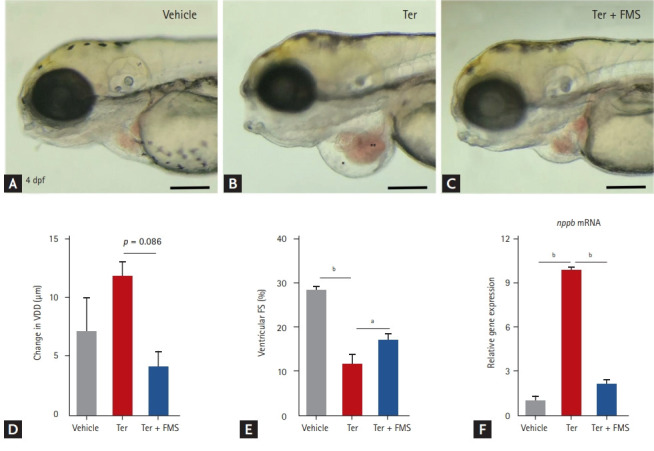
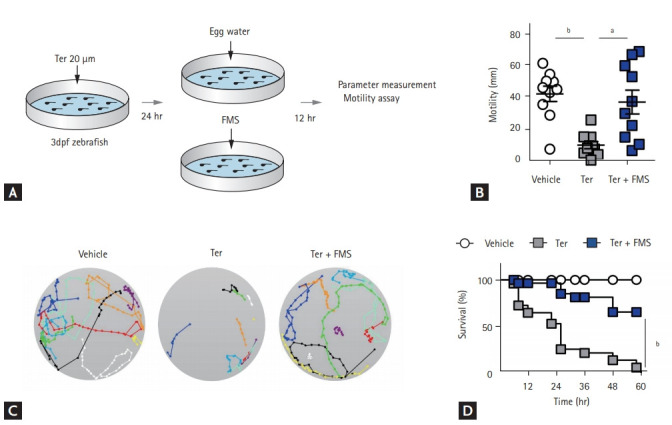
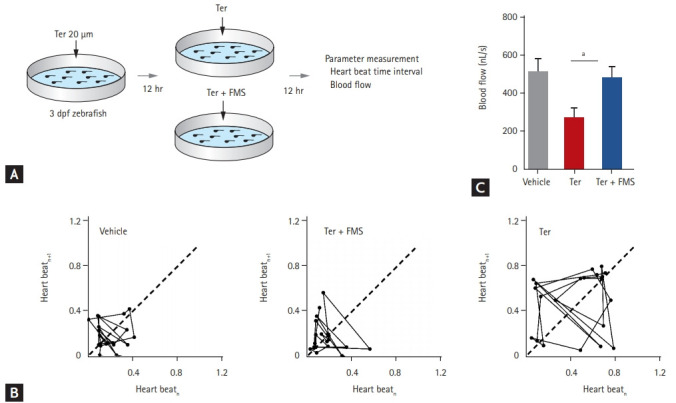
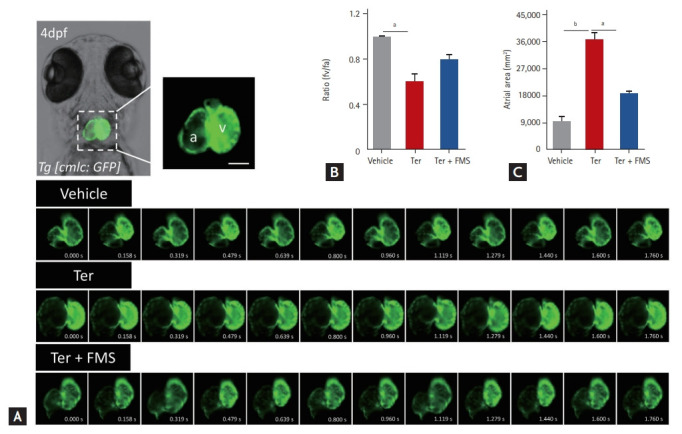
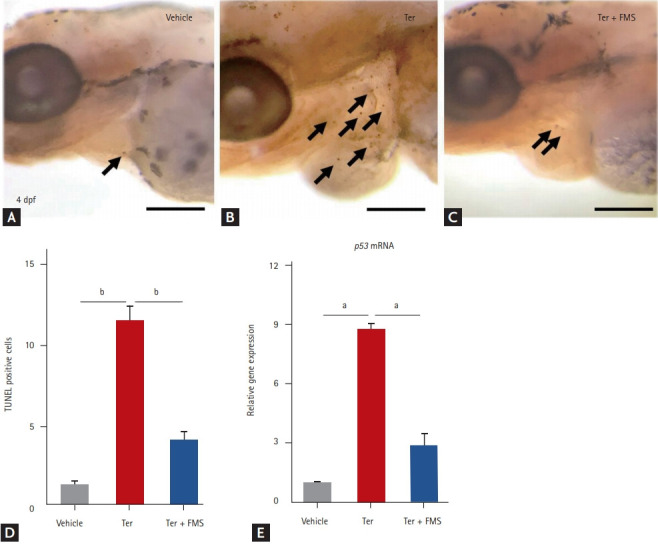
Zebrafish exposed to terfenadine showed marked dilatation of the ventricle and reduced systolic function. Treatment with terfenadine was associated with 10-fold higher expression of atrial natriuretic peptide (p < 0.001 vs. vehicle), increased p53 mRNA expression, and chromatin fragmentation in the TUNEL assay, all of which were significantly reduced by fimasartan treatment. Moreover, fimasartan improved fractional shortening (terfenadine + fimasartan 16.9% ± 3.1% vs. terfenadine + vehicle 11.4% ± 5.6%, p < 0.05) and blood flow (terfenadine + fimasartan 479.1 ± 124.1 nL/sec vs. terfenadine + vehicle 273.0 ± 109.0 nL/sec, p < 0.05). Finally, treatment with fimasartan remarkably reduced mortality (terfenadine + fimasartan 36.0% vs. terfenadine + vehicle 96.0%, p < 0.001).
Fimasartan effectively protected against the progression of HF in zebrafish by improving hemodynamic indices, which improved survival. A reduction in apoptotic cell death and an improvement in hemodynamics may be the mechanisms behind these effects. Further human studies are warranted to evaluate the possible role of fimasartan in the treatment of HF.
背景/目的:血管紧张素 II 在衰竭心脏中最初有助于维持心输出量和血压,但最终会加速其恶化。在这项研究中,我们在斑马鱼中建立了心律失常诱导的心力衰竭 (HF) 模型,并通过评估细胞和生理反应、发病率和死亡率,研究了肾素-血管紧张素-醛固酮系统 (RAAS) 调节的作用,使用血管紧张素 II 型 1 受体阻滞剂法米沙坦。
用 20 μM 特非那定处理斑马鱼幼虫以诱导 HF。在存在或不存在法米沙坦治疗的情况下评估形态、生理和功能参数。
暴露于特非那定的斑马鱼表现出心室明显扩张和收缩功能降低。特非那定治疗与心房利钠肽表达增加 10 倍(p < 0.001 比对照)、p53 mRNA 表达增加和 TUNEL 检测到的染色质片段化相关,这些都被法米沙坦治疗显著降低。此外,法米沙坦改善了分数缩短(特非那定+法米沙坦 16.9%±3.1%比特非那定+载体 11.4%±5.6%,p < 0.05)和血流(特非那定+法米沙坦 479.1±124.1 nL/sec 比特非那定+载体 273.0±109.0 nL/sec,p < 0.05)。最后,法米沙坦治疗显著降低死亡率(特非那定+法米沙坦 36.0%比特非那定+载体 96.0%,p < 0.001)。
法米沙坦通过改善血流动力学指标有效保护斑马鱼免受 HF 进展,从而提高生存率。减少凋亡细胞死亡和改善血液动力学可能是这些作用的机制。需要进一步的人体研究来评估法米沙坦在 HF 治疗中的可能作用。