Kumar Abhijeet, Porter Martyn, Shah Nikhil, Gaba Chakshu, Siney Paul
Wrightington, Wigan and Leigh NHS Foundation Trust, Wigan, United Kingdom.
Institute of Dental Sciences, Bareilly, India.
Open Access Maced J Med Sci. 2019 Dec 12;7(23):4059-4065. doi: 10.3889/oamjms.2019.710. eCollection 2019 Dec 15.
The cement-in-cement femoral revision technique involves removing a femoral component from a well-fixed femoral cement mantle and cementing a new stem into the original mantle. This technique, when carried out for the correct indications, is fast, relatively inexpensive and carries a reduced short-term risk for the patient compared with conventional way of removing well-fixed cement.
To analyze the effectiveness of cement in cement revision of the femoral stem while performing a revision Total Hip Arthroplasty (THA).
We analyzed a consecutive series of 79 patients who underwent a cement in cement revision THA between June-2015 to June-2018. All the patients were retrospectively analysed for operative time, complications, clinical and radiological outcomes.
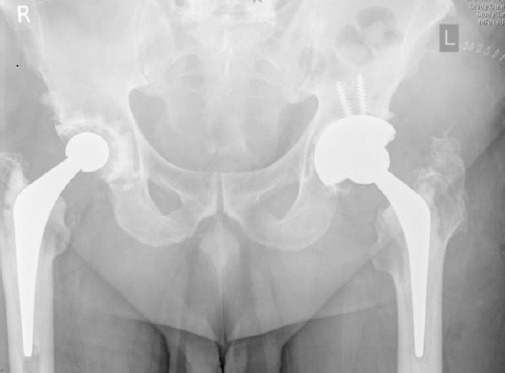
Average age was 76 years (49-86). The mean follow-up was 16.2 months (12-45). The average operative time was 184.6 (90-290) minutes. Most common indication was cup loosening in 28 patients (42.4%), dislocation in 14 patients (21.2%) and stem loosening in 12 patients (18.2%) Nine patients (11%) had one or more complications. Pre-operatively, 10 patients (13%) had lucency at the cement bone interface. Recent review has shown that 8 of these patients' radiographs have remained unchanged, and in 2 of them there is a slight progression of lucency. Common post op clinical complaintswere persistent pain and abductor weakness. Five (6.3%) patients required a re-revision. Most of the patients had a good or satisfactory outcome.No stems showed radiological loosening.
The cement-in-cement technique for revision of the femoral component gave promising results and had the advantages of speed, less blood or bone stock loss, less risk of femoral perforation or fracture, decreased financial costs and reduced post op morbidity.
骨水泥型股骨翻修技术是指从牢固固定的股骨骨水泥壳中取出股骨假体,并将新的股骨柄假体固定于原骨水泥壳内。与传统的取出牢固固定骨水泥的方法相比,该技术在适应证选择正确时操作迅速、成本相对较低,且患者短期风险降低。
分析在翻修全髋关节置换术(THA)时骨水泥型股骨柄翻修的有效性。
我们分析了2015年6月至2018年6月期间连续接受骨水泥型股骨柄翻修THA的79例患者。对所有患者的手术时间、并发症、临床及影像学结果进行回顾性分析。
平均年龄76岁(49 - 86岁)。平均随访时间为16.2个月(12 - 45个月)。平均手术时间为184.6分钟(90 - 290分钟)。最常见的适应证是髋臼松动28例(42.4%)、脱位14例(21.2%)和股骨柄松动12例(18.2%)。9例(11%)患者出现一种或多种并发症。术前,10例(13%)患者在骨水泥 - 骨界面出现透亮区。近期复查显示,其中8例患者的X线片未变化,2例患者透亮区有轻微进展。术后常见的临床主诉是持续疼痛和外展肌无力。5例(6.3%)患者需要再次翻修。大多数患者预后良好或满意。无股骨柄出现影像学松动。
骨水泥型股骨假体翻修技术取得了良好的效果,具有手术速度快、失血或骨量丢失少、股骨穿孔或骨折风险低、费用降低以及术后发病率降低等优点。