Liaw Patricia C, Fox-Robichaud Alison E, Liaw Kao-Lee, McDonald Ellen, Dwivedi Dhruva J, Zamir Nasim M, Pepler Laura, Gould Travis J, Xu Michael, Zytaruk Nicole, Medeiros Sarah K, McIntyre Lauralyn, Tsang Jennifer, Dodek Peter M, Winston Brent W, Martin Claudio, Fraser Douglas D, Weitz Jeffrey I, Lellouche Francois, Cook Deborah J, Marshall John
Thrombosis and Atherosclerosis Research Institute, McMaster University, Hamilton, ON, Canada.
Department of Medicine, McMaster University, Hamilton, ON, Canada.
Crit Care Explor. 2019 Aug 1;1(8):e0032. doi: 10.1097/CCE.0000000000000032. eCollection 2019 Aug.
To determine if a set of time-varying biological indicators can be used to: 1) predict the sepsis mortality risk over time and 2) generate mortality risk profiles.
Prospective observational study.
Nine Canadian ICUs.
Three-hundred fifty-six septic patients.
None.
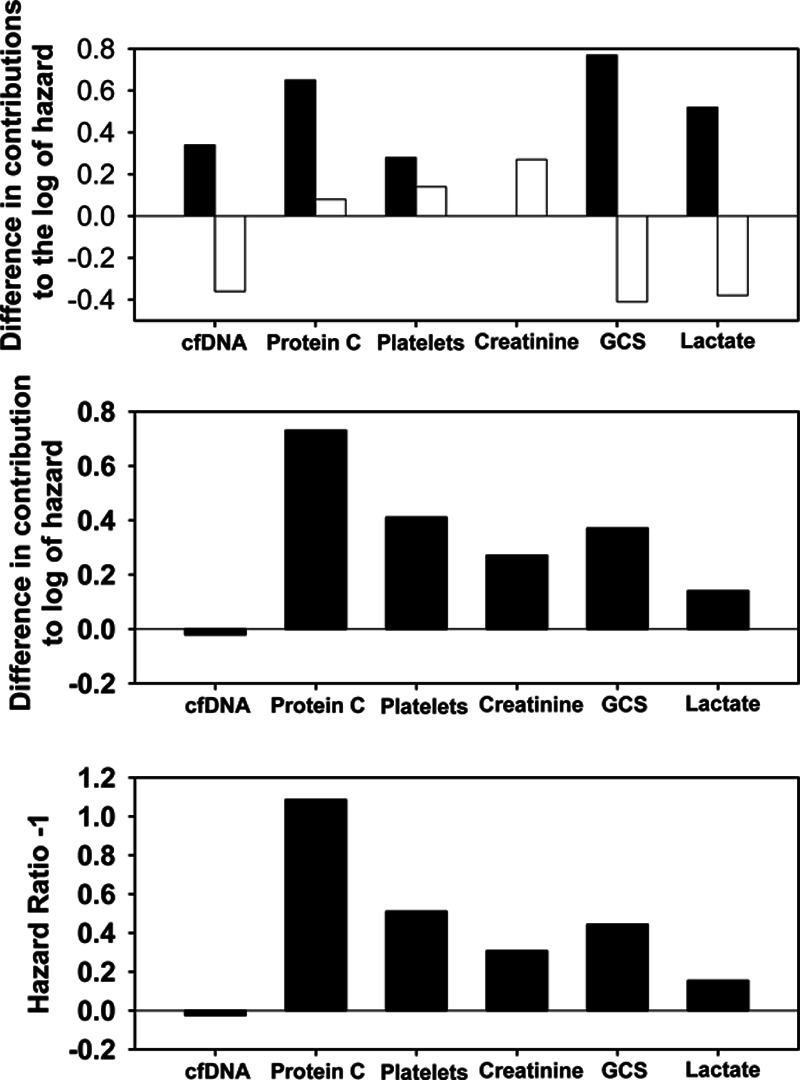
Clinical data and plasma levels of biomarkers were collected longitudinally. We used a complementary log-log model to account for the daily mortality risk of each patient until death in ICU/hospital, discharge, or 28 days after admission. The model, which is a versatile version of the Cox model for gaining longitudinal insights, created a composite indicator (the daily hazard of dying) from the "day 1" and "change" variables of six time-varying biological indicators (cell-free DNA, protein C, platelet count, creatinine, Glasgow Coma Scale score, and lactate) and a set of contextual variables (age, presence of chronic lung disease or previous brain injury, and duration of stay), achieving a high predictive power (conventional area under the curve, 0.90; 95% CI, 0.86-0.94). Including change variables avoided misleading inferences about the effects of day 1 variables, signifying the importance of the longitudinal approach. We then generated mortality risk profiles that highlight the relative contributions among the time-varying biological indicators to overall mortality risk. The tool was validated in 28 nonseptic patients from the same ICUs who became septic later and was subject to 10-fold cross-validation, achieving similarly high area under the curve.
Using a novel version of the Cox model, we created a prognostic tool for septic patients that yields not only a predicted probability of dying but also a mortality risk profile that reveals how six time-varying biological indicators differentially and longitudinally account for the patient's overall daily mortality risk.
为确定一组随时间变化的生物学指标是否可用于:1)预测随时间变化的脓毒症死亡风险,以及2)生成死亡风险概况。
前瞻性观察性研究。
加拿大的9个重症监护病房。
356例脓毒症患者。
无。
纵向收集临床数据和生物标志物的血浆水平。我们使用互补对数-对数模型来计算每位患者在重症监护病房/医院死亡、出院或入院后28天内的每日死亡风险。该模型是Cox模型的一个通用版本,用于获取纵向见解,它根据六个随时间变化的生物学指标(游离DNA、蛋白C、血小板计数、肌酐、格拉斯哥昏迷量表评分和乳酸)的“第1天”和“变化”变量以及一组背景变量(年龄、慢性肺病或既往脑损伤的存在情况以及住院时间)创建了一个综合指标(每日死亡风险),具有较高的预测能力(传统曲线下面积为0.90;95%置信区间为0.86 - 0.94)。纳入变化变量避免了对第1天变量影响的误导性推断,这表明纵向方法的重要性。然后我们生成了死亡风险概况,突出了随时间变化的生物学指标对总体死亡风险的相对贡献。该工具在来自同一重症监护病房的28例非脓毒症患者中进行了验证,这些患者后来发生了脓毒症,并进行了10倍交叉验证,曲线下面积同样较高。
使用Cox模型的一个新版本,我们为脓毒症患者创建了一种预后工具,该工具不仅能产生死亡预测概率,还能生成一个死亡风险概况,揭示六个随时间变化的生物学指标如何不同且纵向地解释患者的总体每日死亡风险。