Homsy Elie, Das Srabani, Consiglio Paul, McAtee Corynn, Zachman Angela, Nagaraja Haikady, Wewers Mark D, Exline Matthew C, Mallampalli Rama K, Sarkar Anasuya
Division of Pulmonary Medicine, Department of Internal Medicine, The Ohio State University Medical Center, Columbus, OH.
Department of Physiology and Cell Biology, The Ohio State University Medical Center, Columbus, OH.
Crit Care Explor. 2019 Sep 17;1(9):e0039. doi: 10.1097/CCE.0000000000000039. eCollection 2019 Sep.
The key to further improving outcomes in sepsis lies in understanding and abrogating the dysfunctional immune response that leads to organ failure. Activation of gasdermin-D, a pore-forming protein within the inflammasome cascade, has recently been recognized as the critical step in pyroptosis and organ dysfunction. In this study, we sought to investigate the presence of gasdermin-D in critically ill subjects.
Prospective pilot study comparing microparticulate active gasdermin-D levels in critically ill patients admitted to the medical ICU at The Ohio State University Medical Center to healthy donors and clinical outcomes.
None.
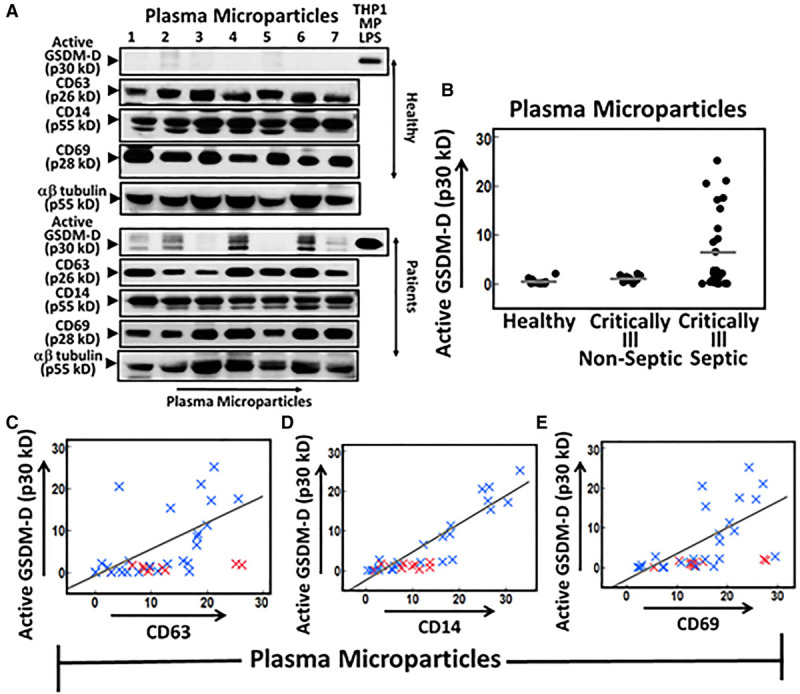
Plasma was collected from subjects upon consent and microparticles were isolated by ultracentrifugation. Proteins of interest were identified by immunoblot analysis of microparticle lysates. Quantification was accomplished by densitometry using ImageJ software (National Institutes of Health, Bethesda, MD). Investigators were then unblinded and compared microparticulate active gasdermin-D levels to physician adjudicated clinical diagnoses and outcomes. No appreciable levels of active gasdermin-D were observed in microparticles from healthy volunteers and nonseptic critically ill patients. However, elevated levels of gasdermin-D were noted in microparticles from the septic cohort of critically ill patients. Furthermore, a significant positive correlation by linear regression was noted when microparticulate active gasdermin-D levels were compared with microparticulate levels of CD63, an exosomal marker, CD14, a monocyte marker, and CD69, a marker of monocyte activation ( = 0.37, = 0.0011, = 0.85, < 0.0001, and R = 0.43, = 0.0003, respectively).
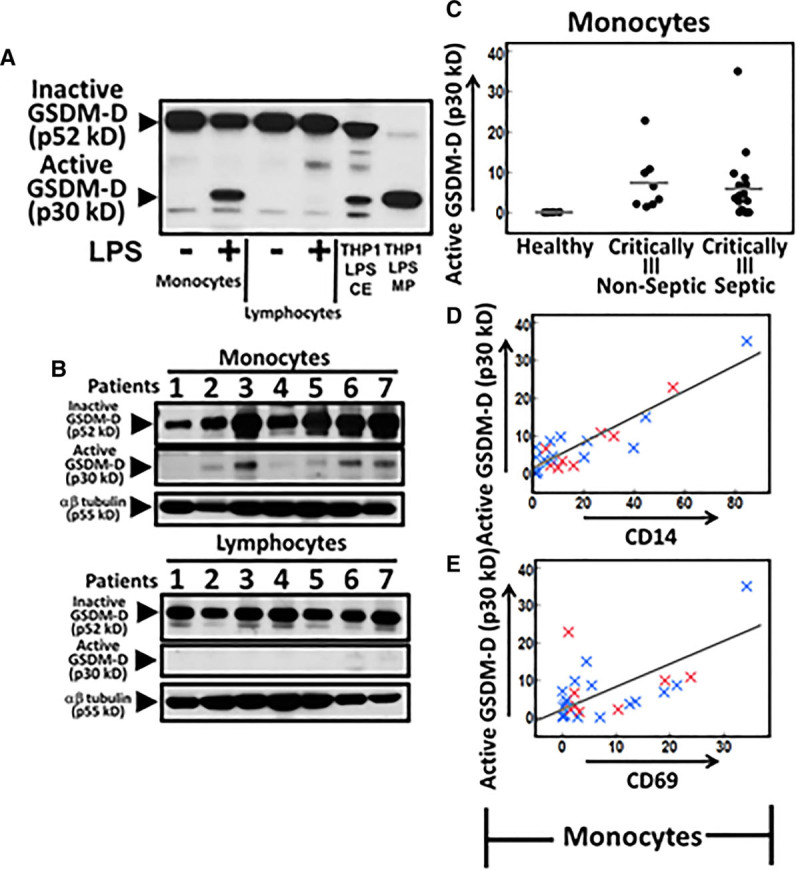
This is the first study to demonstrate circulating active gasdermin-D in septic patients in the intensive care setting. Our findings also suggest that active gasdermin-D in septic patients is encapsulated in exosomes derived from activated monocytes. Further characterization in the clinical setting is warranted.
进一步改善脓毒症治疗效果的关键在于理解并消除导致器官衰竭的功能失调免疫反应。gasdermin-D(一种炎性小体级联反应中的成孔蛋白)的激活最近被认为是细胞焦亡和器官功能障碍的关键步骤。在本研究中,我们试图调查危重症患者体内gasdermin-D的存在情况。
设计、设置与患者:前瞻性试点研究,比较俄亥俄州立大学医学中心内科重症监护病房收治的危重症患者与健康供体的微粒活性gasdermin-D水平及临床结局。
无。
经受试者同意后采集血浆,通过超速离心分离微粒。通过对微粒裂解物进行免疫印迹分析鉴定感兴趣的蛋白质。使用ImageJ软件(美国国立卫生研究院,马里兰州贝塞斯达)通过光密度测定法进行定量分析。然后研究人员解除盲态,将微粒活性gasdermin-D水平与医生判定的临床诊断和结局进行比较。在健康志愿者和非脓毒症危重症患者的微粒中未观察到明显水平的活性gasdermin-D。然而,在脓毒症危重症患者队列的微粒中发现gasdermin-D水平升高。此外,当将微粒活性gasdermin-D水平与外泌体标志物CD63、单核细胞标志物CD14和单核细胞激活标志物CD69的微粒水平进行比较时,通过线性回归发现显著正相关(分别为r = 0.37,P = 0.0011;r = 0.85,P < 0.0001;R = 0.43,P = 0.0003)。
这是第一项在重症监护环境下证明脓毒症患者体内存在循环活性gasdermin-D的研究。我们的研究结果还表明,脓毒症患者体内的活性gasdermin-D包裹在外泌体中,这些外泌体来源于活化的单核细胞。有必要在临床环境中进一步进行特征分析。