Biochemistry Division, CSIR-Central Drug Research Institute, Lucknow, Uttar Pradesh, India.
Academy of Scientific and Innovative Research, Ghaziabad, Uttar Pradesh, India.
Cell Prolif. 2020 Apr;53(4):e12749. doi: 10.1111/cpr.12749. Epub 2020 Mar 13.
Given that autophagy inhibition is a feasible way to enhance sensitivity of cancer cells towards chemotherapeutic agents, identifying potent autophagy inhibitor has obvious clinical relevance. Here, we investigated ability of TN-16, a microtubule disrupting agent, on modulation of autophagic flux and its significance in promoting in vitro and in vivo cancer cell death.
The effect of TN-16 on cancer cell proliferation, cell division, autophagic process and apoptotic signalling was assessed by various biochemical (Western blot and SRB assay), morphological (TEM, SEM, confocal microscopy) and flowcytometric assays. In vivo anti-tumour efficacy of TN-16 was investigated in syngeneic mouse model of breast cancer.
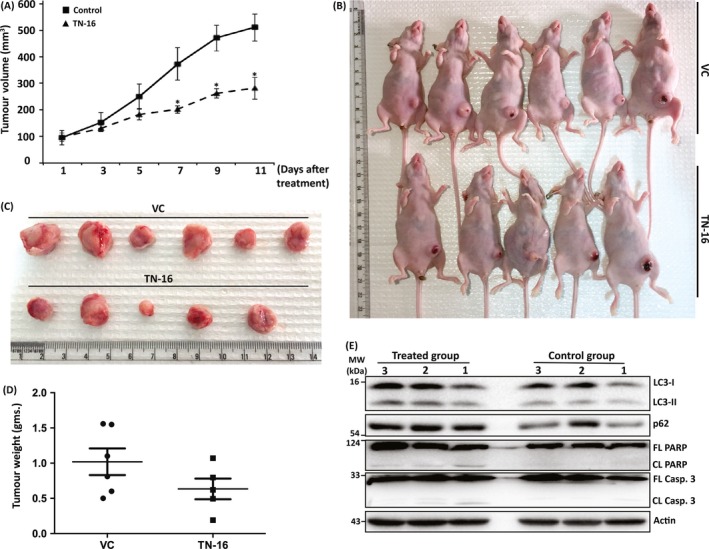
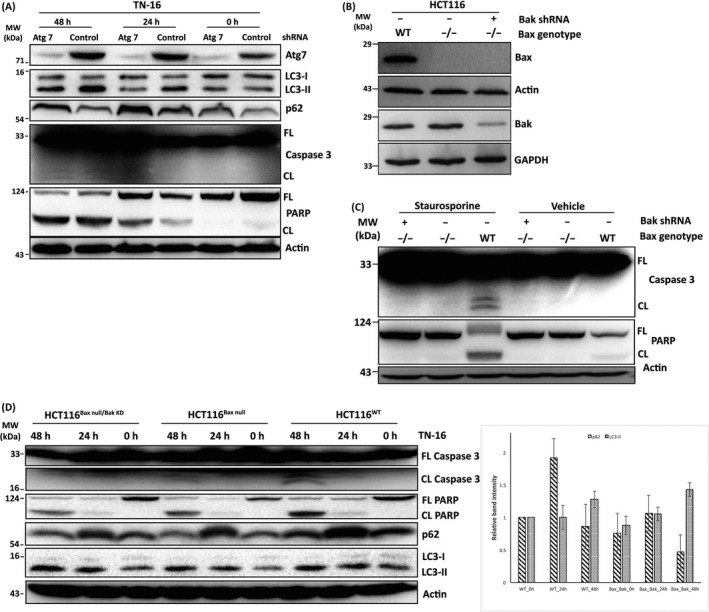
TN-16 inhibited cancer cell proliferation by impairing late-stage autophagy and induction of apoptosis. Inhibition of autophagic flux was demonstrated by accumulation of autophagy-specific substrate p62 and lack of additional LC3-II turnover in the presence of lysosomotropic agent. The effect was validated by confocal micrographs showing diminished autophagosome-lysosome fusion. Further studies revealed that TN-16-mediated inhibition of autophagic flux promotes apoptotic cell death. Consistent with in vitro data, results of our in vivo study revealed that TN-16-mediated tumour growth suppression is associated with blockade of autophagic flux and enhanced apoptosis.
Our data signify that TN-16 is a potent autophagy flux inhibitor and might be suitable for (pre-) clinical use as standard inhibitor of autophagy with anti-cancer activity.
鉴于自噬抑制是增强癌细胞对化疗药物敏感性的一种可行方法,因此鉴定有效的自噬抑制剂具有明显的临床相关性。在这里,我们研究了微管破坏剂 TN-16 调节自噬流的能力及其在促进体外和体内癌细胞死亡方面的意义。
通过各种生化(Western blot 和 SRB 测定)、形态学(TEM、SEM、共聚焦显微镜)和流式细胞术检测 TN-16 对癌细胞增殖、细胞分裂、自噬过程和凋亡信号的影响。在乳腺癌同基因小鼠模型中研究了 TN-16 的体内抗肿瘤疗效。
TN-16 通过损害晚期自噬和诱导细胞凋亡来抑制癌细胞增殖。自噬流的抑制作用通过自噬特异性底物 p62 的积累和溶酶体增敏剂存在时 LC3-II 转换的缺乏来证明。共聚焦显微镜显示自噬体-溶酶体融合减少,验证了这一作用。进一步的研究表明,TN-16 介导的自噬流抑制促进了细胞凋亡。与体外数据一致,我们的体内研究结果表明,TN-16 介导的肿瘤生长抑制与自噬流阻断和凋亡增强有关。
我们的数据表明,TN-16 是一种有效的自噬流抑制剂,可能适合作为具有抗癌活性的标准自噬抑制剂用于(临床前)临床应用。