Department of Medicine, The Medical Team Hospice, Livonia, Michigan, USA.
Department of Public Health and Community Medicine, Pain Research, Education and Policy Program, Tufts University School of Medicine, Boston, Massachusetts, USA.
J Palliat Med. 2020 Sep;23(9):1167-1171. doi: 10.1089/jpm.2019.0618. Epub 2020 Mar 11.
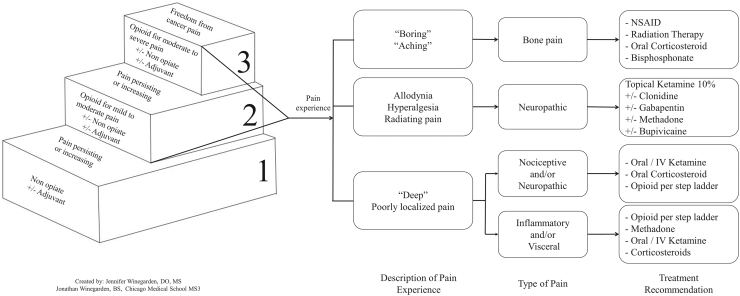
Uncontrolled cancer pain is a significant problem in palliative medicine. Opioids are often first-line treatment that increase risks of analgesic tolerance and hyperalgesia. Topical ketamine with other adjuvant pain medications is an often-overlooked treatment, yet may be most effective in difficult-to-treat cancer pain. We report a case series of hospice patients with uncontrolled cancer pain who were suboptimally treated with opioids and nerve blocks, whose symptoms responded to topical ketamine with other adjuvants. We review the pronociceptive properties of opioids and how topical multimodal treatment of cancer pain can be more effective than standard opioids, other topical adjuvant medications, and nerve blocks. We discuss the shortcomings of the World Health Organization (WHO) stepladder for the treatment of cancer pain and suggest an adjuvant treatment algorithm, directing physicians to appropriate adjuvant pain agents based on pain type and distinct receptor actions. This is a retrospective case series of patients who responded to topical multimodal pain treatment with implementation of findings into an addendum to the WHO stepladder. Subjects were from a case series of community-based hospice patients with previously uncontrolled cancer pain. Measurement was made by self-report of pain levels using the 10-point numeric pain rating scale. Patients' pain was controlled with topical adjuvant medications with return to previously lost function and prevention of otherwise escalating opioid dosing. These patient cases reveal how ketamine-based topical treatment for cancer pain can be more effective than standard opioids, other topical adjuvant medications, and nerve blocks with no noted side effects and observed reduction in opioid consumption.
未控制的癌痛是姑息医学中的一个重大问题。阿片类药物通常是一线治疗药物,但会增加镇痛耐受和痛觉过敏的风险。局部应用氯胺酮加其他辅助性止痛药物是一种经常被忽视的治疗方法,但在治疗难治性癌痛方面可能最为有效。我们报告了一系列患有未控制癌痛的临终关怀患者的病例,这些患者在接受阿片类药物和神经阻滞治疗后效果不佳,他们的症状对局部应用氯胺酮加其他辅助药物有反应。我们回顾了阿片类药物的致痛作用,以及局部多模式治疗癌症疼痛如何比标准阿片类药物、其他局部辅助药物和神经阻滞更有效。我们讨论了世界卫生组织(WHO)阶梯式治疗癌痛的缺点,并提出了一种辅助治疗算法,根据疼痛类型和不同受体作用,指导医生选择适当的辅助止痛药物。这是一项回顾性病例系列研究,研究对象为对局部多模式止痛治疗有反应的患者,并将研究结果纳入 WHO 阶梯式治疗的附录中。这些患者来自社区为基础的临终关怀患者中的一系列先前未得到控制的癌痛病例。通过使用 10 分数字疼痛评分量表来自我报告疼痛水平来进行测量。患者的疼痛通过局部辅助药物得到控制,恢复了以前失去的功能,并防止了阿片类药物剂量的进一步增加。这些患者的病例揭示了基于氯胺酮的局部治疗癌痛如何比标准阿片类药物、其他局部辅助药物和神经阻滞更有效,而且没有明显的副作用,观察到阿片类药物的消耗减少。