Guangdong Provincial Hospital of Chinese Medicine, Guangdong Provincial Academy of Chinese Medical Sciences, and The Second Clinical College, Guangzhou University of Chinese Medicine, Guangzhou, China.
The China-Australia International Research Centre for Chinese Medicine, School of Health and Biomedical Sciences, RMIT University, Bundoora, VIC, Australia.
Integr Cancer Ther. 2023 Jan-Dec;22:15347354231210870. doi: 10.1177/15347354231210870.
Safe and effective management of cancer-related pain is a worldwide challenge. In the search for treatment options, natural products used in Chinese herbal medicines (CHMs) have received attention in clinical studies for their effects on cancer-related pain. The objective of this systematic review is to evaluate the clinical evidence for topically applied CHMs as adjunctive treatments for cancer pain management.
Nine biomedical databases and 4 clinical trial registries were searched for randomized-controlled trials (RCTs) that reported measures of pain and/or quality of life. Risk of bias was assessed using the Cochrane tool. Meta-analysis employed mean difference (MD) with 95% confidence intervals (random effects).
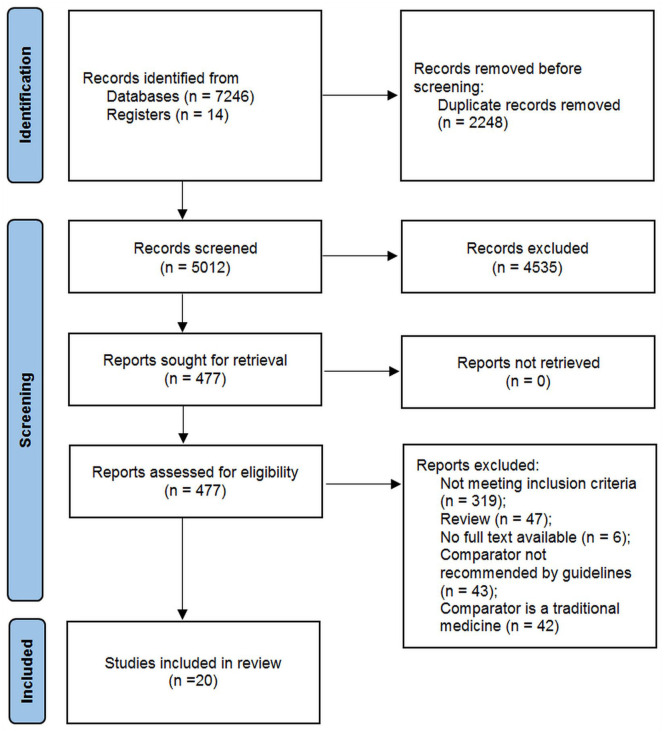
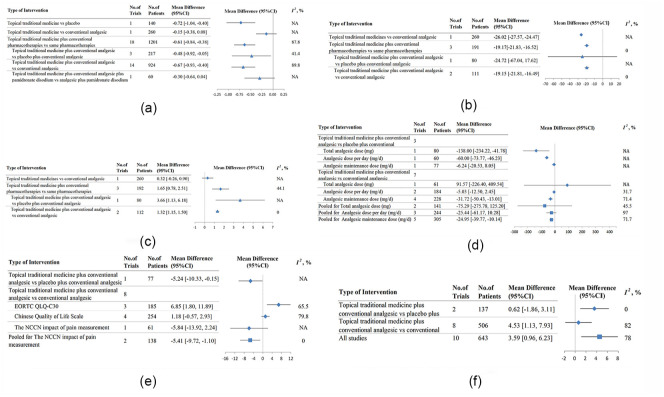
Twenty (20) RCTs (1636 participants) met the inclusion criteria. Meta-analyses were grouped based on the comparisons and outcome measures. For pain intensity, there was a greater reduction in the topical CHM group versus placebo (MD -0.72 [-1.04, -0.40]), no difference when compared to tramadol (MD -0.15 [-0.38, 0.08]), and a greater reduction when topical CHMs were combined with conventional analgesic medications (MD -0.67 [-0.93, -0.40]). Analgesic onset time was reduced in the CHM group compared to tramadol (MD -26.02 [-27.57, -24.47] minutes), and for CHMs combined with conventional medications (MD -19.17 [-21.83, -16.52] minutes). When CHMs were combined with analgesic medications, improvements were found for duration of analgesia (MD 1.65 [0.78, 2.51] hours), analgesic maintenance dose (MD -31.72 [-50.43, -13.01] milligrams/day), and quality of life.
Addition of topical CHMs to conventional analgesic medications was associated with improved outcomes for pain intensity, some other pain-related outcomes, and measures of quality of life. Limitations included methodological issues in some studies and considerable heterogeneity in some pooled results.
安全有效地管理癌痛是全球性的挑战。在寻找治疗方案的过程中,中草药中使用的天然产物因其对癌痛的作用而在临床研究中受到关注。本系统评价的目的是评估局部应用中草药作为癌症疼痛管理辅助治疗的临床证据。
检索了 9 个生物医学数据库和 4 个临床试验注册处,以寻找报告疼痛和/或生活质量测量结果的随机对照试验(RCT)。使用 Cochrane 工具评估偏倚风险。采用均数差(MD)和 95%置信区间(随机效应)进行荟萃分析。
20 项 RCT(1636 名参与者)符合纳入标准。根据比较和结局测量指标对荟萃分析进行分组。对于疼痛强度,与安慰剂相比,局部应用中草药组的疼痛减轻更明显(MD-0.72[-1.04,-0.40]),与曲马多相比无差异(MD-0.15[-0.38,0.08]),与常规镇痛药物联合使用时减轻更明显(MD-0.67[-0.93,-0.40])。与曲马多相比,中草药组的镇痛起效时间缩短(MD-26.02[-27.57,-24.47]分钟),与常规药物联合使用时也缩短(MD-19.17[-21.83,-16.52]分钟)。当中草药与镇痛药物联合使用时,在镇痛持续时间(MD 1.65[0.78,2.51]小时)、镇痛维持剂量(MD-31.72[-50.43,-13.01]毫克/天)和生活质量方面都有改善。
将局部应用中草药与常规镇痛药物联合使用可改善疼痛强度、其他一些与疼痛相关的结局以及生活质量的测量结果。局限性包括一些研究中的方法学问题和一些汇总结果中的高度异质性。