Department of Soils and Agrifood Engineering, Université Laval, Québec City, Québec, Canada.
Quebec Research and Development Centre, Agriculture and Agri-Food Canada, Québec City, Québec, Canada.
PLoS One. 2020 Mar 13;15(3):e0230458. doi: 10.1371/journal.pone.0230458. eCollection 2020.
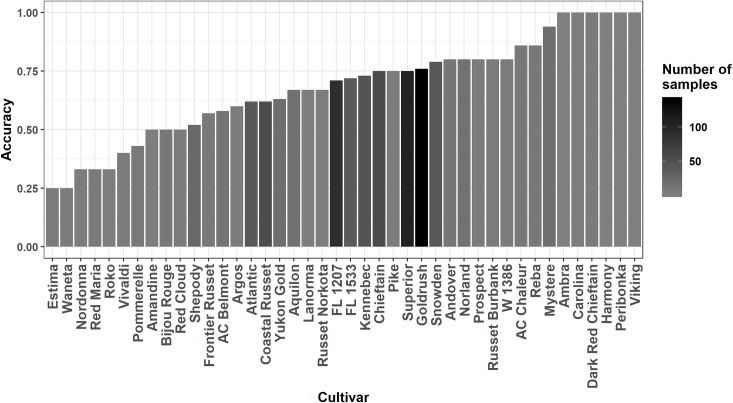
Gradients in the elemental composition of a potato leaf tissue (i.e. its ionome) can be linked to crop potential. Because the ionome is a function of genetics and environmental conditions, practitioners aim at fine-tuning fertilization to obtain an optimal ionome based on the needs of potato cultivars. Our objective was to assess the validity of cultivar grouping and predict potato tuber yields using foliar ionomes. The dataset comprised 3382 observations in Québec (Canada) from 1970 to 2017. The first mature leaves from top were sampled at the beginning of flowering for total N, P, K, Ca, and Mg analysis. We preprocessed nutrient concentrations (ionomes) by centering each nutrient to the geometric mean of all nutrients and to a filling value, a transformation known as row-centered log ratios (clr). A density-based clustering algorithm (dbscan) on these preprocessed ionomes failed to delineate groups of high-yield cultivars. We also used the preprocessed ionomes to assess their effects on tuber yield classes (high- and low-yields) on a cultivar basis using k-nearest neighbors, random forest and support vector machines classification algorithms. Our machine learning models returned an average accuracy of 70%, a fair diagnostic potential to detect in-season nutrient imbalance of potato cultivars using clr variables considering potential confounding factors. Optimal ionomic regions of new cultivars could be assigned to the one of the closest documented cultivar.
马铃薯叶片组织(即其元素组成)的元素组成梯度与其潜在产量有关。由于元素组成是遗传和环境条件的函数,从业者的目标是通过调整施肥来获得基于马铃薯品种需求的最佳元素组成。我们的目标是评估基于叶片元素组成的品种分组的有效性并预测马铃薯块茎产量。该数据集包含 1970 年至 2017 年加拿大魁北克省的 3382 个观测值。在开花初期,从顶部的第一个成熟叶片中采集了总 N、P、K、Ca 和 Mg 分析样本。我们通过将每种养分中心化到所有养分的几何平均值和填充值(一种称为行中心化对数比 (clr) 的变换)来预处理养分浓度(元素组成)。对这些预处理的元素组成进行基于密度的聚类算法 (dbscan) 聚类未能划分出高产量品种的群体。我们还使用预处理的元素组成,使用最近邻、随机森林和支持向量机分类算法,基于品种评估它们对块茎产量等级(高产量和低产量)的影响。我们的机器学习模型返回了平均 70%的准确率,考虑到潜在的混杂因素,使用 clr 变量检测马铃薯品种的季节性养分失衡具有公平的诊断潜力。新品种的最佳元素组成区域可以分配给最接近的记录品种。