Bhaskar Elvin, Kau Chung H
Department of Orthodontics, University of Alabama, Birmingham, Alabama, United States.
Eur J Dent. 2020 Feb;14(1):100-106. doi: 10.1055/s-0040-1702258. Epub 2020 Mar 13.
The purpose of this study was to determine the differences in three-dimensional (3D) facial features in a population from Zimbabwe and the United States. In addition, this study seeks to establish an average facial template of each population allowing clinicians to treat patients according to their cultural esthetic perceptions.
Three hundred one subjects from Zimbabwe and the United States were carefully selected and recruited for the study. Each subject presented with a normal facial profile, no asymmetries, and normal body mass index. The 3D images were captured using the 3dMD cameras. All images were further separated into male and female groups of the respective populations and imported to a dedicated software for analysis.
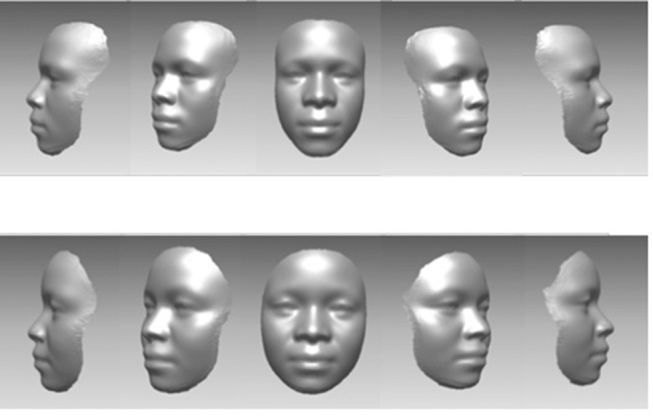
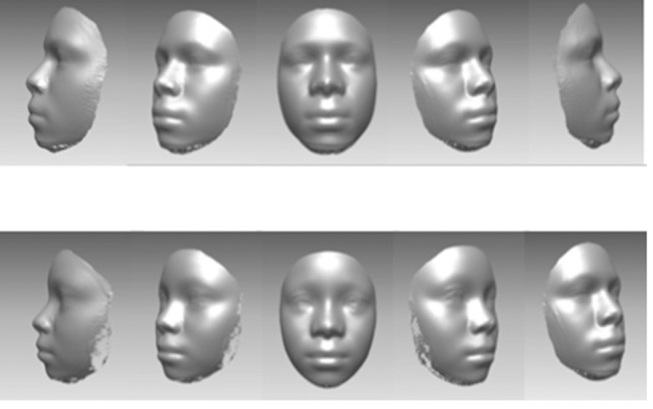
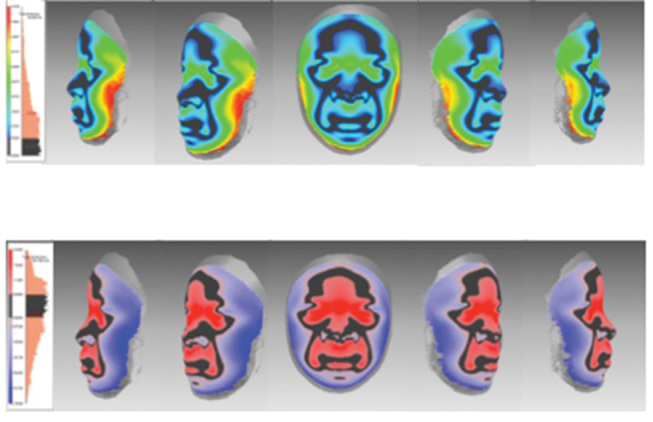
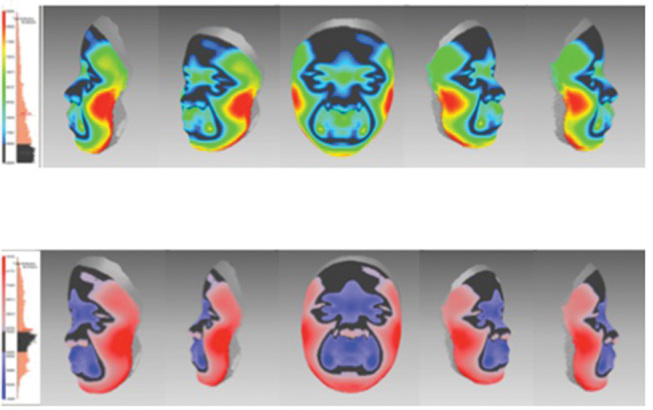
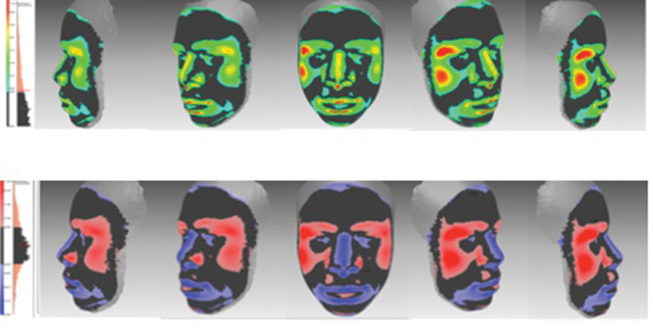
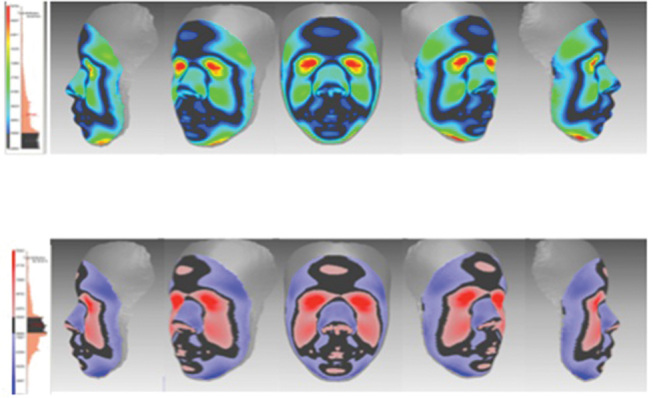
The 3D facial images were constructed using Rapidform 6 software to recreate a composite facial average for each group representing a male and female average 3D face of Zimbabwean (Zim) and United States origin.
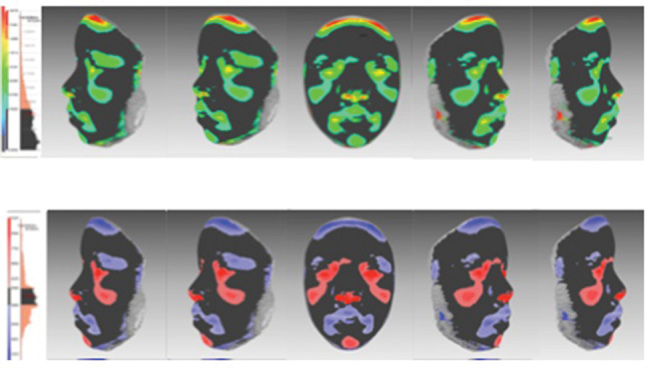
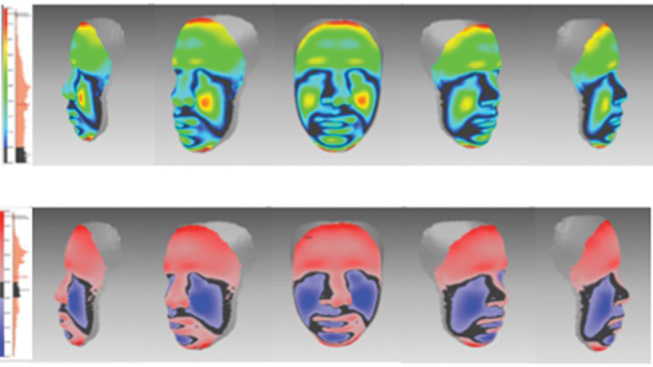
The linear measurements showed that the maximum average distance between the Zim-M and Zim-F was 1.24 mm and the minimum distance between the African American (AA)-M and AA-F was 0.24 mm. This was the absolute distance. When the signed linear measurements were taken into consideration, the maximum average distance between Zim-F and AA-M was 1.22 mm and the least average distance between the Zim-M and AA-M was 0.22 mm. The absolute color histograms showed greatest similarity between the Zim-M and AA-M at 58% and the Zim-F had a 25 and 27% similarity with the AA-F and Zim-M, respectively.
The Zim-F showed the most variable features with a broader face, prominent forehead, and retruded alar base compared with their male counterparts and the Zim-M showed a wider prominent malar/zygomatic region, and prominent lateral supraorbital regions. There was a high similarity of 58% between the Zim-M and the AA-M, with the Zim-M showing a more protrusive superciliary arches, and a lateral zygomatic region tapering to the root of the nose.
本研究的目的是确定来自津巴布韦和美国人群的三维(3D)面部特征差异。此外,本研究旨在建立每个群体的平均面部模板,以便临床医生根据患者的文化审美观念进行治疗。
精心挑选并招募了301名来自津巴布韦和美国的受试者参与本研究。每位受试者面部轮廓正常,无不对称情况,且身体质量指数正常。使用3dMD相机采集3D图像。所有图像进一步按各自群体分为男性和女性组,并导入专用软件进行分析。
使用Rapidform 6软件构建3D面部图像,为每个组重新创建一个复合面部平均值,分别代表津巴布韦(Zim)和美国裔的男性和女性平均3D面部。
线性测量显示,津巴布韦男性(Zim-M)和津巴布韦女性(Zim-F)之间的最大平均距离为1.24毫米,非裔美国男性(AA-M)和非裔美国女性(AA-F)之间的最小距离为0.24毫米。这是绝对距离。考虑有符号线性测量时,Zim-F和AA-M之间的最大平均距离为1.22毫米,Zim-M和AA-M之间的最小平均距离为0.22毫米。绝对颜色直方图显示,Zim-M和AA-M之间的相似度最高,为58%,Zim-F与AA-F和Zim-M的相似度分别为25%和27%。
与男性相比,Zim-F表现出最具变化的特征,面部更宽、额头突出、鼻翼基部后缩;Zim-M表现出更宽且突出的颧骨/颧区以及突出的眶上外侧区。Zim-M和AA-M之间的相似度高达58%,Zim-M的眉弓更突出,颧外侧区向鼻根逐渐变窄。