Institute of Catalysis and Surface Chemistry, Polish Academy of Sciences, ul. Niezapominajek 8, 30239 Cracow, Poland.
Int J Mol Sci. 2020 Mar 11;21(6):1925. doi: 10.3390/ijms21061925.
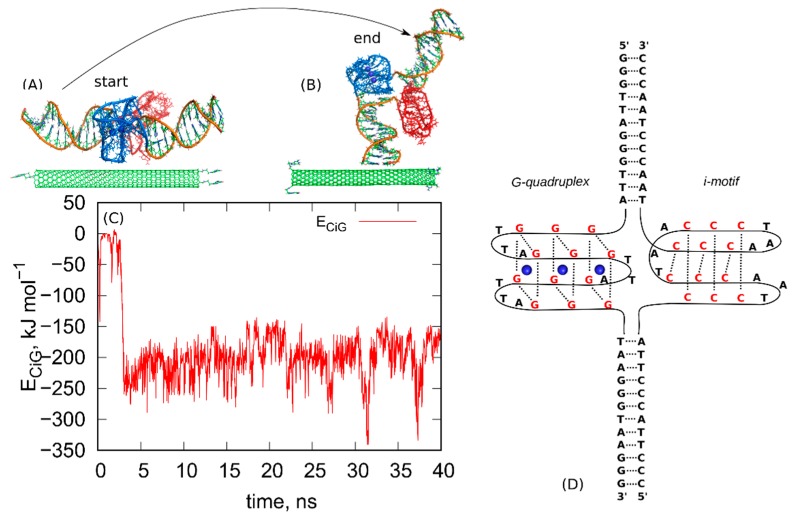
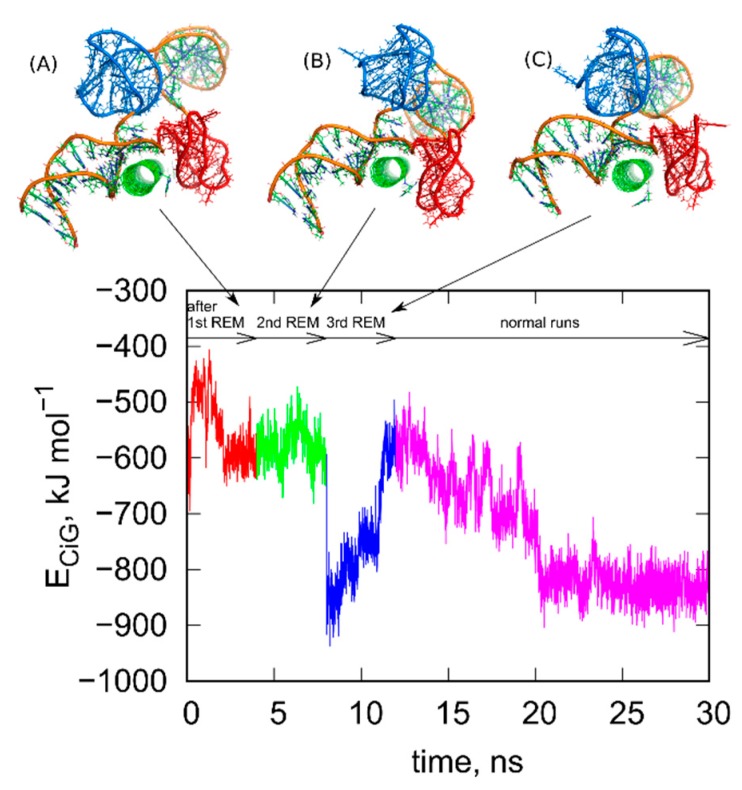
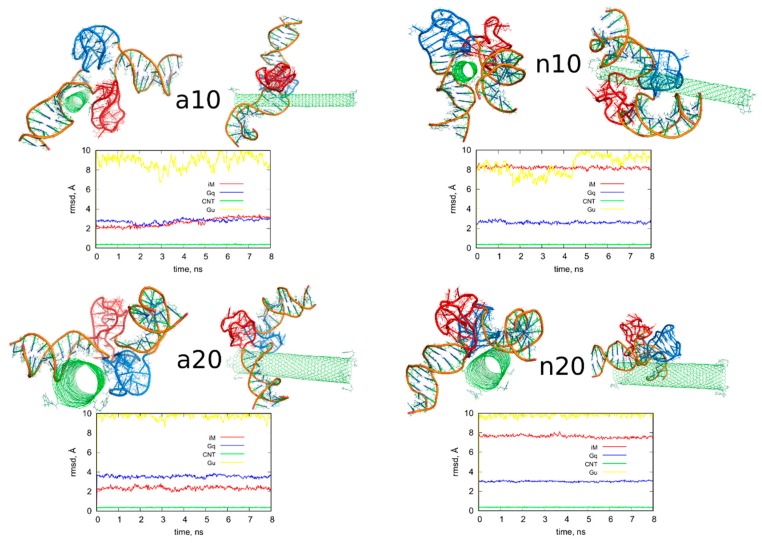
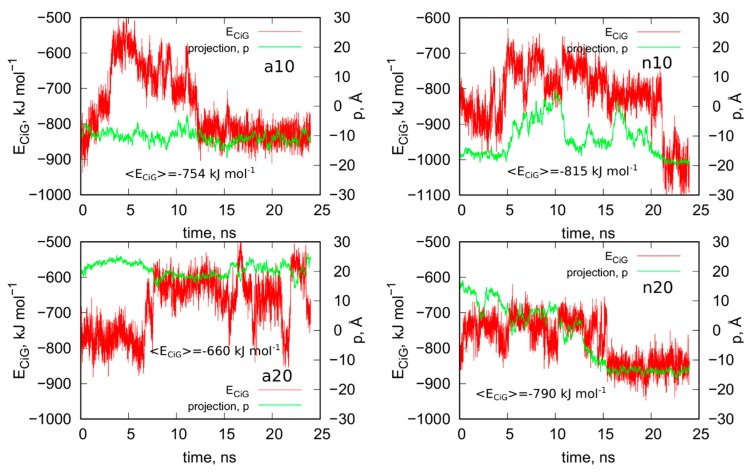
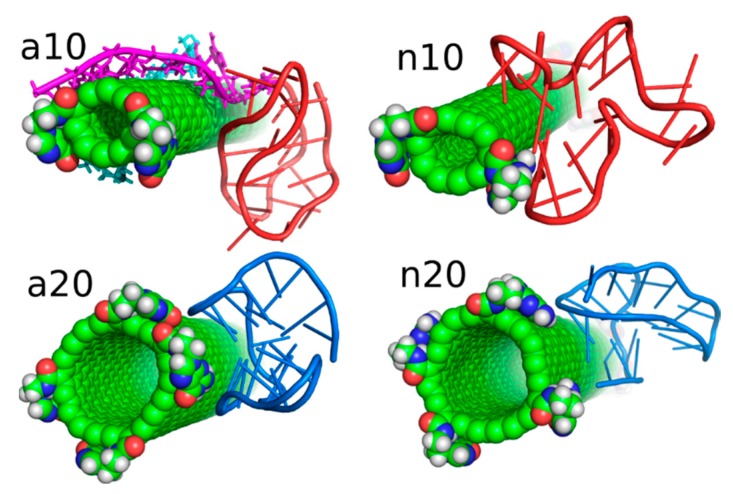
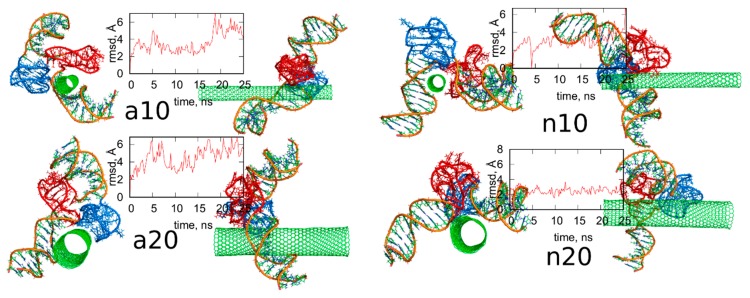
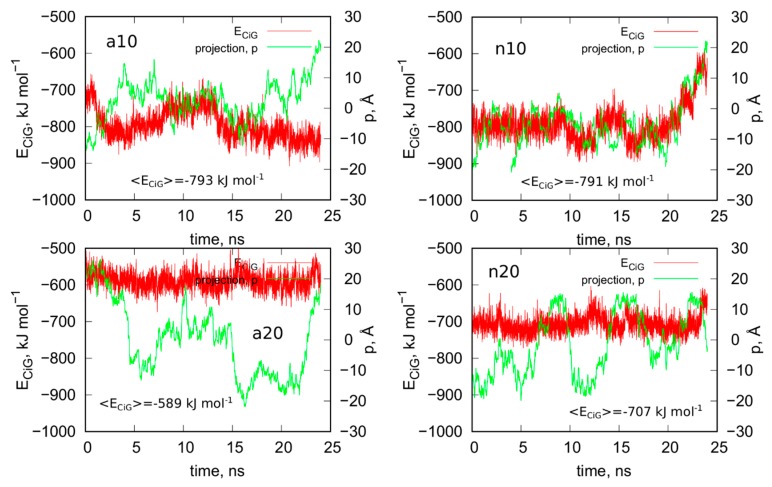
This work deals with molecular dynamics simulations of systems composed of telomeric dsDNA fragments, iG, and functionalized carbon nanotubes, fCNT. The iG contains 90 nucleotides in total and in its middle part the noncanonical i-motif and G-quadruplex are formed. Two chiralities of the fCNT were used, i.e., (10,0) and (20,0) and these nanotubes were either on-tip functionalized by guanine containing functional groups or left without functionalization. We proposed a dedicated computational procedure, based on the replica exchange concept, for finding a thermodynamically optimal conformation of iG and fCNT without destroying the very fragile noncanonical parts of the iG. We found that iG forms a V-shape spatial structure with the noncanonical fragments located at the edge and the remaining dsDNA strands forming the arms of V letter. The optimal configuration of iG in reference to fCNT strongly depends on the on-tip functionalization of the fCNT. The carbon nanotube without functionalization moves freely between the dsDNA arms, while the presence of guanine residues leads to immobilization of the fCNT and preferential location of the nanotube tip near the junction between the dsDNA duplex and i-motif and G-quadruplex. We also studied how the presence of fCNT affects the stability of the i-motif at the neutral pH when the cytosine pairs are nonprotonated. We concluded that carbon nanotubes do not improve the stability of the spatial structure of i-motif also when it is a part of a bigger structure like the iG. Such an effect was described in literature in reference to carboxylated nanotubes. Our current results suggest that the stabilization of i-motif is most probably related to easy formation of semiprotonated cytosine pairs at neutral pH due to interaction with carboxylated carbon nanotubes.
这项工作涉及到由端粒 dsDNA 片段、iG 和功能化碳纳米管(fCNT)组成的系统的分子动力学模拟。iG 总共包含 90 个核苷酸,在其中间部分形成了非规范的 i- 发夹结构和 G- 四链体。我们使用了两种手性的 fCNT,即(10,0)和(20,0),这些纳米管要么是顶端功能化的含鸟嘌呤的官能团,要么是没有功能化的。我们提出了一种专用的计算程序,基于复制交换的概念,寻找 iG 和 fCNT 的热力学最优构象,而不会破坏 iG 非常脆弱的非规范部分。我们发现,iG 形成了 V 形空间结构,非规范片段位于边缘,其余的 dsDNA 链形成 V 字形的臂。iG 相对于 fCNT 的最佳构象强烈依赖于 fCNT 的顶端功能化。没有功能化的碳纳米管在 dsDNA 臂之间自由移动,而鸟嘌呤残基的存在导致 fCNT 的固定化,并优先将纳米管尖端定位在 dsDNA 双链体和 i- 发夹结构和 G- 四链体的连接处附近。我们还研究了当胞嘧啶对非质子化时,fCNT 的存在如何影响中性 pH 下 i- 发夹结构的稳定性。我们得出结论,即使 fCNT 是更大结构(如 iG)的一部分,碳纳米管也不会提高 i- 发夹结构的空间稳定性。在文献中,这种效应被描述为羧基化纳米管。我们目前的结果表明,i- 发夹结构的稳定化很可能与中性 pH 下由于与羧基化碳纳米管的相互作用而容易形成半质子化的胞嘧啶对有关。