Department of Reproductive Medicine Center, Tongji Hospital, Tongji Medical College, Huazhong University of Science and Technology, 1095 JieFang Avenue, Wuhan, 430030, People's Republic of China.
BMC Pregnancy Childbirth. 2020 Mar 14;20(1):161. doi: 10.1186/s12884-020-02858-3.
Adverse obstetric outcomes are correlated with altered circulating hormone levels at the time implantation by the trophectoderm. What' more, embryo freezing process may also have adverse effect on perinatal outcomes. This study aims to evaluate whether increasing interval time between a freeze-all cycle and a subsequent frozen-thawed single blastocyst transfer could have any effect on pregnancy and perinatal outcomes.
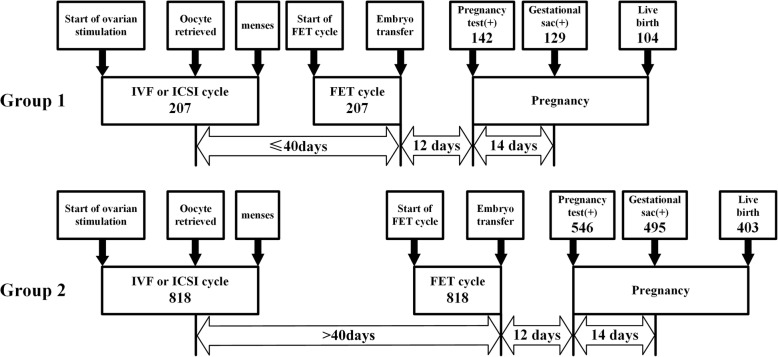
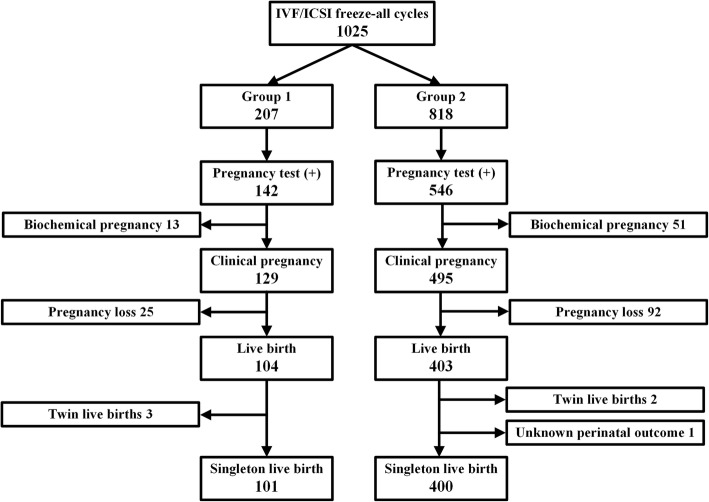
This was a retrospective cohort study included the first single blastocyst transfer in artificially cycles of all patients who underwent a freeze-all cycle between January 1, 2016 and September 30, 2018. All patients were divided into two groups according to the time interval between oocyte retrieval and the day of first frozen-thawed embryo transferred (FET): Group 1 (immediate FET cycles) and Group 2 (delayed FET cycles).
No significant differences were reported between the two groups regarding the rates of clinical pregnancy, live birth, biochemical pregnancy and pregnancy loss even after adjusting for measured confounding. When accounting for perinatal outcomes, gestational age, birth weight, delivery mode, fetus gender, preterm birth, gestational hypertension, GDM, placenta previa, fetal malformation and low birthweight also did not vary significantly between the two groups. Only the incidence of macrosomia was more frequently in the Group 2 compared with the Group 1 (AOR 3.886, 95%CI 1.153-13.103, P = 0.029) after adjusting with a multiple logistic regression model.
We found delayed FET cycles for blastocyst transfer following freeze-all cycles may not improve the pregnancy outcomes. On the contrary, postponement of FET cycles may increase the risk of macrosomia. Therefore, FET cycles for blastocyst transfer should be done immediately to avoid adverse effects of delayed time on perinatal outcomes.
滋养层植入时循环激素水平的改变与不良产科结局相关。此外,胚胎冷冻过程也可能对围产期结局产生不良影响。本研究旨在评估冷冻-全部周期和随后的冷冻-解冻单个囊胚移植之间增加间隔时间是否会对妊娠和围产期结局产生影响。
这是一项回顾性队列研究,纳入了 2016 年 1 月 1 日至 2018 年 9 月 30 日期间进行冷冻-全部周期的所有患者的第一次单个囊胚移植的人工周期。所有患者根据卵母细胞回收与首次冷冻-解冻胚胎移植(FET)日之间的时间间隔分为两组:第 1 组(即刻 FET 周期)和第 2 组(延迟 FET 周期)。
即使在调整了测量的混杂因素后,两组之间的临床妊娠率、活产率、生化妊娠率和妊娠丢失率均无显著差异。当考虑围产期结局时,两组之间的胎龄、出生体重、分娩方式、胎儿性别、早产、妊娠期高血压、GDM、前置胎盘、胎儿畸形和低出生体重也没有显著差异。只有在调整多因素逻辑回归模型后,第 2 组的巨大儿发生率明显高于第 1 组(OR 3.886,95%CI 1.153-13.103,P=0.029)。
我们发现,冷冻-全部周期后囊胚移植的延迟 FET 周期可能不会改善妊娠结局。相反,延迟 FET 周期可能会增加巨大儿的风险。因此,应立即进行囊胚移植的 FET 周期,以避免延迟时间对围产期结局的不良影响。