UCL Institute of Archaeology, 31-34 Gordon Square, London, WC1H 0PY, United Kingdom.
Department of Earth Sciences, Natural History Museum, Cromwell Road, London, SW7 5BD, United Kingdom.
Sci Rep. 2020 Mar 13;10(1):4694. doi: 10.1038/s41598-020-61448-7.
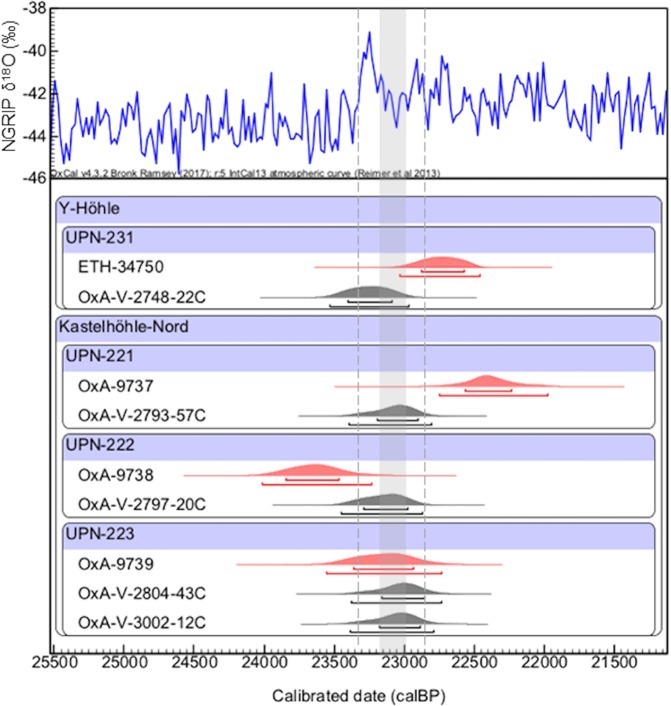
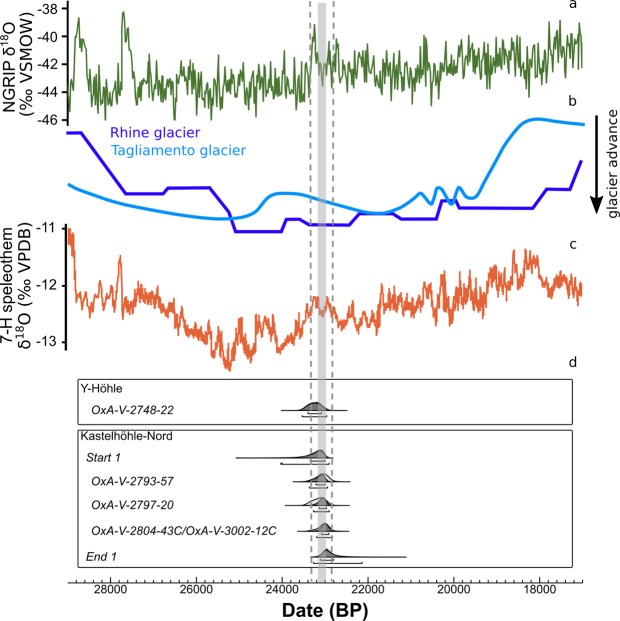
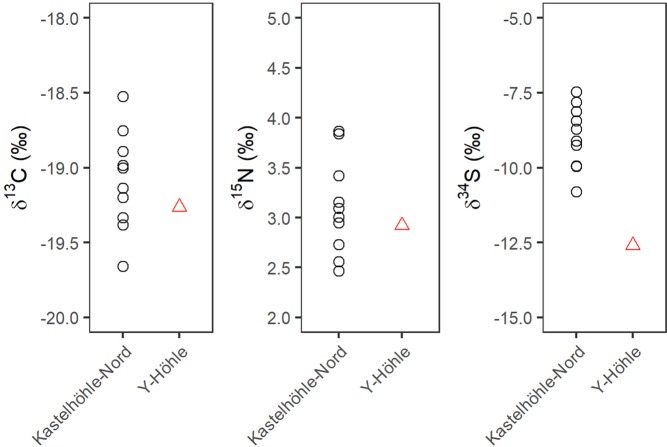
Central Europe during the Last Glacial Maximum (LGM) was dominated by polar desert and steppe-tundra biomes. Despite this, a human presence during this time period is evident at several locations across the region, including in Switzerland, less than 50 km from the Alpine ice sheet margin. It has been hypothesised that such human activity may have been restricted to brief periods of climatic warming within the LGM, but chronological information from many of these sites are currently too poorly resolved to corroborate this. Here we present a revised chronology of LGM human occupation in Switzerland. AMS radiocarbon dating of cut-marked reindeer (Rangifer tarandus) bones from the sites of Kastelhöhle-Nord and Y-Höhle indicates human occupation of Switzerland was most likely restricted to between 23,400 and 22,800 cal. BP. This timeframe corresponds to Greenland Interstadial 2, a brief warming phase, supporting the hypothesis that human presence was facilitated by favourable climatic episodes. Carbon, nitrogen and sulphur stable isotope analysis of the fauna provides palaeoenvironmental information for this time period. These findings contribute to our understanding of human activity in ice-marginal environments and have implications for understanding cultural connections across central Europe during the LGM.
末次冰盛期(LGM)期间的中欧以极地荒漠和草原苔原生物群系为主。尽管如此,在该地区的几个地方都有人类在这段时间存在的证据,包括瑞士,距离阿尔卑斯冰盖边缘不到 50 公里。有人假设,这种人类活动可能仅限于 LGM 内短暂的气候变暖时期,但由于这些地点中的许多地点的年代信息目前分辨率太低,无法证实这一点。本文介绍了瑞士 LGM 人类居住的修订年代表。来自 Kastelhöhle-Nord 和 Y-Höhle 地点的有切割痕迹的驯鹿(Rangifer tarandus)骨骼的 AMS 放射性碳测年表明,瑞士的人类居住很可能仅限于 23400 至 22800 年前。这个时间范围与格陵兰间冰期 2 相对应,是一个短暂的变暖阶段,支持了人类的存在是由有利的气候事件促成的假设。对动物群的碳、氮和硫稳定同位素分析为这一时期提供了古环境信息。这些发现有助于我们了解冰缘环境中的人类活动,并对理解 LGM 期间中欧各地的文化联系具有重要意义。