Craine Joseph M, Elmore Andrew J, Wang Lixin, Augusto Laurent, Baisden W Troy, Brookshire E N J, Cramer Michael D, Hasselquist Niles J, Hobbie Erik A, Kahmen Ansgar, Koba Keisuke, Kranabetter J Marty, Mack Michelle C, Marin-Spiotta Erika, Mayor Jordan R, McLauchlan Kendra K, Michelsen Anders, Nardoto Gabriela B, Oliveira Rafael S, Perakis Steven S, Peri Pablo L, Quesada Carlos A, Richter Andreas, Schipper Louis A, Stevenson Bryan A, Turner Benjamin L, Viani Ricardo A G, Wanek Wolfgang, Zeller Bernd
Division of Biology, Kansas State University, Manhattan, KS, 66506, USA.
Appalachian Laboratory, University of Maryland Center for Environmental Science, Frostburg, MD, 21532, USA.
Sci Rep. 2015 Feb 6;5:8280. doi: 10.1038/srep08280.
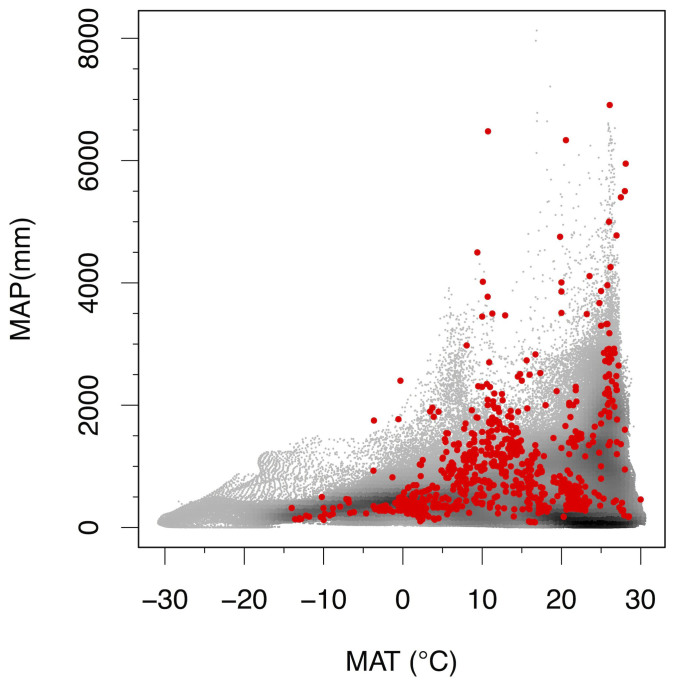
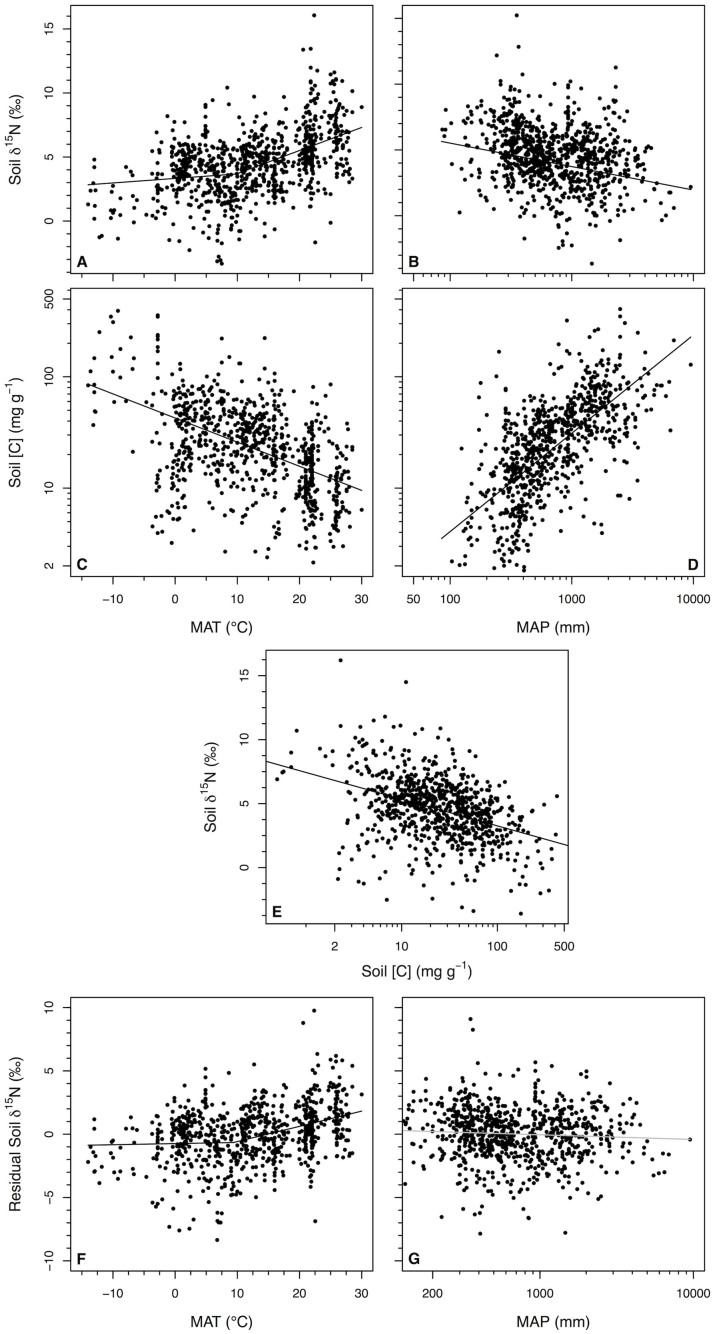
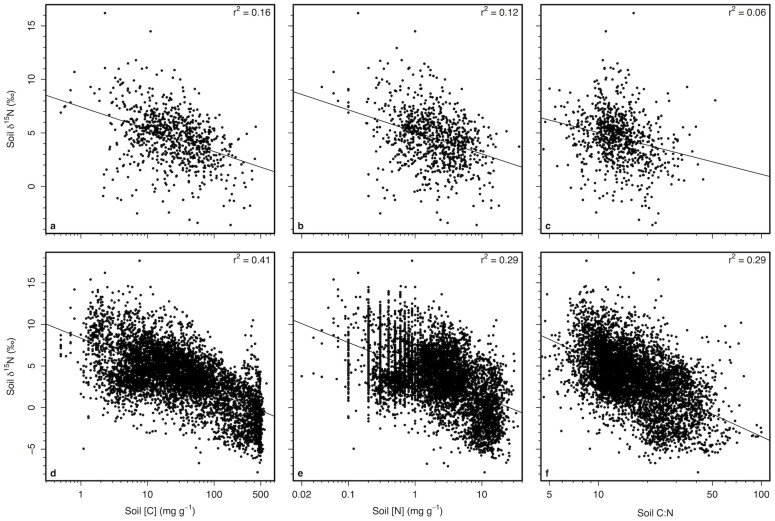
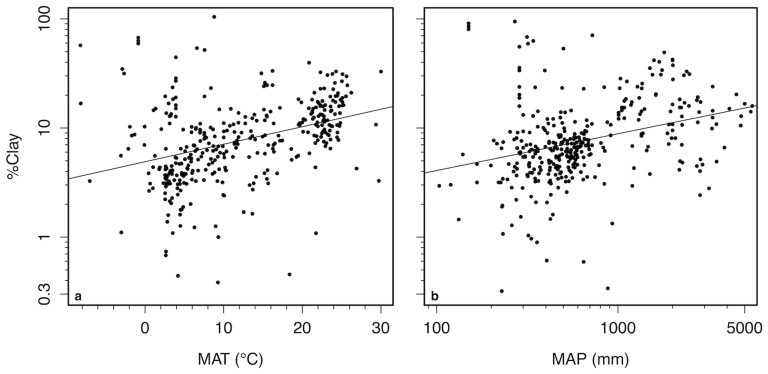
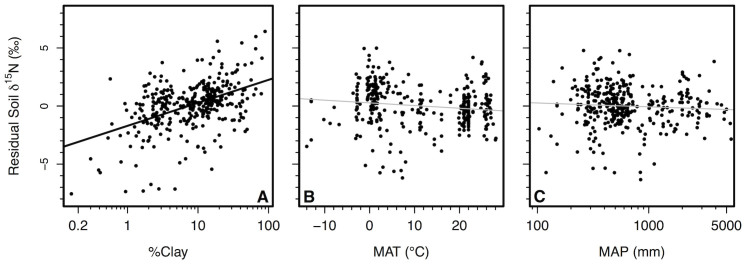
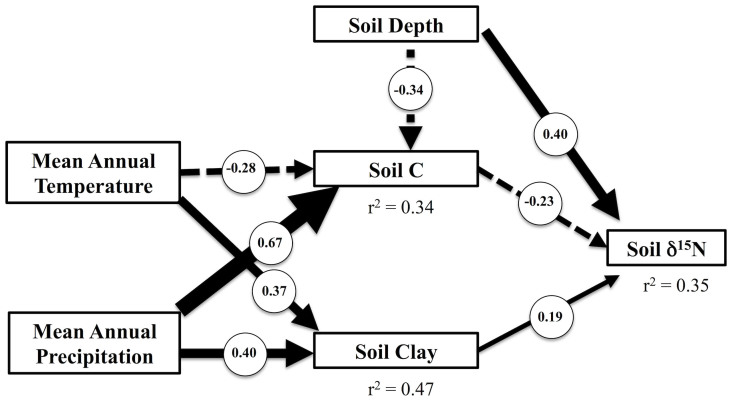
Quantifying global patterns of terrestrial nitrogen (N) cycling is central to predicting future patterns of primary productivity, carbon sequestration, nutrient fluxes to aquatic systems, and climate forcing. With limited direct measures of soil N cycling at the global scale, syntheses of the (15)N:(14)N ratio of soil organic matter across climate gradients provide key insights into understanding global patterns of N cycling. In synthesizing data from over 6000 soil samples, we show strong global relationships among soil N isotopes, mean annual temperature (MAT), mean annual precipitation (MAP), and the concentrations of organic carbon and clay in soil. In both hot ecosystems and dry ecosystems, soil organic matter was more enriched in (15)N than in corresponding cold ecosystems or wet ecosystems. Below a MAT of 9.8°C, soil δ(15)N was invariant with MAT. At the global scale, soil organic C concentrations also declined with increasing MAT and decreasing MAP. After standardizing for variation among mineral soils in soil C and clay concentrations, soil δ(15)N showed no consistent trends across global climate and latitudinal gradients. Our analyses could place new constraints on interpretations of patterns of ecosystem N cycling and global budgets of gaseous N loss.
量化陆地氮(N)循环的全球模式对于预测未来初级生产力、碳固存、养分向水生系统的通量以及气候强迫模式至关重要。由于全球尺度上土壤氮循环的直接测量方法有限,对土壤有机质的(15)N:(14)N比值在气候梯度上的综合分析为理解全球氮循环模式提供了关键见解。在综合分析来自6000多个土壤样本的数据时,我们发现土壤氮同位素、年平均温度(MAT)、年平均降水量(MAP)以及土壤中有机碳和粘土的浓度之间存在很强的全球关系。在炎热生态系统和干旱生态系统中,土壤有机质中的(15)N比相应的寒冷生态系统或湿润生态系统中的更富集。在MAT低于9.8°C时,土壤δ(15)N随MAT不变。在全球尺度上,土壤有机碳浓度也随着MAT的增加和MAP的降低而下降。在对矿质土壤中土壤碳和粘土浓度的变化进行标准化后,土壤δ(15)N在全球气候和纬度梯度上没有显示出一致的趋势。我们的分析可能会对生态系统氮循环模式和气态氮损失的全球预算的解释施加新的限制。