Kvakić Marko, Tzagkarakis George, Pellerin Sylvain, Ciais Philippe, Goll Daniel, Mollier Alain, Ringeval Bruno
ISPA, Bordeaux Sciences Agro, INRAE, Villenave d'Ornon, France.
LSCE/IPSL, CEA-CNRS-UVSQ, Universite Paris-Saclay, Gif-sur-Yvette, France.
Front Plant Sci. 2020 Feb 27;11:149. doi: 10.3389/fpls.2020.00149. eCollection 2020.
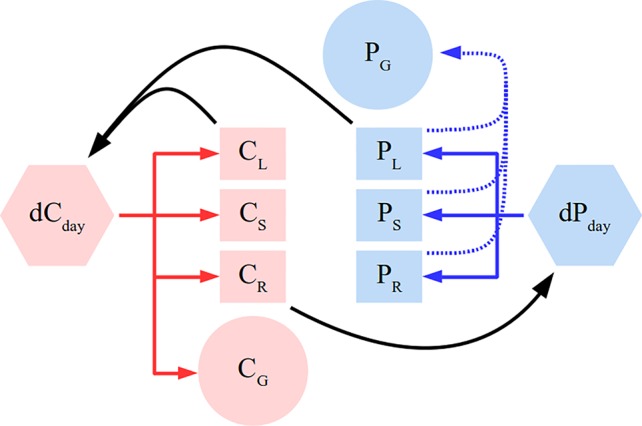
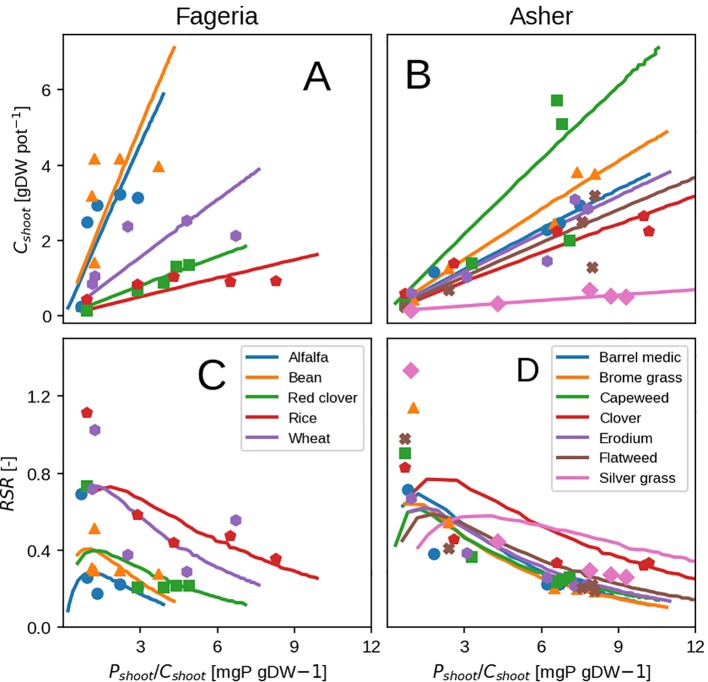
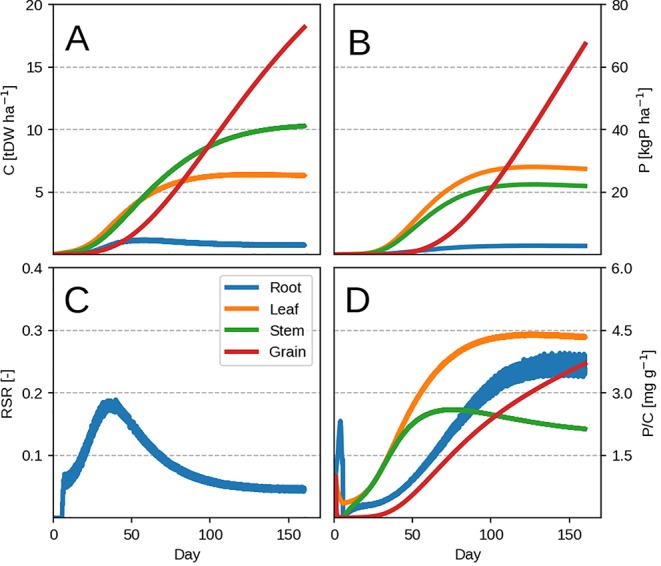
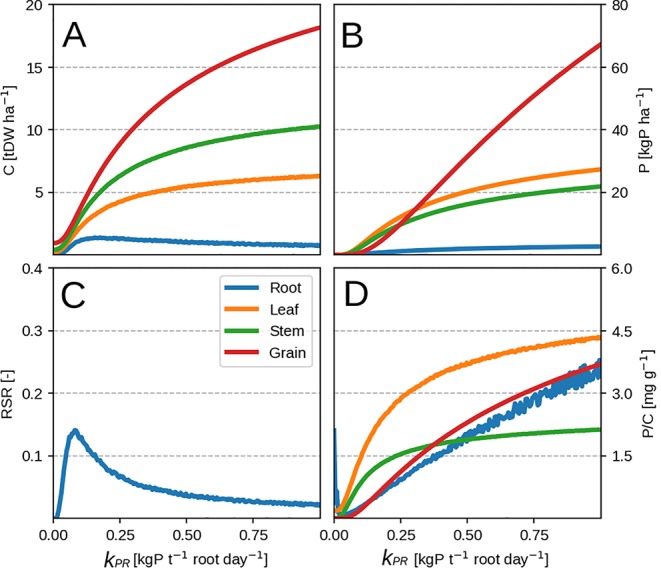
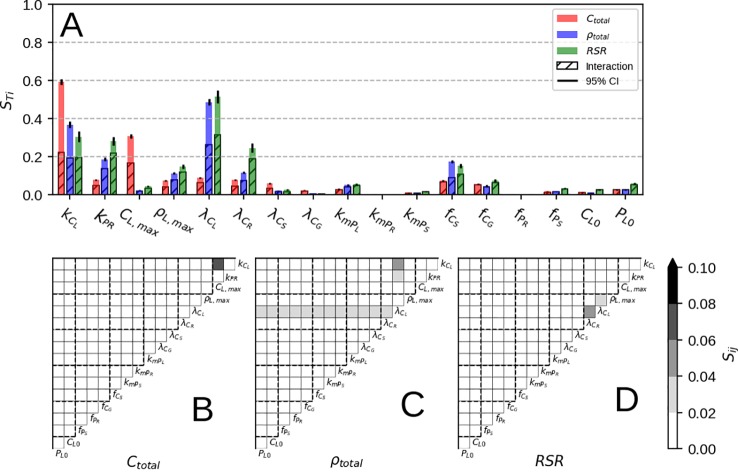
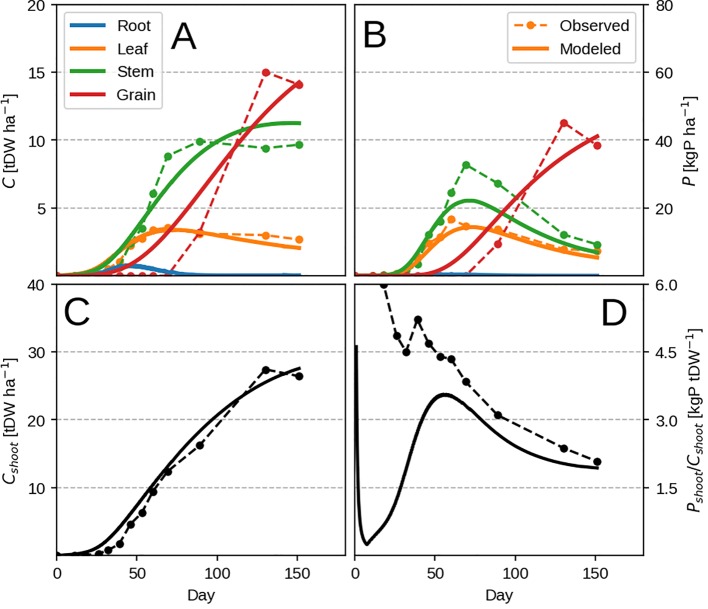
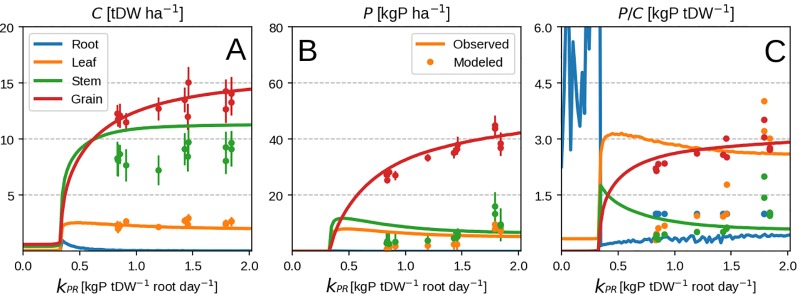
Phosphorus (P) is the second most important nutrient after nitrogen (N) and can greatly diminish plant productivity if P supply is not adequate. Plants respond to soil P availability by adjusting root biomass to maintain uptake and productivity due to P use. In spite of our vast knowledge on P effects on plant growth, how to functionally model enhanced root biomass allocation in low P environments is not fully explored. We develop a dynamic plant model based on the principle of optimal carbon (C) and P allocation to investigate growth and functional response to contrasting levels of soil P availability. By describing plant growth as a balance of growth and respiration processes, we optimize C and P allocation in order to maximize leaf productivity and drive plant response. We compare our model to a field trial and a set of hydroponic experiments which describe plant response at varying P availabilities. The model is able to reproduce long-term plant functional response to different P levels like change in root-shoot ratio (RSR), total biomass and organ P concentration. But it is not capable of fully describing the time evolution of organ P uptake and cycling within the plant. Most notable is the underestimation of organ P uptake during the vegetative growth stage which is due to the model's leaf productivity formalism. In spite of the model's parsimonious nature, which optimizes for and predicts whole plant response through leaf productivity alone, the optimal growth hypothesis can provide a reasonable framework for modelling plant response to environmental change that can be used in more physically driven vegetation models.
磷(P)是仅次于氮(N)的第二重要养分,如果磷供应不足,会极大地降低植物生产力。植物通过调节根系生物量来响应土壤磷的有效性,以维持因磷利用而产生的吸收和生产力。尽管我们对磷对植物生长的影响有广泛的了解,但如何在功能上模拟低磷环境下根系生物量分配的增强尚未得到充分探索。我们基于最优碳(C)和磷分配原则开发了一个动态植物模型,以研究对不同土壤磷有效性水平的生长和功能响应。通过将植物生长描述为生长和呼吸过程的平衡,我们优化碳和磷的分配,以最大化叶片生产力并驱动植物响应。我们将我们的模型与一个田间试验和一组水培实验进行比较,这些实验描述了不同磷有效性下的植物响应。该模型能够重现植物对不同磷水平的长期功能响应,如根冠比(RSR)、总生物量和器官磷浓度的变化。但它无法完全描述植物体内器官磷吸收和循环的时间演变。最值得注意的是,由于模型的叶片生产力形式主义,在营养生长阶段对器官磷吸收的低估。尽管该模型具有简约性,仅通过叶片生产力进行优化和预测整个植物的响应,但最优生长假说可以为模拟植物对环境变化的响应提供一个合理的框架,可用于更基于物理驱动的植被模型。