Department of Public Health, Medical School, Qinghai University, Qinghai, China.
Clinical Psychology, Australian College of Applied Psychology, Sydney, NSW 2000, Australia.
J Epidemiol Glob Health. 2020 Mar;10(1):16-27. doi: 10.2991/jegh.k.191117.002.
Double Burden of Malnutrition (DBM)-the coexistence of undernutrition along with overnutrition-is a significant public health issue in the Asia-Pacific region. The scope of the DBM in this region is largely unknown. This review aims to determine the prevalence of under- and overnutrition as major DBM components and to investigate whether there has been a shift from under- to overnutrition in the Asia-Pacific region.
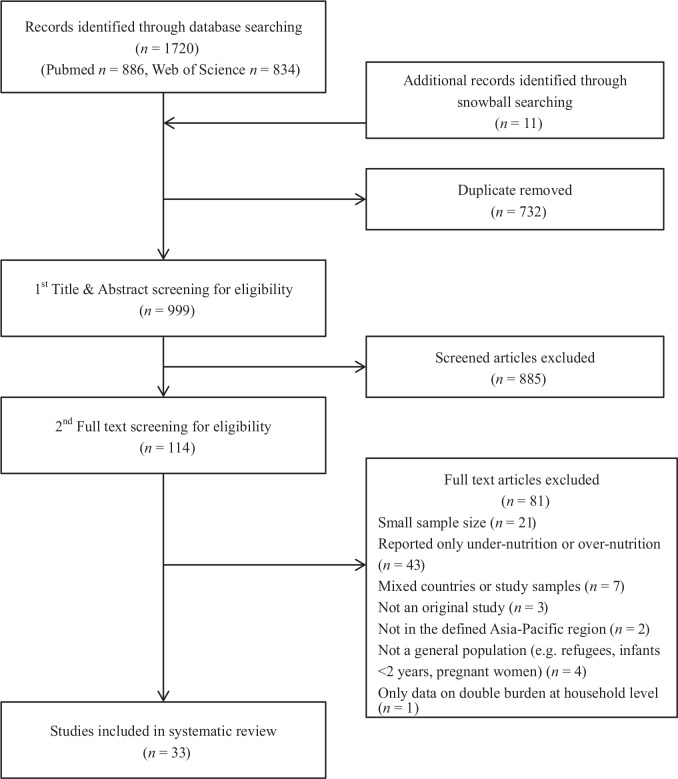
Online databases including PubMed and Web of Science were searched for original studies on DBM prevalence in the Asia-Pacific region; particularly, those published from January 2008 to December 2018 were screened for eligibility. We collected data on indicators of under- and overnutrition on the population level and adapted the ratio of prevalence of overweight/obesity versus prevalence of underweight as the main outcome indicator. Pooled prevalence estimates of DBM and the ratio of overnutrition versus undernutrition were generated using R (3.4.0).
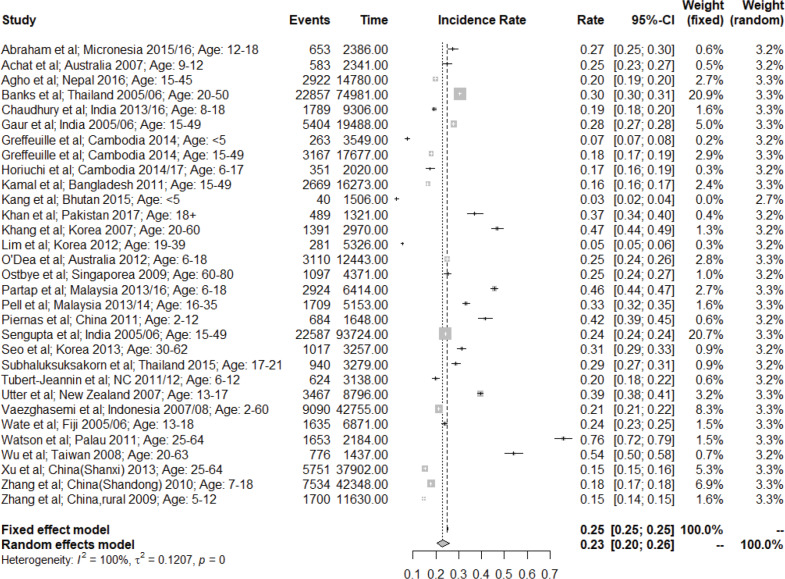
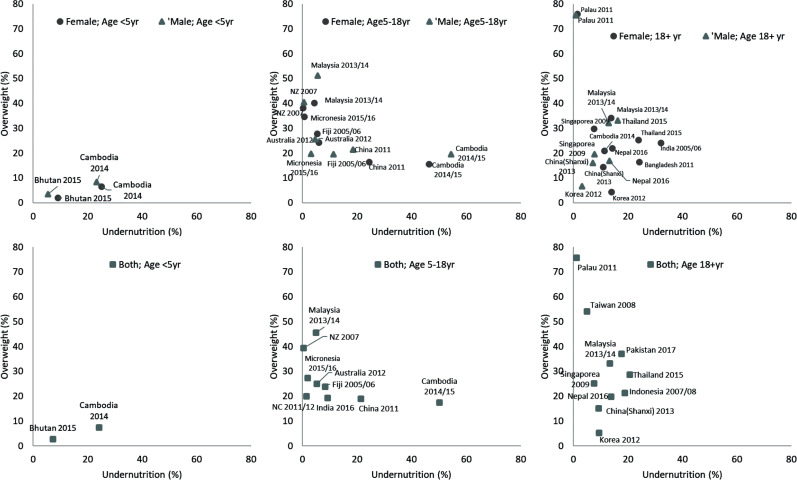
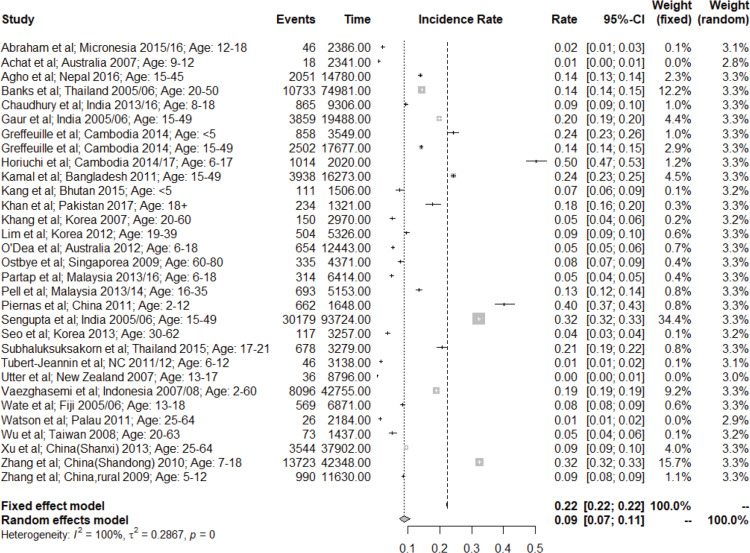
In total, 33 studies were included in this review. Pooled analysis demonstrated that DBM was generally presented among countries/areas in the Asia-Pacific region except in high-income countries (HICs). Overall, the prevalence of undernutrition was 8.8% (95% CI 7.3-10.6%) while overnutrition among the same population reached 23.0% (95% CI 20.3-26.0%). Countries in the Oceania region or HICs reported low level of undernutrition (less than 3%). All subgroup analysis (geolocation, income level, sex, age) reported pooled prevalence of overweight/obesity as more than 18%. Overall, the whole region and all subgroups were more likely to experience a higher prevalence of overnutrition than undernutrition, except that low- and lower-middle-income countries (L-MICs) had similar prevalence for over- and undernutrition.
DBM in the Asia-Pacific region is alarmingly high and is titled toward overnutrition. As a result, future interventions/policy targeting to maintain a healthy weight for the population should not just focus on prevention and treatment toward one direction.
营养不良的双重负担(DBM)——营养不足与营养过剩并存——是亚太地区一个重大的公共卫生问题。该地区 DBM 的范围在很大程度上尚不清楚。本综述旨在确定作为 DBM 主要组成部分的营养不足和营养过剩的流行程度,并调查亚太地区是否已经从营养不足转向营养过剩。
在线数据库包括 PubMed 和 Web of Science 被用来搜索亚太地区 DBM 流行率的原始研究;特别是,筛选了 2008 年 1 月至 2018 年 12 月发表的研究,以确定其是否符合条件。我们收集了人口层面营养不足和营养过剩的指标数据,并采用超重/肥胖流行率与消瘦流行率之比作为主要结果指标。使用 R(3.4.0)生成 DBM 和营养过剩与营养不足之比的汇总流行率估计值。
共有 33 项研究纳入本综述。汇总分析表明,亚太地区各国/地区普遍存在 DBM,高收入国家(HICs)除外。总体而言,营养不足的流行率为 8.8%(95%CI 7.3-10.6%),而同一人群的营养过剩率达到 23.0%(95%CI 20.3-26.0%)。大洋洲地区或 HICs 的国家报告的营养不足水平较低(低于 3%)。所有亚组分析(地理位置、收入水平、性别、年龄)报告的超重/肥胖的汇总流行率均超过 18%。总体而言,整个地区和所有亚组更有可能经历营养过剩的流行率高于营养不足,除了低收入和中低收入国家(L-MICs)的营养过剩和营养不足的流行率相似。
亚太地区的 DBM 令人震惊地高,而且呈营养过剩趋势。因此,未来针对人口健康体重的干预措施/政策不应仅仅关注一个方向的预防和治疗。