Department of Public Health, College of Medicine, Fu Jen Catholic University, Xinzhuang, New Taipei City, Taiwan.
Department of Psychology, Auburn University, Auburn, AL, United States of America.
PLoS One. 2020 Mar 16;15(3):e0229853. doi: 10.1371/journal.pone.0229853. eCollection 2020.
Needlestick and sharp injuries (NSIs) experienced by physicians have been identified as a major occupational hazard. Blood-borne pathogens resulting from the NSIs experienced by physicians pose severe physical and psychological threats to them, as well as people who are around them. However, there is little research focusing on physicians' behaviours to prevent NSIs. In the present study, we investigated the roles of safety climate, job demands experienced by physicians, and physicians' self-efficacy in affecting physicians' behaviours to prevent NSIs.
401 physicians from four teaching hospitals in Northern Taiwan were recruited to participate in an anonymous survey. Among them, 189 physicians returned the completed survey with a response rate of 47.1%.
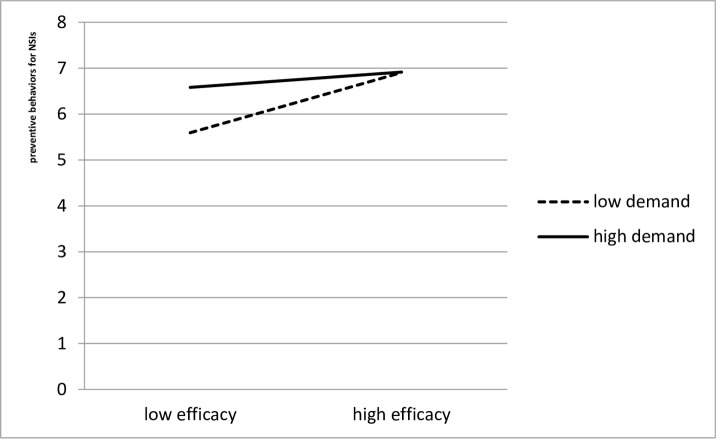
Overall, respondents reported frequently engaging in NSI prevention behaviours. As expected, safety climate in hospitals and physicians' self-efficacy to prevent NSIs were significantly related to their behaviours to prevent NSIs (r = 0.22 and r = 0.33, respectively). The moderating analysis also revealed that physicians with high self-efficacy tended to engage in NSI prevention behaviours regardless of levels of job demand they experienced. In contrast to our expectation, however, physicians with low self-efficacy engaged in more NSI prevention behaviours when job demands were high than when the demands were low.
Our findings show the important roles safety climate, job demands and self-efficacy play in shaping physicians' NSI prevention behaviours. Hospitals may consider improving safety climate via strengthening management commitments to NSIs prevention, reducing job demands by training physicians to proactively redesign their own jobs, and increasing physicians' self-efficacy via well-designed skill-based training.
医生所经历的针刺和锐器伤已被确定为主要的职业危害。由于医生所经历的针刺和锐器伤而导致的血源性病原体,对他们自己以及周围的人都构成了严重的身体和心理威胁。然而,很少有研究关注医生预防针刺和锐器伤的行为。在本研究中,我们调查了安全氛围、医生所经历的工作需求以及医生的自我效能感在影响医生预防针刺和锐器伤行为方面的作用。
从台湾北部的四家教学医院招募了 401 名医生参与匿名调查。其中,189 名医生返回了已完成的调查,应答率为 47.1%。
总体而言,受访者报告经常采取针刺和锐器伤预防行为。正如预期的那样,医院的安全氛围和医生预防针刺和锐器伤的自我效能感与他们预防针刺和锐器伤的行为显著相关(r = 0.22 和 r = 0.33)。调节分析还表明,自我效能感高的医生无论所经历的工作需求水平如何,都更倾向于采取针刺和锐器伤预防行为。然而,与我们的预期相反,自我效能感低的医生在工作需求高时比需求低时更倾向于采取针刺和锐器伤预防行为。
我们的研究结果表明安全氛围、工作需求和自我效能感在塑造医生的针刺和锐器伤预防行为方面发挥了重要作用。医院可以通过加强对针刺和锐器伤预防的管理承诺来改善安全氛围,通过培训医生主动重新设计自己的工作来减少工作需求,并通过精心设计的基于技能的培训来提高医生的自我效能感。