Université de Paris, UMR 261 MERIT, IRD, F-75006, Paris, France.
Institut Universitaire de France (IUF), Paris, France.
Sci Rep. 2020 Mar 16;10(1):4842. doi: 10.1038/s41598-020-61181-1.
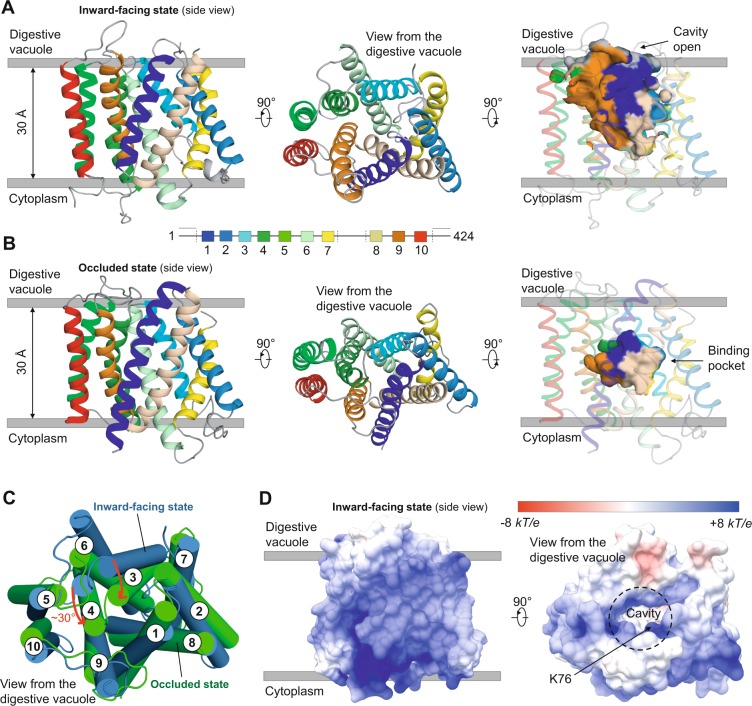
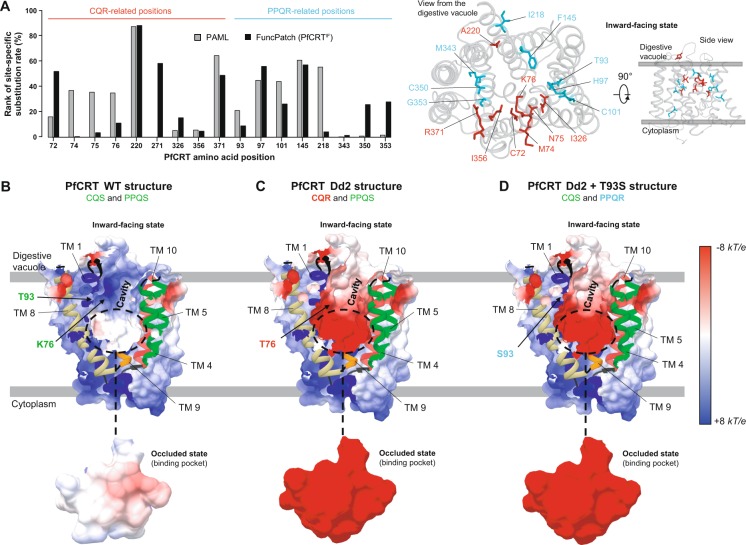
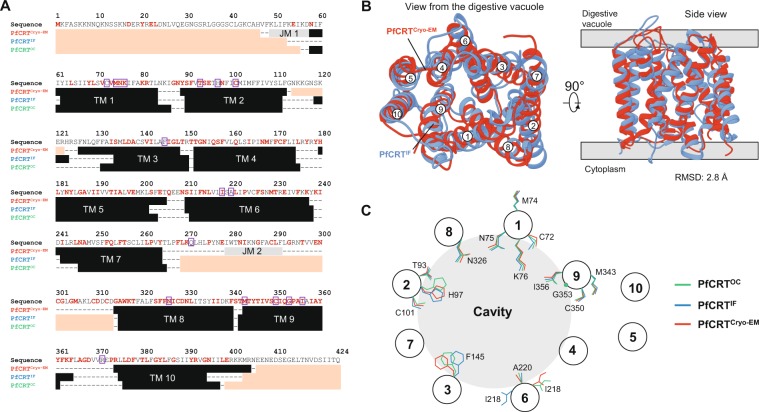
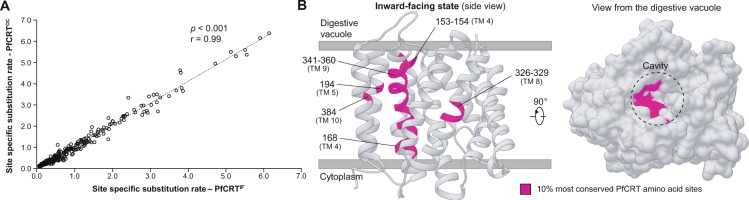
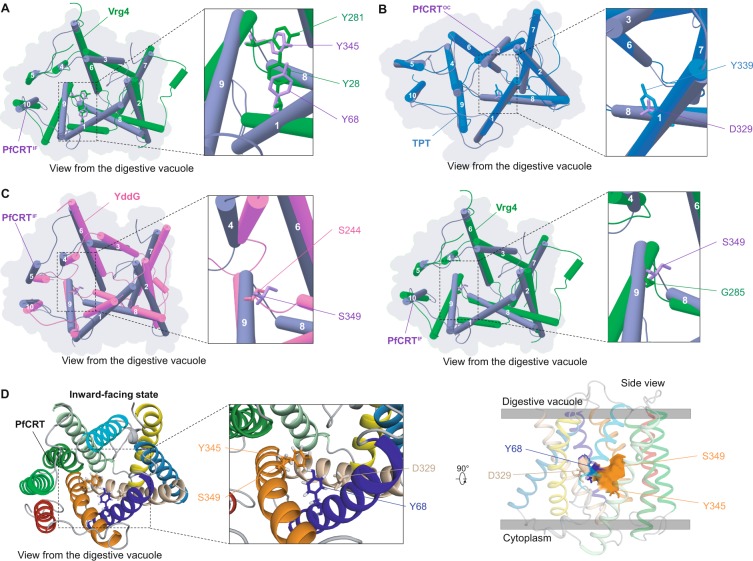
Mutations in the Plasmodium falciparum chloroquine resistance transporter (PfCRT) confer resistance to several antimalarial drugs such as chloroquine (CQ) or piperaquine (PPQ), a partner molecule in current artemisinin-based combination therapies. As a member of the Drug/Metabolite Transporter (DMT) superfamily, the vacuolar transporter PfCRT may translocate substrate molecule(s) across the membrane of the digestive vacuole (DV), a lysosome-like organelle. However, the physiological substrate(s), the transport mechanism and the functional regions of PfCRT remain to be fully characterized. Here, we hypothesized that identification of evolutionary conserved sites in a tertiary structural context could help locate putative functional regions of PfCRT. Hence, site-specific substitution rates were estimated over Plasmodium evolution at each amino acid sites, and the PfCRT tertiary structure was predicted in both inward-facing (open-to-vacuole) and occluded states through homology modeling using DMT template structures sharing <15% sequence identity with PfCRT. We found that the vacuolar-half and membrane-spanning domain (and especially the transmembrane helix 9) of PfCRT were more conserved, supporting that its physiological substrate is expelled out of the parasite DV. In the PfCRT occluded state, some evolutionary conserved sites, including positions related to drug resistance mutations, participate in a putative binding pocket located at the core of the PfCRT membrane-spanning domain. Through structural comparison with experimentally-characterized DMT transporters, we identified several conserved PfCRT amino acid sites located in this pocket as robust candidates for mediating substrate transport. Finally, in silico mutagenesis revealed that drug resistance mutations caused drastic changes in the electrostatic potential of the transporter vacuolar entry and pocket, facilitating the escape of protonated CQ and PPQ from the parasite DV.
疟原虫氯喹耐药转运蛋白(PfCRT)中的突变赋予了对几种抗疟药物的耐药性,如氯喹(CQ)或哌喹(PPQ),这是目前基于青蒿素联合疗法中的一种伴侣分子。作为药物/代谢物转运体(DMT)超家族的一员,PfCRT 可能将底物分子跨过消化液泡(DV)的膜转运,DV 是一种类似溶酶体的细胞器。然而,PfCRT 的生理底物、转运机制和功能区域仍有待充分表征。在这里,我们假设在三级结构背景下鉴定进化保守的位点有助于定位 PfCRT 的可能功能区域。因此,在每个氨基酸位点上,根据疟原虫的进化,估计了特定位点的取代率,并且使用 DMT 模板结构,通过同源建模预测了 PfCRT 的内向(面向液泡)和闭塞状态的三级结构,这些模板结构与 PfCRT 的序列同一性<15%。我们发现 PfCRT 的液泡半和跨膜域(特别是跨膜螺旋 9)更保守,这支持其生理底物从寄生虫 DV 中排出。在 PfCRT 闭塞状态下,一些进化保守的位点,包括与耐药突变相关的位置,参与位于 PfCRT 跨膜域核心的假定结合口袋。通过与实验表征的 DMT 转运体的结构比较,我们确定了位于该口袋中的几个保守 PfCRT 氨基酸位点作为介导底物转运的稳健候选者。最后,计算机诱变显示耐药突变导致转运体液泡进入和口袋的静电势发生剧烈变化,从而促进质子化的 CQ 和 PPQ 从寄生虫 DV 中逸出。