Strietzel Christian, Sterby Mia, Huang Hao, Strømme Maria, Emanuelsson Rikard, Sjödin Martin
Nanotechnology and Functional Materials, Department of Materials Science and Engineering, The Ångström Laboratory, Uppsala University, Box 534, 75121, Uppsala, Sweden.
Angew Chem Int Ed Engl. 2020 Jun 8;59(24):9631-9638. doi: 10.1002/anie.202001191. Epub 2020 Mar 31.
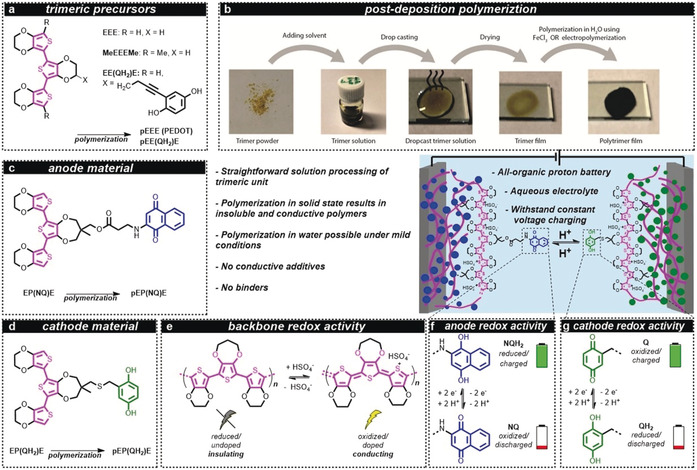
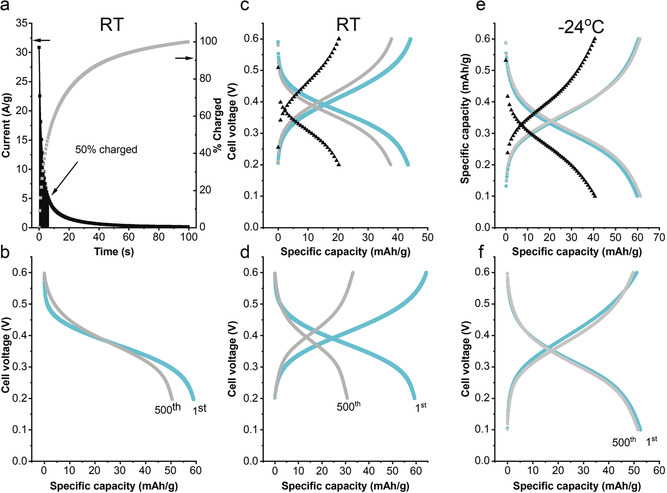
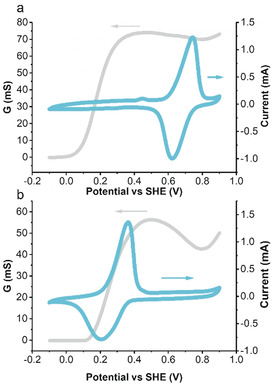
Electrodes based on organic matter operating in aqueous electrolytes enable new approaches and technologies for assembling and utilizing batteries that are difficult to achieve with traditional electrode materials. Here, we report how thiophene-based trimeric structures with naphthoquinone or hydroquinone redox-active pendent groups can be processed in solution, deposited, dried and subsequently polymerized in solid state to form conductive (redox) polymer layers without any additives. Such post-deposition polymerization offers efficient use of material, high mass loading (up to 10 mg cm ) and good flexibility in the choice of substrate and coating method. By employing these materials as anode and cathode in an acidic aqueous electrolyte a rocking-chair proton battery is built. The battery shows good cycling stability (85 % after 500 cycles), withstands rapid charging, with full capacity (60 mAh g ) reached within 100 seconds, allows for direct integration with photovoltaics, and retains its favorable characteristics even at -24 °C.
基于在水性电解质中运行的有机物质的电极,为组装和利用电池带来了新的方法和技术,而这些是传统电极材料难以实现的。在此,我们报告了具有萘醌或对苯二酚氧化还原活性侧基的噻吩基三聚体结构如何在溶液中进行处理、沉积、干燥,随后在固态下聚合,以形成无任何添加剂的导电(氧化还原)聚合物层。这种沉积后聚合提供了材料的高效利用、高负载量(高达10 mg/cm²)以及在基材和涂覆方法选择上的良好灵活性。通过将这些材料用作酸性水性电解质中的阳极和阴极,构建了一种摇椅式质子电池。该电池显示出良好的循环稳定性(500次循环后为85%),能够承受快速充电,在100秒内达到全容量(60 mAh/g),允许与光伏直接集成,并且即使在-24°C下仍保持其良好特性。